What Is Churn Rate in SaaS? The Plain-English Definition (and the Part Most Guides Skip)
Churn rate is the percentage of customers or revenue you lose each period. Here's the plain-English definition, the types, and how to read your number.
The definition in one breath
Churn rate is the percentage of your customers or revenue that disappears in a given time period. Start the month with 100 customers, lose 5, and your monthly customer churn rate is 5%. That's it. Everything else in the churn literature is commentary on that one idea.
The reason a simple idea fills entire books: which customers, which revenue, and which period you pick changes the answer completely, and the internet will happily mix all three. Let's untangle it.
Why churn rate is THE SaaS number
SaaS is a subscription business, which means the money you made yesterday is the baseline for the money you make tomorrow. Churn is the force working against that. Growth with 2% monthly churn is a flywheel. The same growth with 8% monthly churn is a treadmill — you're sprinting to stand still.
The compounding math is brutal. At 5% monthly churn, you lose about 46% of your customers over a year. At 3% monthly, it's about 31%. At 10% monthly, it's 72% — you essentially replace your entire customer base every year. Small differences in churn rate are huge differences in company value, which is why investors ask about it in the first five minutes.
The two churn rates you actually need
Customer churn (logo churn)
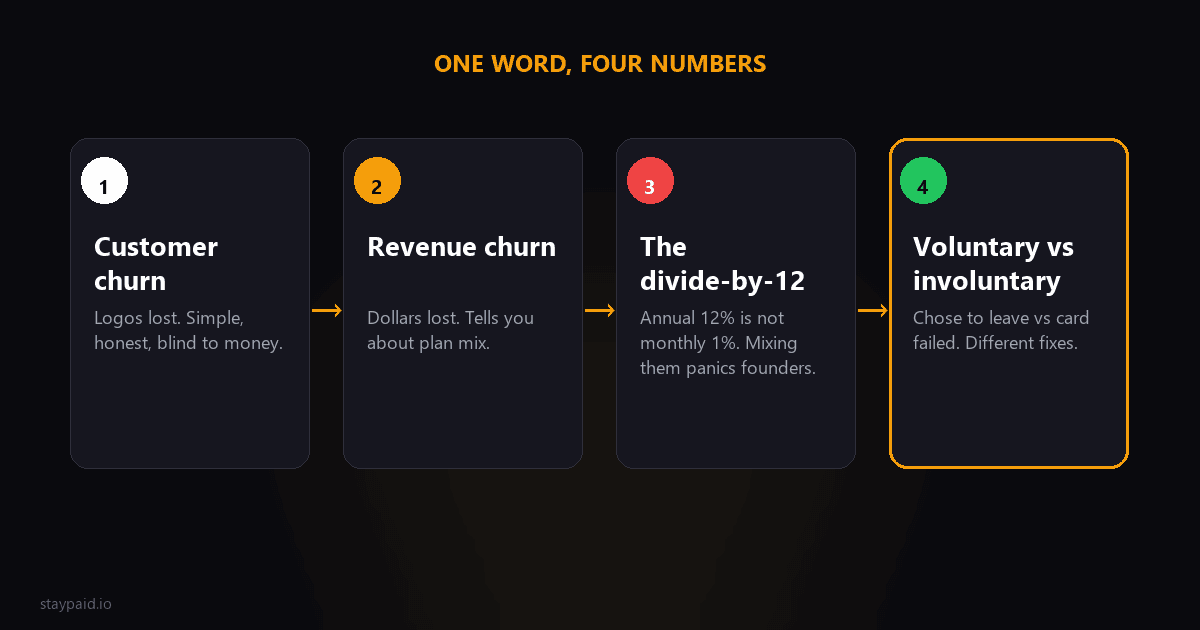
How many customers left, as a percentage of how many you had. Simple, honest, and blind to money. Losing five hobbyists counts the same as losing five enterprise accounts. Use it to understand product satisfaction at the individual level.
Revenue churn (MRR churn)
How much recurring revenue left, as a percentage of what you had. This one sees money. And it splits further: gross revenue churn (everything that left) vs net revenue churn (what left minus what expansion added back). Net revenue churn can go negative — that's the famous 'net negative churn,' where your existing customers grow faster than they leave, and the business compounds even with zero new sales.
If you only track one, track gross revenue churn monthly. It's the least gameable. (We have a full post on the formulas and a free calculator when you're ready to run your own numbers.)
The split most guides skip: chose to leave vs couldn't pay
Here's the interpretation layer that generic definitions never mention. Your churn is two different problems mixed into one number:
- •Voluntary churn: the customer decided to leave. They cancelled. This is a product, pricing, or fit problem.
- •Involuntary churn: the customer's payment failed and never got fixed. Expired card, insufficient funds, a bank that got fussy. They didn't choose anything — their billing did it for them.
A 6% churn rate that's mostly voluntary is a five-alarm product fire. A 6% churn rate that's half involuntary is a product that's probably fine and a billing process that's on fire. Same number, opposite diagnosis. Before you act on your churn rate, split it.
Reading your number without lying to yourself
- •Match the period. Comparing your monthly churn to someone's annual benchmark is how founders panic over nothing. 3% monthly is not 36% annual — it's about 30.6% after compounding, but it's still an annual-style number in a monthly costume.
- •Match the stage. A pre-product-market-fit SaaS at 7% monthly is normal-ish. A mature B2B tool at 7% monthly is dying. Benchmarks only make sense within a stage.
- •Match the price point. $10/month consumer-ish products churn far more than $1,000/month B2B tools. Cheap, easy-to-leave products have churn built into the model.
- •Separate the failed payments. If you don't know how much of your churn is involuntary, you don't know your churn rate — you know a blended number that hides the fixable part.
Three confusions that trip almost everyone
- •Churn vs retention: they're mirror images. 5% monthly churn is 95% monthly retention. People mix the vocabularies mid-sentence and the math goes sideways — pick one frame per conversation.
- •Churn vs contraction: a customer who downgrades from $200 to $50 didn't churn as a logo, but $150 of revenue churned. If your dashboard only tracks logos, downgrades are invisible leaks.
- •A single month vs a trend: one bad month after a price change means less than a slow three-quarter climb. Churn is a trend metric. React to the slope, not the spike.
And a bonus one specific to subscription billing: failed payments that quietly become cancellations. Some dashboards file those under churn, some under 'unpaid,' and some double-count them. Know how your own tooling categorizes a customer whose card died before you compare your number to anyone else's — it's the most expensive categorization detail in this whole list.
Why founders obsess over churn (the compounding)
Churn gets called 'the silent killer' so often it's become wallpaper, but the math underneath deserves one honest, unhurried look. Growth adds linearly; churn subtracts geometrically. At 5% monthly churn, you're replacing your entire customer base roughly every 20 months just to stand still. Every new customer you add has to first cancel out the ones leaving before they count as growth.
Flip it around and the same math becomes your friend. Cutting monthly churn from 5% to 4% doesn't sound like much — one point. But it stretches average customer lifetime from 20 months to 25, which is a 25% raise on the value of every customer you ever acquire, past and future. Small churn reductions are the highest-leverage growth work a subscription business can do, because they multiply everything else.
What to do with the number once you have it
Churn rate is a diagnostic, not a score. The workflow: calculate it monthly, split it voluntary vs involuntary, and pick your fight. Voluntary churn sends you to the product roadmap and the cancel flow. Involuntary churn sends you to retries, card updaters, and recovery emails — a problem that's mostly solved with plumbing and decent follow-up, not soul-searching.
And if you want the benchmarks to compare against, we keep a separate post on average SaaS churn rates by stage and pricing model, with the sourcing to back the numbers.
If you only adopt one habit from this post, make it this: every time you quote your churn rate — to a co-founder, an investor, yourself in the shower — attach three labels to it. Monthly or annual. Customer or revenue. Voluntary or involuntary. 'We churn 4%' is a meaningless sentence. 'We churn 4% of customers monthly, about half of it failed payments' is the start of a plan. The labels are what turn a scary number into a to-do list.
The takeaway
Churn rate is the percentage of customers or revenue you lose per period — simple to define, easy to misread, and impossible to improve until you know which version you're actually looking at. Track gross revenue churn monthly, split voluntary from involuntary, and compare only against companies at your stage and price point.
The involuntary slice is the one you can fix this week. That's StayPaid's whole job: when a payment fails, the customer hears from a person — you — instead of a billing robot, and a surprising amount of 'churn' turns out to be a card that just needed updating. Start there, and the voluntary number you have left is finally honest enough to act on.
What a good churn rate looks like
Benchmarks vary wildly by price point and market, so treat any single number with suspicion. The honest pattern: consumer subscriptions churn several times faster than B2B, monthly plans churn faster than annual ones, and cheap products churn faster than expensive ones because switching costs less emotionally. A bootstrapped B2B SaaS under $50 per month is doing well with monthly logo churn in the low single digits. Consumer products can live with rates that would kill a B2B company.
Before comparing yourself to any benchmark, make sure you are comparing the same metric. Logo churn and revenue churn tell different stories, and monthly versus annual framing changes the number by an order of magnitude. We keep a fuller benchmark breakdown in our average SaaS churn rate post, with the sourcing for each range.
FAQ
What is churn rate in SaaS?
Churn rate is the percentage of customers (or revenue) you lose in a given period. If you start the month with 100 customers and 5 leave, your monthly customer churn rate is 5%. It's the leak in the bucket — growth only counts after you've accounted for it.
What is a good churn rate for a SaaS?
It depends on stage and market. Early-stage SaaS commonly runs 5-7% monthly, while established B2B SaaS often targets 3-5% annually for logos and under 1% monthly for revenue at the top end. Context matters more than any single benchmark — compare against companies at your stage and price point.
What's the difference between customer churn and revenue churn?
Customer churn (logo churn) counts how many customers left. Revenue churn counts how much money left. Losing five $10/month customers and one $500/month customer is 5% logo churn but very different revenue churn — the two numbers tell different stories.
Why is my churn rate higher than the benchmarks I read?
Usually one of three reasons: you're comparing a monthly number against annual benchmarks, you're lumping failed-payment (involuntary) churn in with deliberate cancellations, or you're earlier-stage than the companies in the benchmark. Fix the comparison before fixing the product.
Keep reading
Robert
Founder at StayPaid
Want to recover failed payments like a founder?
Start Free — First 3 recoveries