How to Calculate Retention Time (Average Customer Lifetime) for a Subscription Business
Retention time = how long customers stay. The 1/churn shortcut, cohort measurement, the LTV connection, and why the shortcut lies for young products.
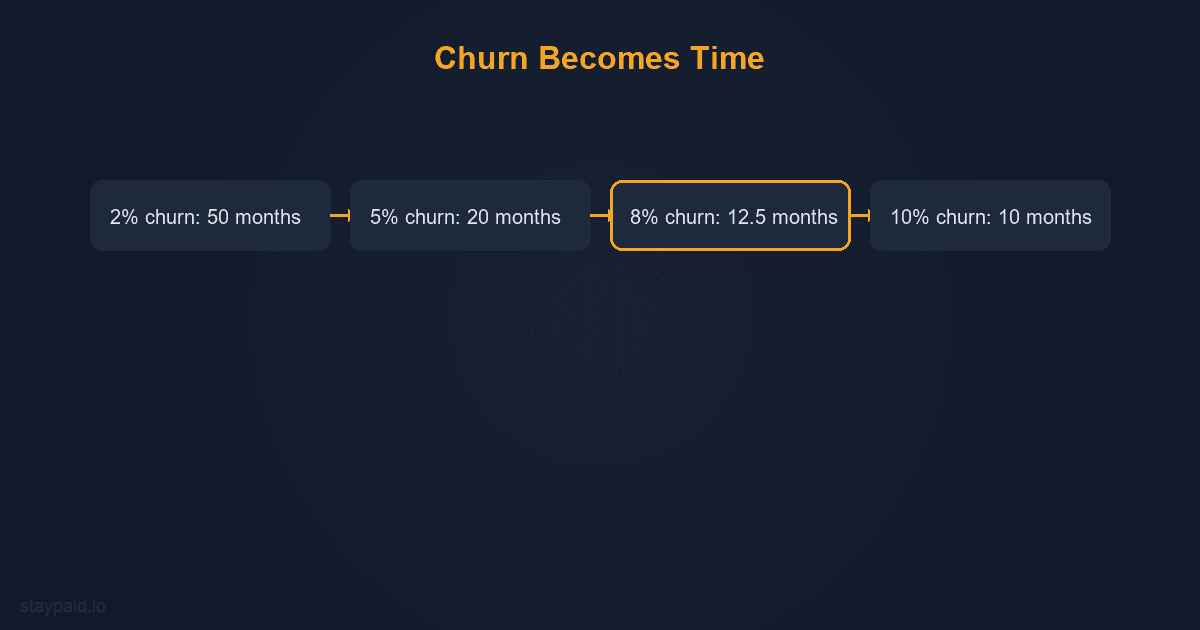
Retention time is how long the average customer stays subscribed, expressed in months. The fastest way to estimate it: divide 1 by your monthly churn rate. Five percent monthly churn means an average retention time of about 20 months. Two percent means about 50 months. This one number quietly drives your LTV, your CAC ceiling, and how much you can afford to grow.
Most founders I talk to know their churn rate but have never converted it into time. That conversion is where the number gets useful, so let me walk through the shortcut, the honest way to measure it, and where the shortcut misleads you.
The 1/churn shortcut, with the math shown
If churn is constant, subscribers decay like compound interest in reverse. Start with 1,000 customers and 5 percent monthly churn: after month 1 you have 950, after month 2 about 902, and so on. Sum the expected months each customer contributes and the total works out to 1,000 divided by 0.05, which is 20,000 customer-months, or 20 months per customer on average. That is why the formula is just 1 divided by churn rate.
A quick reference for the churn rates most indie SaaS actually see:
- •2% monthly churn = about 50 months average retention time
- •3% monthly churn = about 33 months
- •5% monthly churn = about 20 months
- •8% monthly churn = about 12.5 months
- •10% monthly churn = about 10 months
Notice the nonlinearity. Going from 10 to 8 percent churn buys you 2.5 months of average lifetime. Going from 5 to 3 percent buys you 13. Retention time rewards improvement more the better you already are, which is the mathematical case for fixing churn early instead of after you scale.
The honest way: measure a cohort
The shortcut assumes churn is constant across a customer's life. It is not. Most subscription products lose a disproportionate share of new customers in the first 2 or 3 months (bad fit, onboarding failures, impulse signups), then churn flattens for the survivors. A single blended churn rate hides all of that.
The measured approach: take everyone who subscribed in one month, and track how long until half of them are gone. That median survival time is your real retention time, and it needs no assumptions. The catch is time. A January cohort tells you its 6-month survival in July. Young companies cannot wait, so the practical setup is both: 1/churn for fast planning math, cohort curves for validation once you have the history. I wrote up how to read the curve shapes in the retention curve post.
Why this number runs your growth math
Retention time is the multiplier in customer lifetime value. LTV is roughly retention time times monthly revenue per customer times gross margin. A $50 per month customer with 20-month retention and 80 percent margin is worth about $800. Double the retention time and the same customer is worth $1,600, with zero change to pricing or costs.
That LTV number sets your CAC ceiling: the maximum you can pay to acquire a customer and still make money. If your LTV is $800 and you want a 3:1 LTV-to-CAC ratio, you can spend about $265 per customer. Founders who do not know their retention time are guessing at the single number that decides whether paid growth is possible at all.
A worked example end to end
Say you run a $30 per month product with 6 percent monthly churn and 85 percent gross margin. Retention time is about 16.7 months. LTV is 16.7 times $30 times 0.85, roughly $425. At a 3:1 target ratio you can spend about $140 to acquire a customer. Now cut churn to 4 percent. Retention time becomes 25 months, LTV becomes about $638, and your CAC ceiling rises to about $212. Two points of churn bought you 50 percent more acquisition budget. No new features, no price change.
This is why I keep telling founders to calculate retention time before they touch ad spend. The ones who skip it find out the hard way that their CAC ceiling was lower than their CPC.
Where the shortcut lies to you
Three honest caveats. First, the blend problem: if your churn mixes voluntary and involuntary churn, the two have different shapes, and the shortcut averages them into a number that describes neither. Second, early-cohort heaviness: if you grew fast recently, most of your customers are young, so your measured churn is dominated by the leaky early months and 1/churn understates the lifetime of customers who survive onboarding. Third, seasonality: annual plans and seasonal businesses break the constant-churn assumption entirely.
None of these kill the shortcut. They just mean you should treat the result as a planning estimate and check it against cohort curves twice a year. When the two disagree, believe the cohorts.
Retention time vs retention rate: which one to watch
These two numbers describe the same reality from opposite directions, and teams confuse them constantly. Retention rate is a snapshot: of the customers who existed at some point, what share are still here later. Retention time is a duration: how long the average customer relationship lasts. Retention rate is better for spotting a problem (this month's number dropped, find out why). Retention time is better for planning (can we afford this acquisition channel). You need both, but for different meetings.
If you only have budget to track one, track monthly churn and derive the rest. Churn converts to retention time with the shortcut, retention time converts to LTV with ARPU and margin, and LTV converts to a CAC ceiling with your target ratio. One measured input, three planning outputs. That chain is the entire financial model of a subscription business in four lines, and it is worth understanding deeply before you hire anyone with 'growth' in their title.
One practical habit: put the derived retention time next to your churn rate wherever you report it. '5 percent monthly churn' feels abstract. 'Average customer stays 20 months' is a number a whole team can reason about, and it makes the value of a churn reduction visceral: going from 5 to 4 percent is going from 20 months to 25, and everyone can picture what five extra months of revenue per customer buys.
If you have never run these numbers on your own business, do it now before reading further: pull your monthly churn, convert it, multiply by ARPU and margin. Five minutes with the churn calculator gives you the retention time and LTV figures this post keeps referencing, on your own data instead of my examples. The gap between what founders assume their lifetime is and what the math says is usually the most valuable part of the exercise.
The churn you can remove from the equation
A useful exercise: calculate retention time twice, once with total churn and once with involuntary churn removed. Failed-payment churn is not a verdict on your product; it is expired cards and bank declines happening to customers who never chose to leave. Removing it is the cheapest retention-time improvement available, because nothing about your product has to change. That is the problem I built StayPaid for: smart retries and personal recovery emails from your own address, $29 a month flat. Every point of involuntary churn you remove flows straight through the formula into lifetime, LTV, and the size of the business you can afford to build.
FAQ
What is retention time in SaaS?
Retention time is how long the average customer stays subscribed, usually expressed in months. It is also called average customer lifetime or customer lifespan. For a subscription with a stable churn rate, you can estimate it as 1 divided by the monthly churn rate: 5 percent monthly churn means an average retention time of about 20 months.
What is the formula for retention time?
The shortcut formula is average customer lifetime = 1 / monthly churn rate. A 2 percent monthly churn gives roughly 50 months, 5 percent gives 20 months, 10 percent gives 10 months. It assumes churn is constant across the customer's life, which is an approximation, so treat the result as an estimate, not a measurement.
How does retention time relate to LTV?
Customer lifetime value is roughly retention time multiplied by monthly revenue per customer, multiplied by gross margin. A $50 per month customer with a 20-month retention time and 80 percent margin is worth about $800. Retention time is the multiplier in that equation, which is why small churn improvements move LTV so dramatically.
Why does my measured retention time differ from 1/churn?
Because churn is rarely constant. Most SaaS products see high churn in the first 2 or 3 months, then much lower churn for customers who survive onboarding. The 1/churn shortcut averages all of that into one number, so it usually understates the lifetime of customers who make it past the early months.
Keep reading
Robert
Founder at StayPaid
Want to recover failed payments like a founder?
Start Free — First 3 recoveries