MRR Churn: What It Is, Gross vs Net, and How to Calculate It
MRR churn explained plainly: the formula, gross vs net, worked examples, and what a healthy rate looks like for small SaaS.
MRR churn in one sentence
MRR churn is the monthly recurring revenue you lost this month from customers canceling or downgrading, usually shown as a percentage of the MRR you started the month with. It's the leak in the bucket, measured in dollars instead of people.
Why measure churn in MRR instead of customer count? Because customers aren't equal. Losing one enterprise customer at $400 a month hurts more than losing ten at $19. Logo churn (customer count) tells you how many left. MRR churn tells you how much it cost. For decisions about pricing, plans, and where to spend retention effort, the dollar version is the one that matters.
The MRR churn formula
The basic formula is simple: MRR churn rate equals MRR lost to cancellations and downgrades in the month, divided by MRR at the start of the month, times 100.
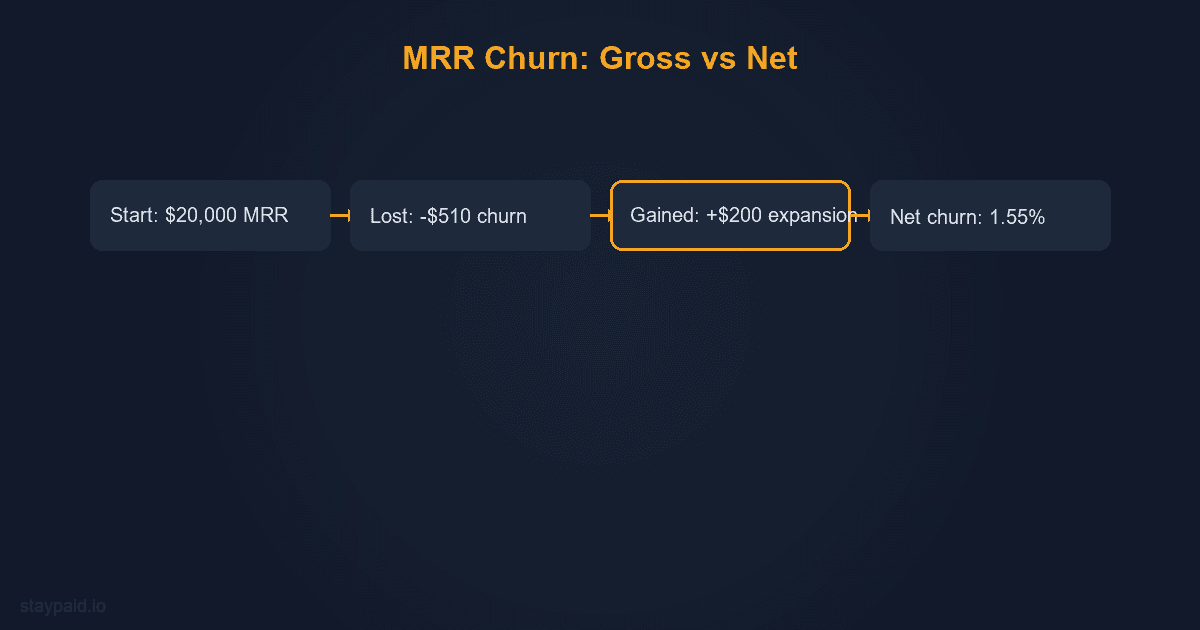
Worked example. You start June with $20,000 MRR. During June, three customers cancel ($150, $80, and $220) and one downgrades from $100 to $40 (a $60 loss). Total lost: $510. Your gross MRR churn rate is 510 divided by 20,000, which is 2.55 percent. Notice what's not in the formula: new customers, upgrades, reactivations. Gross churn only counts money that left.
A word on measurement hygiene. Pick one day per month, snapshot your MRR, and log every movement against it: new, expansion, contraction, churn, reactivation. Most billing tools produce this movement report for free. The founders who get confused by churn are usually the ones computing it from memory against a moving base instead of from a fixed snapshot.
Gross vs net MRR churn
Net MRR churn adds one more input: expansion. Take the same lost MRR, subtract the MRR you gained from existing customers upgrading or adding seats, then divide by starting MRR.
Same June. You lost $510, but two existing customers upgraded for an extra $200 total. Net MRR churn is 510 minus 200, so $310, divided by $20,000: 1.55 percent. Same company, same month, two very different numbers. Gross tells you how bad the leak is. Net tells you how well your surviving customers are covering it.
Track both. A business can look healthy on net while gross quietly rots, because a handful of whales upgrading masks a steady bleed of small customers. When the upgrades slow down, the hidden leak becomes the whole story. Investors learned this the hard way across a lot of SaaS decks: always ask for gross alongside net. Anyone who refuses to split them is telling you something.
Negative MRR churn: the holy grail
If expansion revenue exceeds lost revenue, your net MRR churn goes negative. Existing customers grew your revenue before you sold anything new. This is why SaaS investors obsess over net revenue retention: a company with negative churn compounds even with mediocre sales.
You don't need a usage-based pricing model to get there, though it helps. Annual upgrades, seat expansions, add-ons, and moving happy customers up a tier all count. But be honest with yourself: for most early SaaS, negative churn is a destination, not a description. Get gross churn under control first. Expansion can't outrun a broken bucket forever.
One useful mental model: negative net churn means your existing customer base is worth more every month even if marketing went on holiday. That's the closest thing SaaS has to magic, and it's why the metric shows up in every serious investor conversation. But it only counts if gross churn is honest. A company at 8 percent gross churn and 9 percent expansion isn't healthy, it's running on a treadmill that speeds up every month.
The churn nobody puts in the spreadsheet
Here's a bias in almost every churn discussion: people only count customers who clicked cancel. A big slice of MRR churn is involuntary. The card expired, the bank declined the renewal, and the subscription silently died. The customer didn't leave you. Their payment rails did.
Payments industry research from companies like Recurly and ProfitWell has consistently put involuntary churn at roughly 20 to 40 percent of total churn for subscription businesses. So when you calculate MRR churn, split it: how much was a decision, and how much was a declined card? The fixes are completely different. Voluntary churn is product and pricing work. Involuntary churn is retries, card updaters, and recovery emails, and it's the more fixable of the two.
MRR churn vs the other churn metrics
MRR churn isn't the only churn number, and mixing them up produces nonsense benchmarks. Quick map: logo churn counts customers lost, revenue churn counts dollars lost, and MRR churn is revenue churn measured specifically against monthly recurring revenue. Gross and net apply to any of the dollar versions. Then there's retention, which is churn flipped: revenue retention is 100 minus revenue churn, with the net version allowed past 100 because it counts expansion.
The trap: someone quotes '3 percent churn' without saying which churn. Three percent monthly logo churn, gross MRR churn, and net MRR churn are three different companies wearing the same number. When you compare against a benchmark, match the metric, the unit (monthly vs annual), and the gross vs net flavor, or the comparison is theater.
What a good MRR churn rate looks like
Benchmarks vary by market, so treat these as orientation, not gospel. For small and mid-sized SaaS, monthly gross MRR churn commonly lands between 3 and 5 percent. Under 3 percent is strong. Consistently above 7 percent means retention work will pay back more than any marketing spend. Enterprise-heavy businesses run lower, consumer subscriptions run higher.
One more thing that trips founders up: monthly percentages compound. A 5 percent monthly MRR churn rate is not 60 percent a year. It's 1 minus (0.95 to the power of 12), about 46 percent. Still brutal, but if you're comparing your monthly number against someone's annual benchmark, convert first or you'll panic over nothing. Or celebrate over nothing.
How to lower gross MRR churn
Lowering gross churn is unglamorous work: better onboarding so customers reach value before the first renewal, annual plans that filter for intent, and honest cancellation surveys that tell you why people actually leave instead of why you hope they left. Fix the top one or two reasons first. Churn reduction is a targeting game, not a vibes game.
And separate the voluntary work from the involuntary work. If a fifth of your churned MRR is failed renewals, your biggest gross-churn win this quarter might not be product at all. It might be retry timing, card updaters, and recovery emails that sound like a person. Cheapest churn you'll ever fix.
What to actually do with the number
MRR churn is a diagnosis tool, not a trophy. Calculate it monthly, split voluntary from involuntary, and watch the trend rather than any single month. If voluntary churn climbs, talk to the customers who left. If involuntary churn is a real slice, fix the payment plumbing before touching anything else, because it's the cheapest churn to recover.
And if you don't know your baseline yet, start there. Our churn calculator gives you the number in thirty seconds from customer count, MRR, and churn inputs, no signup. Know the leak before you buy the mop.
FAQ
What is MRR churn?
MRR churn is the amount of monthly recurring revenue you lose in a period from cancellations and downgrades, expressed as a dollar figure or a percentage of your starting MRR.
What is the difference between gross and net MRR churn?
Gross MRR churn counts only revenue lost from cancellations and downgrades. Net MRR churn subtracts expansion revenue from upgrades and add-ons, so it shows what you actually lost after existing customers grew.
What is negative MRR churn?
Negative MRR churn means expansion revenue from existing customers exceeded the revenue lost to cancellations and downgrades. Your existing base grew your MRR even before counting new sales.
What is a good MRR churn rate for SaaS?
For small SaaS businesses, 3 to 5 percent monthly gross MRR churn is common, under 3 percent is good, and anything consistently above 7 percent signals a retention problem worth fixing before you buy more growth.
Keep reading
Robert
Founder at StayPaid
Want to recover failed payments like a founder?
Start Free — First 3 recoveries