Gross vs Net Revenue Retention: The Difference and Why It Matters
Gross vs net revenue retention explained for founders: both formulas, one worked example, honest benchmarks, and what each number tells you to fix.
The one-paragraph answer
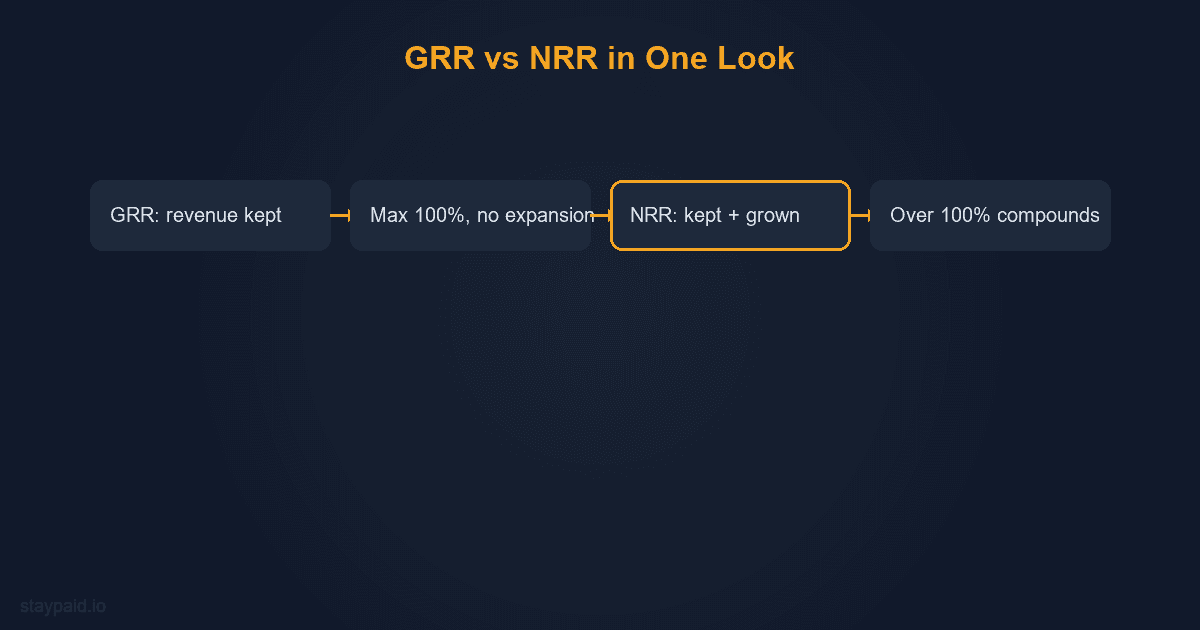
Gross revenue retention (GRR) is how much recurring revenue you kept from your existing customers, counting only what left: cancellations and downgrades. Net revenue retention (NRR) is the same base but also counts what grew: upgrades, add-ons, seat expansion. GRR can't exceed 100 percent. NRR can, and when it does, your existing customers are a growth engine.
The formulas, no jargon
Both start with the same idea: take only your existing customer base at the start of the period, and ask what happened to that group's revenue. New customers are excluded entirely. That's what makes it retention.
The naming is a mess across the industry, so a quick translation layer helps. Net revenue retention (NRR) and net dollar retention (NDR) are the same metric with different labels. Gross revenue retention sometimes travels as gross dollar retention (GDR). If a report says 'dollar-based net retention,' that's NRR in a trench coat. When reading benchmark posts or investor updates, always figure out which of the two flavors is being quoted before comparing anything.
- •GRR = (starting MRR - churned MRR - contraction MRR) / starting MRR. Downgrades and cancellations only. Maximum: 100%.
- •NRR = (starting MRR - churned MRR - contraction MRR + expansion MRR) / starting MRR. Same as GRR plus upgrades and add-ons from existing customers.
Worked example. You start the quarter with $50,000 MRR from existing customers. During the quarter: $2,000 cancels, $1,000 downgrades, and $4,000 upgrades to higher tiers. GRR is (50,000 - 2,000 - 1,000) / 50,000 = 94%. NRR is (50,000 - 2,000 - 1,000 + 4,000) / 50,000 = 102%. Same company, same quarter: sticky but not yet compounding.
What each number is actually telling you
GRR answers: is the product sticky? Strip away all the good news from upsells and ask the brutal question — of the revenue we had, how much did we keep? A low GRR means the core product leaks customers. No amount of expansion covers a bad core forever, because expansion eventually runs out of customers to expand.
NRR answers: does the business compound? Above 100 percent, your existing base grows even if you sell nothing new. This is the number that makes SaaS valuations weird and wonderful. But watch the composition: NRR propped up by a few whale upgrades while the long tail churns is a fragile 105%. That's why you track both, always. GRR is the floor, NRR is the ceiling.
There's also a relationship between the two worth knowing: NRR minus GRR tells you how much expansion contributes, in points. A company at 90 percent GRR and 115 percent NRR is getting 25 points of expansion, which is an expansion-led business, great until expansion slows. A company at 97 percent GRR and 102 percent NRR is a sticky product with modest upsell, safer but less explosive. Neither is wrong. But they need completely different strategies, and you can't pick one without both numbers.
Honest benchmarks
Numbers float around a lot in this space, so treat these as orientation rather than gospel. Among SMB-focused SaaS, GRR commonly lands in the 85 to 95 percent range. Enterprise-heavy businesses run higher because contracts lock in. For NRR, best-in-class public SaaS companies have historically reported 110 to 130 percent, while early-stage products often sit near or below 100 percent until they find expansion levers.
If your NRR is under 90 percent, churn is eating expansion alive and retention work beats any growth spend. If GRR is high but NRR is stuck at 100, you have a pricing problem, not a retention problem: customers stay but never grow. That usually means your plans have no natural upgrade path, or your best features are locked where nobody reaches them.
Context matters more than the absolute number, though. A consumer subscription at 85 percent GRR can be a great business because acquisition is cheap and fast. An enterprise product at 85 percent GRR is in trouble, because each lost logo took months to win. Read your retention numbers against your sales motion, not against a universal league table.
Expansion levers that actually move NRR
If your GRR is healthy but NRR is flat, you need revenue growth from inside the base. The levers, roughly in order of how hard they are to fake:
- •Tiered plans customers grow into. The classic. A customer's success should naturally push them toward the next tier, or your pricing ladder has a missing rung.
- •Seat expansion. Per-seat pricing turns every customer's hiring spree into your expansion revenue.
- •Add-ons and usage components. Storage, extra projects, API volume. Let power users pay like power users without forcing everyone up a tier.
- •Annual plan upgrades. Moving a monthly customer to annual isn't expansion revenue in the MRR math, but it locks in retention and improves cash. Track it separately and celebrate it anyway.
One warning: don't engineer expansion by crippling lower tiers. Customers can tell when the plan they bought was designed to be outgrown. Expansion should feel like graduating, not escaping.
The churn hiding inside retention numbers
Here's what the standard GRR/NRR guides skip: part of your 'churned MRR' was never a decision. The card expired, the bank declined the renewal, the subscription died quietly, and your retention metric just absorbed a payments problem as if it were a product problem.
Payments industry research from companies like Recurly and ProfitWell has consistently put involuntary churn at roughly 20 to 40 percent of total churn for subscription businesses. Before you conclude your GRR says the product isn't sticky, split the churn: voluntary versus involuntary. Voluntary churn needs product and pricing work. Involuntary churn needs retries, card updaters, and recovery emails. Mixing them means misreading both metrics and 'fixing' the wrong thing.
How often to calculate retention
Monthly is the right cadence for most small SaaS: annual smoothes away problems until it's too late to fix them, and weekly is noise. Pick a snapshot day, compute GRR and NRR for the trailing month and trailing twelve months, and watch the trend line rather than any single reading. A one-month dip is weather. Three months in a row is climate. React to climate.
How to move each number
GRR moves with retention basics: onboarding that gets customers to value fast, annual plans that pre-commit intent, and plugging the involuntary leak so only real decisions count as churn. NRR moves with expansion design: tiers customers grow into, seat-based pricing, add-ons, and usage components where they fit the product.
If you're only going to do one thing after reading this: compute both numbers for last quarter, then split churned MRR into voluntary and involuntary. Three numbers, one afternoon, and you'll know exactly whether your next quarter of effort belongs in product, pricing, or payment plumbing. Most founders guess at this. You won't have to.
Start with the floor. If involuntary churn is inflating your churned MRR, the cheapest retention win available is fixing payment failures — retries timed well, expired cards refreshed automatically, and recovery emails that sound like a person. It's why I built StayPaid: that plumbing runs in the background, emails go out from your own address, and your retention numbers start reflecting reality. Clean inputs first, then trust the metrics.
A worked example with real numbers
Say you start the month at $100,000 MRR. Over the month you gain $8,000 in expansion from upgrades, lose $5,000 to cancellations, and lose $2,000 to downgrades. Gross revenue retention counts only the losses: ($100,000 minus $5,000 minus $2,000) divided by $100,000, which is 93%. Net revenue retention counts losses and expansion together: ($100,000 plus $8,000 minus $5,000 minus $2,000) divided by $100,000, which is 101%.
Same month, two numbers, eight points apart. GRR tells you how much revenue leaks no matter how good your upsell motion is. NRR tells you whether the existing base grows on its own. Investors treat NRR above 100% as the magic line, but GRR is the one that exposes a leaky bucket you are papering over with upgrades.
Why failed payments hide inside both numbers
Involuntary churn lands in GRR and NRR like any other cancellation, but it is not a product problem. A customer whose card expired counts as lost revenue in both formulas, and most teams never separate it out. When we audit accounts, failed-payment churn is typically a third to a half of all churn, which means both retention numbers are understated until recovery is fixed.
Practical takeaway: report three numbers, not two. GRR, NRR, and involuntary churn recovered. The third one is the only metric that tells you whether your dunning actually works.
FAQ
What is the difference between gross and net revenue retention?
Gross revenue retention (GRR) measures how much recurring revenue you kept from existing customers, counting only losses. Net revenue retention (NRR) also counts expansion revenue from upgrades and add-ons, so NRR can exceed 100 percent while GRR never can.
What is a good net revenue retention rate for SaaS?
Over 100 percent means your existing base grows by itself. Best-in-class SaaS companies run 110 to 130 percent. For early-stage products, anything above 100 percent is strong; below 90 percent means churn is outpacing expansion.
Can gross revenue retention be over 100%?
No. GRR only counts revenue kept and revenue lost — it includes no expansion — so its maximum is 100 percent. If your GRR shows over 100, expansion revenue leaked into the formula.
Which matters more, GRR or NRR?
They answer different questions. GRR tells you if your product is sticky — can you keep what you sold? NRR tells you if the business compounds — does the base grow on its own? Investors look at NRR; operators should watch GRR first.
Keep reading
Robert
Founder at StayPaid
Want to recover failed payments like a founder?
Start Free — First 3 recoveries