Voluntary vs Involuntary Churn: Two Different Fights, Two Different Fixes
Voluntary churn is a customer choosing to leave. Involuntary churn is a payment failure losing them. Learn to tell them apart and fix each properly.
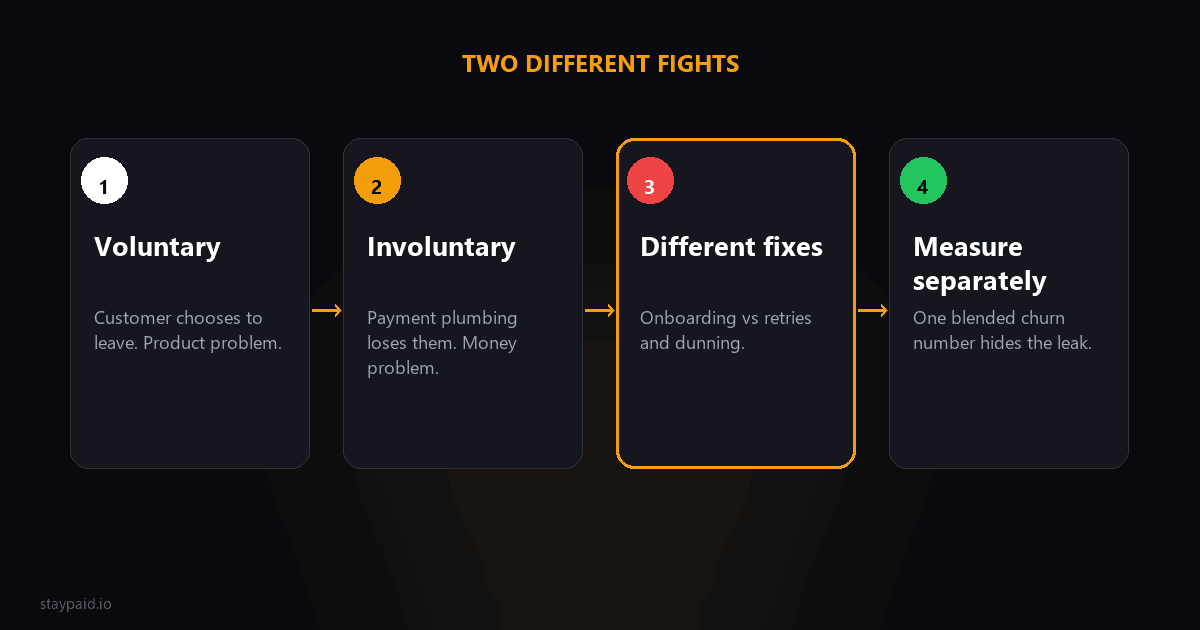
Voluntary vs involuntary churn: one sentence to tell them apart
Voluntary churn is a customer who chose to leave. Involuntary churn is a customer the payment system lost for you — the card died, the bank said no, and you never even had a conversation about it. That distinction sounds simple, but it changes everything about how you fix the problem. Most founders treat churn as one number and one fight. It's not. It's two fights with two completely different sets of tools.
Why the split changes how you fix it
You can't A/B test your way out of a dead card. No pricing experiment, no onboarding email, no feature launch will recover a payment that failed because the customer's card expired and they never updated it. That's the whole point of the split.
Voluntary churn is a product and positioning conversation. Involuntary churn is a payments-operations conversation. Confuse the two and you'll spend energy on the wrong fix and watch the same revenue leak every single month. It's the difference between arguing with your co-founder about onboarding versus turning on a card updater — one is a strategy debate, the other is a twenty-minute setup that starts paying for itself immediately.
How much of your churn is involuntary?
Estimates for how much subscription churn is involuntary vary by source and by who's selling what, so treat any precise number with suspicion. The honest framing is that it's typically a meaningful slice — commonly somewhere in the 20–40% range for card-based SaaS, depending on your billing frequency and card base.
The practical takeaway isn't the exact percentage. It's that a chunk of your churn every month is not customers leaving. They would stay if their payment worked. You just never found out — and neither did they, in most cases. That's the part that still bugs me: a customer who wanted to stay, silently dropped, because nobody was paying attention to the plumbing.
How to tell which one you have
The distinction isn't a vibe — it's in your data. Here's how to actually sort your cancellations into the two buckets:
- •Voluntary: customers who cancel from your settings page or send a cancellation request with a reason — pricing, fit, found a competitor, doesn't use it anymore
- •Involuntary: subscriptions Stripe cancels or you cancel because the payment kept failing — expired card, insufficient funds, a decline that never cleared
- •The tell: if the customer never initiated anything and you just lost the revenue, that's involuntary
If you're not recording why a customer was cancelled, start. A box on the customer record that says "cancelled in-app" versus "failed payment" is worth more than any churn dashboard.
A quick worked example (the math is worth doing)
Let's make it concrete. Say you have 1,000 subscribers on a $50/mo plan, and you're seeing a 4% monthly churn rate. That's 40 subscriptions gone every month — and about $2,000 in MRR bleeding out before you even count new signups.
Now split it. If a third of that churn is involuntary — right in the middle of that 20–40% range I mentioned — you're losing roughly 13 customers a month ($650 in MRR) to failed payments. Not to bad product. Not to pricing. To cards that died and nobody fixed.
Here's why that number changes your behavior: voluntary churn of 27 customers a month is the product team's job, and fixing it takes months of iteration. Involuntary churn of 13 customers a month is a tooling problem you can start solving this afternoon. You can't ship your way out of the first quickly, but you can absolutely plug the second before the weekend.
Two different fix stacks
The voluntary side of that stack got deeper recently. Three levers do most of the work: a cancellation flow that asks why and matches the response (see /blog/subscription-cancellation-flow), save offers matched to the exit reason (/blog/save-offers-cancellation), and a pause option for the large bucket of customers leaving for temporary reasons (/blog/subscription-pause). Each targets a different cancellation reason; together they cover most of the voluntary bucket that is saveable at all.
Voluntary churn is fixed with product, pricing, onboarding, and retention work. That's a whole different lane — and honestly not mine to lecture you on at length. If customers are actively choosing to leave, the answer lives in value delivered, not card processing.
Involuntary churn is fixed with plumbing. Card account updaters that silently refresh reissued cards. Smart retry timing that catches the soft declines. Pre-dunning on expiring cards. And, most importantly, personal recovery emails from a real human address — not no-reply@. That's the lane I live in, and it's the place where most SaaS founders leave recoverable revenue sitting.
"Voluntary churn is a product conversation. Involuntary churn is a plumbing problem. Fixing one with the other's tools never works."
Why one 'churn rate' number hides the leak
If you track churn the way most SaaS companies do — one percentage, one dashboard — you can't see the split. A 4% monthly churn rate could be 1% voluntary and 3% involuntary, or the reverse, and the number looks identical.
That matters because the two demand different fixes. If you aggressively attack pricing promotions to fix 3% involuntary churn, you'll lose margin and recover almost nothing. If you buy a dunning tool to fix 3% voluntary churn, your recovery emails will go to customers who already made up their minds — and probably annoy them. The split has to be visible before you can act on it. If you need the formulas, start with my guide to calculating churn rate, then compare your numbers against average SaaS churn benchmarks to see where you actually stand.
Voluntary churn isn't always your enemy
One thing I want to be honest about: not all voluntary churn is a failure. Sometimes it's a healthy mismatch — a customer who outgrew your tool, a team that shrunk, a budget that got cut. In those cases, the churn happened for a legitimate reason and chasing it is a waste of energy.
The difference is intent data. A customer who cancels after six months of daily use because pricing went up is telling you something about pricing. A customer who signed up last week, never logged in, and silently lapsed is telling you something about onboarding. Both are voluntary churn, but they need totally different responses.
Involuntary churn has no such nuance. There's no signal in a failed payment, no lesson about your product. It's pure, silent, avoidable revenue loss. That's what makes it the cheapest fight to win — and why it makes sense to fix it first, before you spend months on the slower product work.
Start with the plumbing
Here's the thing I've learned running StayPaid: involuntary churn is the churn you can actually do something about this week. You can't redesign your product in a week. You can stop losing people to dead cards in a week. Turn on card account updates, set a sane retry schedule, and start emailing customers personally the moment a payment fails — from your own address, not a robot.
The recovery emails matter most, and they work best when they come from a person — from your own address, with a real P.S. note, sent after a human glances at the situation. That's the difference between recovering a customer and watching them quietly disappear. Most founders don't know how much revenue they're bleeding here until they actually split the numbers. Once you do, the two fights stop being one confusing blob and start being two clear jobs — and the involuntary one is yours to win this week.
FAQ
What's the difference between voluntary and involuntary churn?
Voluntary churn is when a customer actively decides to leave — they cancel, downgrade, or just stop using your product. Involuntary churn is when they'd happily keep paying but the payment itself fails — a dead card, an expired card, a bank decline. One is a decision, the other is a plumbing problem.
Which is worse: voluntary or involuntary churn?
Involuntary churn is usually the worse leak because it's almost entirely preventable and it's silent — the customer never chose to leave, so you're losing revenue from people who still want your product. Voluntary churn is at least a signal about your product or pricing. Involuntary churn is just lost money.
How much churn is involuntary?
Industry estimates vary widely, but involuntary churn is typically a meaningful slice of overall subscription churn — commonly in the 20–40% range depending on your payment mix. Precise numbers depend on your card base and billing frequency, so treat any single figure as a range, not a law.
How do I reduce involuntary churn?
You stack three layers: prevent what you can (card updater coverage, pre-dunning on expiring cards), retry what's soft (smart retry timing), and personally recover the rest with dunning emails from your own address. I walk through the full playbook in How to Reduce Involuntary Churn.
Keep reading
Robert
Founder at StayPaid
Want to recover failed payments like a founder?
Start Free — First 3 recoveries