How to Reduce Voluntary Churn: The 5 Levers That Actually Work for Subscription SaaS
Voluntary churn is customers choosing to leave. Five levers move it: onboarding, value reminders, pricing fit, cancel flows, and real exit reasons.
First, make sure you're fighting the right enemy
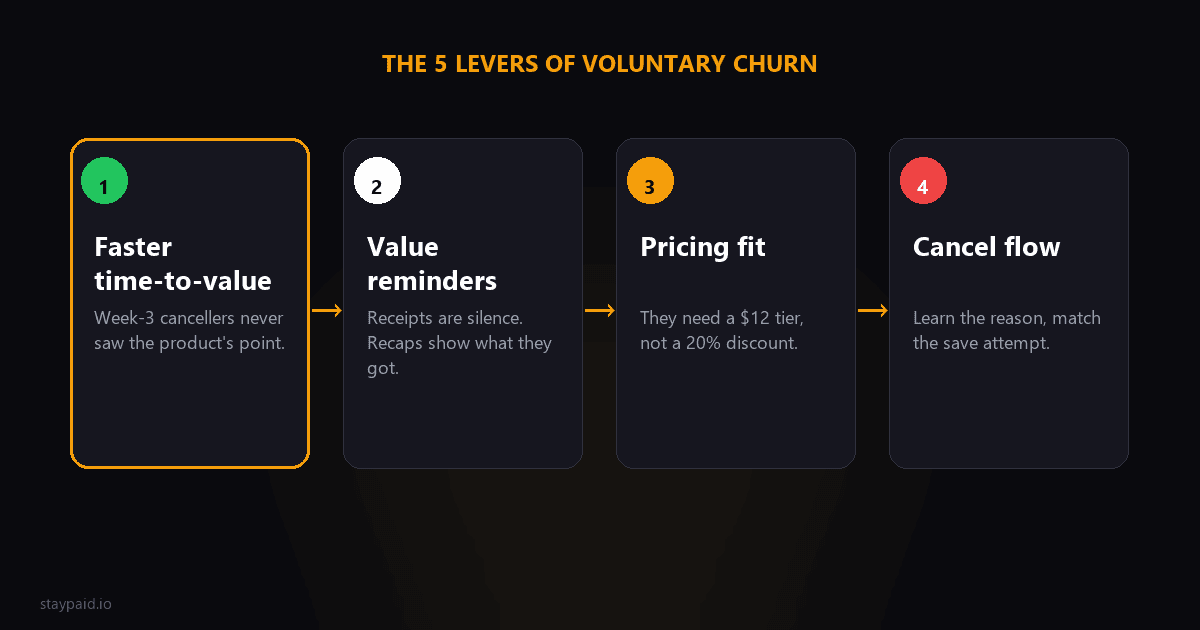
Voluntary churn is customers deciding to leave. Reducing it comes down to five levers: faster time-to-value in onboarding, communicating value before renewal moments, pricing that fits usage, a cancel flow that learns and saves, and an honest read on why people actually go. Everything else — the dark patterns, the guilt-trip modals — is noise that buys you chargebacks.
One prerequisite before touching any of it: split your churn. If a chunk of your 'voluntary' churn is actually failed payments that aged into cancellations, fixing your dunning stack moves the number faster than anything below. (We have a whole post on the involuntary side.) This post is about the customers who meant it.
Lever 1: Win the first 30 days
Plot your voluntary cancellations by customer age. For most subscription products, the bars cluster hard at the left — week one to month two. That's not a retention problem. That's an onboarding problem wearing a retention costume.
The customer who cancels in week three almost never experienced the thing your product is actually for. They signed up, poked around, didn't reach the moment of value, and left politely. The fix isn't a better cancellation survey — it's a shorter path to that first win. Cut setup steps. Seed their account with something real. Whatever it takes to get them to 'oh, THAT'S what this does' before the credit card statement arrives.
Lever 2: Remind them of the value before they go looking
Customers rarely cancel because of a single bad day. They cancel during a quiet audit: scrolling their card statement, asking 'am I still using this?' If the last time they heard from you was a receipt, the answer drifts toward no.
- •Send usage or outcome recaps that show what the product did for them — reports generated, hours saved, payments recovered. Make the value concrete and periodic.
- •Time the reminder before renewal moments, especially before annual renewals. A 'here's what you got this year' email lands very differently than silence followed by a $600 charge.
- •Keep receipts human. A receipt from a person, with a line of actual text, is retention work in disguise.
One warning on this lever: value reminders only work when the product is actually being used. If the recap email goes out and the numbers in it are embarrassing — zero logins, nothing generated — you just handed the customer a written argument for cancelling. For dormant accounts, the reminder play flips into a re-engagement play: one specific, useful thing they could do right now, not a report card on their inactivity.
Lever 3: Fix pricing fit, not pricing
When customers leave over money, the instinct is to discount. Resist it. Most pricing churn is a fit problem: they're on a plan sized for a company three times their actual usage. The options that work:
- •A lower tier they can step down to — a downgrade keeps the relationship alive, and usage grows back.
- •A pause option for seasonal businesses. Paused customers return; cancelled ones mostly don't.
- •Annual plans for proven customers — not as a lock-in, but because annual billing removes eleven monthly 'should I still pay for this' moments.
A customer paying $29/month who uses the product twice a month doesn't need 20% off. They need the $12 tier you never built.
Lever 4: Build a cancel flow that learns before it saves
The cancel button is the most underused research instrument in your company. Every voluntary churner walks past it on their way out and tells you exactly why they're going — if you bother to ask, and if you make asking effortless.
- •Ask one question — 'what's the main reason you're leaving?' — with real options plus a free-text field. Not a ten-question survey. One question, high response rate, honest data.
- •Match the save attempt to the reason. Leaving over price gets the downgrade or pause offer. Leaving over a missing feature gets 'it's on the roadmap, want me to email you when it ships?' Leaving over value gets nothing — let them go cleanly.
- •Never hide the button. Customers who have to email support to cancel don't churn less — they charge back more, and they tell people.
Lever 5: Get the real reason, not the polite one
Cancel surveys say 'too expensive.' Exit conversations say 'I never figured out how to make it do the thing.' The polite reason and the real reason are different documents, and only one of them is actionable.
Every month, pick five recent churned customers and email them like a person: no survey link, no incentive, just 'noticed you cancelled — mind if I ask what happened? Two sentences is fine.' The reply rate will surprise you, because almost nobody does this, and ex-customers have nothing left to protect. Five conversations a month compounds into the clearest product signal you own.
How to tell if it's working
Voluntary churn moves slowly, so pick leading indicators instead of staring at the monthly number. Watch activation rate (what share of new signups reach the core value action in week one), tenure-at-cancellation (is the early-churn cluster flattening?), cancel-reason mix (is 'too expensive' shrinking after you added the lower tier?), and save-offer acceptance. Those four move weeks before the headline churn rate does, and they tell you which lever is actually pulling.
Give each change a cohort. Customers who signed up after your onboarding fix should churn differently than the cohort before it. If they don't, the fix wasn't a fix — revert it and try the next lever. Retention work without cohorts is just collecting anecdotes.
What doesn't work (stop doing these)
- •Guilt-trip cancel modals ('are you SURE you want to lose everything?'). Converts nobody, angers everybody.
- •Hiding cancellation behind a support call. You get chargebacks and one-star reviews instead of churn.
- •Blanket discount blasts to at-risk customers. You train your happiest customers to threaten cancellation for money off.
- •Obsessing over the churn number while ignoring the tenure histogram. Where churn happens tells you what churn is.
What a realistic goal looks like
Don't aim for zero — some voluntary churn is structural and even healthy (customers who outgrow you, companies that fold, projects that simply end). A realistic goal for a first quarter of retention work: shift the tenure curve so fewer people leave in month one, and convert one cancellation reason into a solved problem. Do that twice and the headline number follows on its own.
The takeaway
Voluntary churn drops when customers reach value fast, see that value reflected back at them, sit on a plan that fits, and meet a cancel flow that listens. None of it is exotic. All of it is work — the unglamorous, compounding kind that separates the SaaS that survives year three from the one that blogs about lessons learned.
And when you're done with the voluntary side, the involuntary side is sitting there waiting — customers who never chose to leave at all, lost to expired cards and billing emails nobody answered. That half is my home turf: StayPaid recovers failed payments with personal emails from your own address, so the customers who wanted to stay actually do.
FAQ
What is the fastest way to reduce voluntary churn?
Fix the first 30 days. Most voluntary churn concentrates early — customers who never reached the product's core value cancel within the first month or two. A tighter onboarding path to the 'aha' moment usually beats any retention tactic applied later.
Do cancel-flow offers and discounts actually work?
They work on the right customers — the price-sensitive ones who were leaving over money. They're wasted (and margin-burning) on customers leaving over value. Ask why they're cancelling first, then offer the fix that matches the reason.
How much voluntary churn is normal for SaaS?
After separating out failed-payment churn, established B2B SaaS often runs low single digits annually for deliberate cancellations, while early-stage and low-price products run much higher. The trend line matters more than the absolute number — rising voluntary churn is a product signal.
Should I make cancelling harder to reduce churn?
No. Dark patterns produce chargebacks, angry reviews, and regulator attention — not retention. Make cancelling easy and honest, and use the exit moment to learn why they're leaving. Customers who leave cleanly come back; customers who were trapped never do.
Keep reading
Robert
Founder at StayPaid
Want to recover failed payments like a founder?
Start Free — First 3 recoveries