What Is Involuntary Churn? The Silent SaaS Revenue Killer
Your customers aren't leaving you. Their cards are. Involuntary churn is the quietest way to lose MRR — and the easiest to fix.
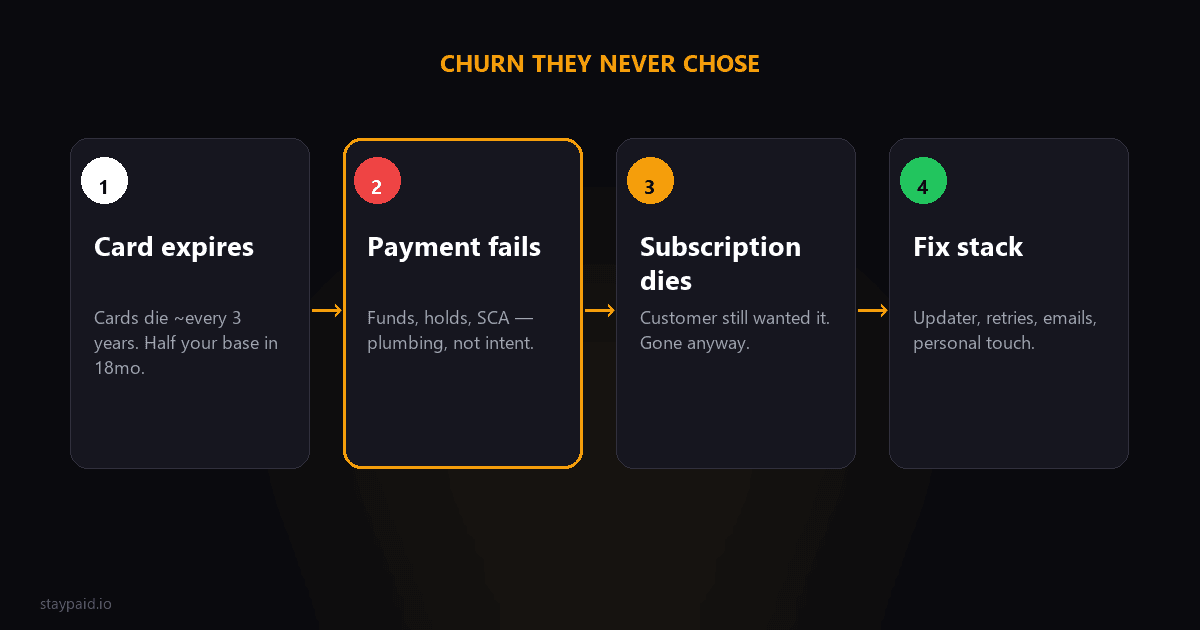
Involuntary churn is when a customer's subscription ends because their payment failed and nobody recovered it — not because they decided to leave. The customer never cancels, never gets an exit survey, and in many cases never even notices their access lapsed. They just stop showing up in your MRR one day.
That distinction matters more than it sounds. When a founder sees a lapsed subscription, the first instinct is to blame the product. But a huge share of those losses has nothing to do with whether customers liked what you built. It has to do with whether their card worked on the day you tried to charge it.
What counts as involuntary churn
Think of churn as sitting in two buckets. Voluntary churn is a decision: the customer chose to leave, usually because the product stopped being worth the price. Involuntary churn is an accident: the customer wanted to stay, but a payment failed and nobody in the loop recovered it in time.
- •Voluntary churn: customer decides to cancel — a product problem.
- •Involuntary churn: payment fails, access lapses — a plumbing problem.
- •The first needs better product and pricing. The second needs a better email.
Why it happens: the real mechanics
Involuntary churn isn't random bad luck. It follows a handful of predictable payment failures, and once you can name them you can fix them. On Stripe, most of it comes down to a few recurring patterns.
Card expiration is the biggest one. Cards expire roughly every three years, and the recurring reminder from the bank about a replacement is easy for customers to shrug off. The card keeps working for offline purchases, but the automatic subscription renewal your system was banking on silently stops. Paddle's data frames it bluntly: because cards expire about every three years, roughly half your customers will hit a payment issue at some point in an 18-month window.
Insufficient funds is the other everyday culprit, and it's more insidious because it's timing-driven, not permanent. The customer has the money — just not on the day your system tried to run the charge, which was probably the day after a big bill cleared. Bank holds add a third layer: some banks block recurring charges from smaller or newer merchants out of caution, so a healthy customer gets a spontaneous decline out of nowhere.
How big is it really?
The industry numbers are uncomfortable. Depending on the source and the market, failed payments account for somewhere between 20% and 40% of total subscription churn. That's not a rounding error — for a lot of small SaaS companies, it's the difference between a flat month and a growing one.
And here's the part that keeps founders up at night: Paddle's estimate about the 18-month window means this is not a rare edge case hitting a few unlucky customers. It's a volume problem. Half your customer base is statistically due for a payment hiccup inside a year and a half. If you have no recovery process, a meaningful share of those hiccups quietly become lost customers.
"The customer never decided to leave — Stripe's own framing of involuntary churn gets at the core of it. They didn't churn on the product. They churned on a Tuesday when their card didn't work."
Why normal churn tactics don't touch it
Here's the trap most playbooks fall into. They treat churn as a retention problem, so they build better onboarding, better emails, better features, better everything. All of that is aimed at the customer who is considering leaving. The customer in involuntary churn isn't considering anything. They have no intent to churn — they're just gone because a payment didn't clear.
- •Win-back campaigns target people who chose to leave — wrong audience here.
- •Discount codes assume price was the objection — they never saw a price they objected to.
- •Better product won't help — the product was fine, the card was the problem.
That's why involuntary churn is called the silent killer. It shows up in your metrics as a slightly worse retention number, and if you don't look closely, you'll blame the product and grind away on features while the real leak is a plumbing problem no one is fixing.
The fix stack, in order
The good news is that involuntary churn is the most fixable churn there is, because the customer is already on your side. You don't have to re-win them. You just have to catch the failed payment and remove the friction between them and a working card. Here's the order that works.
- •Card account updaters — let the card networks quietly push updated card numbers to Stripe so recurring charges keep working with zero customer effort.
- •Smart retries — retry the charge at a better time, since many declines are temporary timing problems rather than dead cards.
- •Dunning emails — a short, clear message with a link to update payment details, sent before the subscription actually dies.
- •Personal touch — a real human (ideally the founder) sending the final nudge from their own address, because customers reply to people and ignore robots.
The order matters. Each layer catches failures the layer before it misses, and together they turn a lost customer into a recovered one in most cases. You want the quiet, automatic fixes running first, and the human moment reserved for the customers who slip through the machine.
One thing worth internalizing: speed beats cleverness here. A customer who gets a friendly fix-your-card email within a day or two updates a card and never thinks twice. A customer who gets nothing for three weeks has already quietly re-subscribed to a competitor or stopped caring. The recovery window is real, and it's short.
What most SaaS companies get wrong
The most common mistake isn't doing nothing — it's handling recovery with the worst possible email. The classic version is a payment-failed notice from a no-reply@yoursaas.com address, subject line Payment failed — action required, body of nothing but a panic link. Customers see a scary automated warning from a robot and either ignore it or assume it's spam. Meanwhile the subscription lapses and the customer gets a refund confusion follow-up later.
The fix is to treat a failed payment like the relationship moment it is. The customer is one click from staying. A short, human note from a person — hey, your card didn't go through, here's the link to fix it in ten seconds — recovers most of them. No fine print, no fake urgency, no guilt. Just remove the friction and get out of the way.
"Involuntary churn is the only kind of churn where the customer is already on your side. All you have to do is not be silent."
Where to start
If your recovery process is a webhook that fires into the void, start by figuring out your actual scale. How many failed payments did you have last month, and how many of those customers came back? That number tells you whether you have a leak-you-walk-right-past problem or a contained one. Then work the stack from the top: let card updaters and smart retries do the silent lifting, and make sure there's a human follow-up before any subscription actually dies.
That's exactly why I built StayPaid. It watches your Stripe account, catches every failed payment, and puts it in front of you immediately — who failed, why, and what to say. You send the email from your own address, the customer updates their card, and the whole thing is over before anyone thinks about leaving. Because for involuntary churn, they never really were leaving. They just needed one person to not be silent.
FAQ
What is involuntary churn in SaaS?
Involuntary churn is when a subscription ends because a payment failed and nobody recovered it, not because the customer decided to cancel. The customer never chooses to leave — their card expired, had insufficient funds, or was declined, and the lapse slips through silently.
How is involuntary churn different from voluntary churn?
Voluntary churn is a decision: the customer actively cancels, usually because the product lost value. Involuntary churn is an accident: the customer wants to stay, but a failed payment ends the subscription. One needs better product, the other needs a better payment-recovery email.
How much revenue does involuntary churn cost?
Depending on your market, failed payments account for somewhere between 20% and 40% of total subscription churn. Because cards expire roughly every three years, about half your customers will hit a payment issue within an 18-month window.
How do I reduce involuntary churn on Stripe?
Work the recovery stack in order: card account updaters, smart retries at better times, short dunning emails with a payment link, and a personal follow-up from a human before the subscription dies. The customer is already on your side — you just have to not be silent.
Keep reading
Robert
Founder at StayPaid
Want to recover failed payments like a founder?
Start Free — First 3 recoveries