Let Customers Pause Instead of Cancel: The Most Underused Retention Lever
A pause option turns some cancellations into returns. How to offer it, the Stripe mechanics, and why pauses also prevent failed payments.
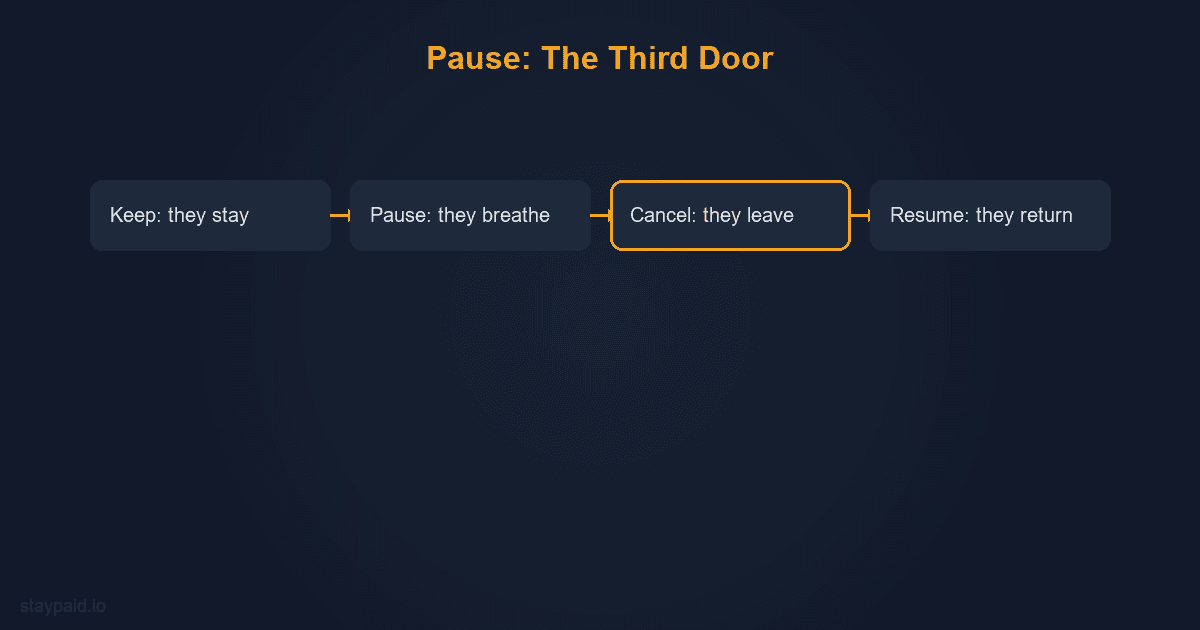
A subscription pause lets a customer stop billing for 1 to 3 months without canceling, then resume automatically. It is the highest-leverage retention feature most SaaS founders never build: it catches the large group of customers who are leaving for temporary reasons, and it quietly protects you from failed-payment churn while they are gone.
Look at your cancellation reasons. If they include 'not using it right now', 'too busy', 'budget is tight this quarter', or 'seasonal', those are not lost customers. Those are paused customers you forced to cancel because cancel was the only door.
The customers you are throwing away
Cancellations come in two flavors. Permanent: the customer got no value, found a competitor, or closed their business. You were never saving those. Temporary: a freelancer between contracts, a team in a slow quarter, a user going on leave, a seasonal business in the off-season. Their problem is timing, not your product.
Without a pause option, every temporary canceller becomes a full churn event. Their card leaves your system, their account data often follows, their habit breaks, and winning them back later costs acquisition-level effort. With a pause, the same customer keeps their account, their card on file, and a dated commitment to return. The difference in lifetime value between those two paths is enormous, and it costs you one screen and a few emails.
How to offer it without gutting revenue
- •Offer the pause inside the cancellation flow, not on a public pricing page. It is a save offer for someone already leaving, not a feature people game to pay less.
- •Give three fixed durations: 1, 2, or 3 months. Fixed options beat 'pick your own date' because the decision is easier and your reactivation timing becomes predictable.
- •Ask why in one tap before showing the pause. If the reason is 'too expensive', a pause is the wrong save; that is a downgrade or discount conversation. Route by reason.
- •Send three emails: a confirmation when the pause starts, a heads-up 7 days before it ends, and a welcome-back when billing resumes. Silence during a pause kills restart rates.
- •Decide the access rules explicitly. Most products keep read access and pause the paid features. Whatever you choose, say it clearly in the confirmation email.
The Stripe mechanics
Stripe supports pausing natively. On a subscription, you set pause_collection with a resumes_at timestamp, and Stripe stops generating invoices until that date, then resumes billing automatically. You can do it from the dashboard for a one-off request or via the API if you build the self-serve flow. The subscription object survives intact, which is the entire point: the card stays on file, the customer record stays whole, and resuming is a non-event instead of a new signup.
One detail to handle yourself: Stripe pauses billing, not your application. Decide what paused users can see when they log in, gate it in your own code, and reflect the state in your UI. A paused customer who hits a broken-looking product does not restart; they churn with extra steps.
The involuntary churn angle nobody mentions
Here is the hidden benefit. A paused subscription cannot fail a payment. Every customer who pauses for a slow quarter is a customer whose card does not decline three times in March, who does not get dunning emails they feel guilty about, and who does not drift into delinquent churn while meaning to come back. Founders obsess over recovering failed payments from customers who wanted to stay. Pauses quietly delete a whole category of failure from customers who wanted to leave temporarily.
There is a second-order effect too. When the pause ends and billing resumes, that first renewal charge is a moment of risk: months have passed, cards have expired. Treat the resume like a mini trial-to-paid transition. The 7-day pre-resume email doubles as a 'make sure your card is current' nudge, which catches expiring cards before they become failed payments. Prevention beats recovery every time it is offered.
The edge cases worth deciding upfront
A few questions will come up the week you ship this, so decide them now. Can a customer pause twice in a row? Most products allow it once, then force a resume-or-cancel decision, because perpetual pausers are churn with extra paperwork. What happens to annual plans? Pausing an annual subscription usually means extending the term, not stopping payment, so write that rule down before support has to improvise it. And what about trials? Never pause a trial; a paused trial is just an abandoned one with a date attached.
Also decide who can pause. Self-serve in the billing page is the goal, but early on there is nothing wrong with 'email us and we will pause it' while you watch demand. Ten manual pauses will teach you the exact durations and reasons to build for, and you will ship the automated version with real data instead of guesses.
One more design decision that pays off: make the resume automatic and loud. Automatic, because a pause that requires the customer to remember to come back is just a delayed cancellation. Loud, because the resume email is a re-onboarding moment, not a receipt. 'Welcome back, here is what you missed, here is the newest thing we shipped' turns a billing event into a reason to log in. The founders who treat resumes as silent background charges get a wave of 'wait, what is this charge?' disputes three months later. The ones who treat them as relaunches get engaged users back.
If you are worried about abuse, put the worry in perspective. Yes, a small number of customers will pause to squeeze free months out of you, especially if you keep access generous during the pause. The mitigation is boring: read-only or limited access while paused, and one consecutive pause maximum. Do not let the 2 percent who might game the system deny the save offer to the 98 percent who just need a breather. Build for the honest majority, monitor the edge cases, and tighten later only if the data says you must.
What to measure
Track four numbers monthly: how many cancellers see the pause offer, how many take it, how many paused customers restart, and the revenue difference between a paused customer and a matched canceller. The last one is the number that justifies the feature. Even a modest restart rate on paused customers is found MRR, because the alternative path was a full loss with reacquisition costs on top.
"Some of your churn is not churn. It is customers asking for a break, and you are answering with a door."
Where this fits in the bigger retention picture
Pause is one offer in a save ladder: pause for timing problems, downgrade for price problems, discount for hesitation, and a clean, instant cancellation for everyone else. The ladder only works if each rung exists. Most founders build exactly one rung, the cancel button, and then wonder why voluntary churn is high.
And when customers do stay and their payments fail anyway, that is the other half of the problem. StayPaid exists for that half: smart retries and personal recovery emails from your own address, so the customers who never wanted to leave do not churn by accident. Fix both halves and 'churn problem' stops being a category in your week.
FAQ
How do I pause a subscription in Stripe?
Stripe supports pausing natively through pause_collection on the subscription object, either in the dashboard or via the API. You can set a resume date, and Stripe stops invoicing until then. You still need to decide what happens to product access yourself; Stripe pauses the billing, not your app.
Should pausing be free?
Yes. Charging for a pause defeats its purpose. The pause is a bet that a customer who would have churned forever instead comes back. Any friction, including a fee, pushes them toward full cancellation, which is the outcome you built the pause to avoid.
How long should a pause option be?
Offer 1, 2, or 3 months. Shorter than a month feels pointless to the customer, and longer than three months means the relationship goes cold and restart rates drop. Three fixed options keep the decision simple and give you clean cohorts to measure.
Do paused customers actually come back?
A meaningful share do, and retention platforms consistently report pause as one of their top save offers. The honest caveat: some paused customers never return, and that is fine. A pause that converts 30 to 50 percent of would-be cancellers into returning customers is found revenue, and even the ones who leave gave you time instead of an instant loss.
Keep reading
Robert
Founder at StayPaid
Want to recover failed payments like a founder?
Start Free — First 3 recoveries