Involuntary Churn Rate: What's Normal for SaaS, How to Calculate Yours, and How to Move It
What involuntary churn rate is normal for SaaS, how to calculate yours from Stripe data, and the levers that actually move the number.
What involuntary churn rate measures
Your involuntary churn rate is the share of customers you lose each month to failed payments rather than to a decision. They didn't cancel. Their card expired, hit a limit, or got declined, and nobody fixed it in time.
It's worth measuring separately because it answers a different question than total churn. Total churn asks whether people want your product. Involuntary churn asks whether your billing plumbing leaks. Different problem, different fix, different owner.
What's normal, and what's a fire
Payments industry research from companies like Recurly and ProfitWell has consistently put involuntary churn at roughly 20 to 40 percent of total churn for subscription businesses. In monthly rate terms, under 0.5 percent of customers lost to failed payments is strong. Up to 1 percent is common and fixable. Above 1.5 percent a month, failed payments aren't background noise anymore. They're a top-three growth problem wearing a disguise.
Context matters. Annual-heavy billing mixes see lower monthly involuntary churn but bigger single hits when a renewal fails. Consumer products with lots of debit cards see more failures than B2B tools with corporate cards. Compare yourself to your own trend line first, benchmarks second.
How to calculate your real number
The formula is simple: customers lost to failed payments this month, divided by total customers at the start of the month, times 100. The hard part is the numerator, because most churn reports lump everyone together.
In Stripe, the honest way to count: find subscriptions that ended after their invoices went past due or uncollectible, or check cancellation_details for the payment-failure reason. Those customers are your involuntary churn. Everyone who clicked cancel is the other pile. If you're not splitting these two piles, your churn number is lying to you about why people leave.
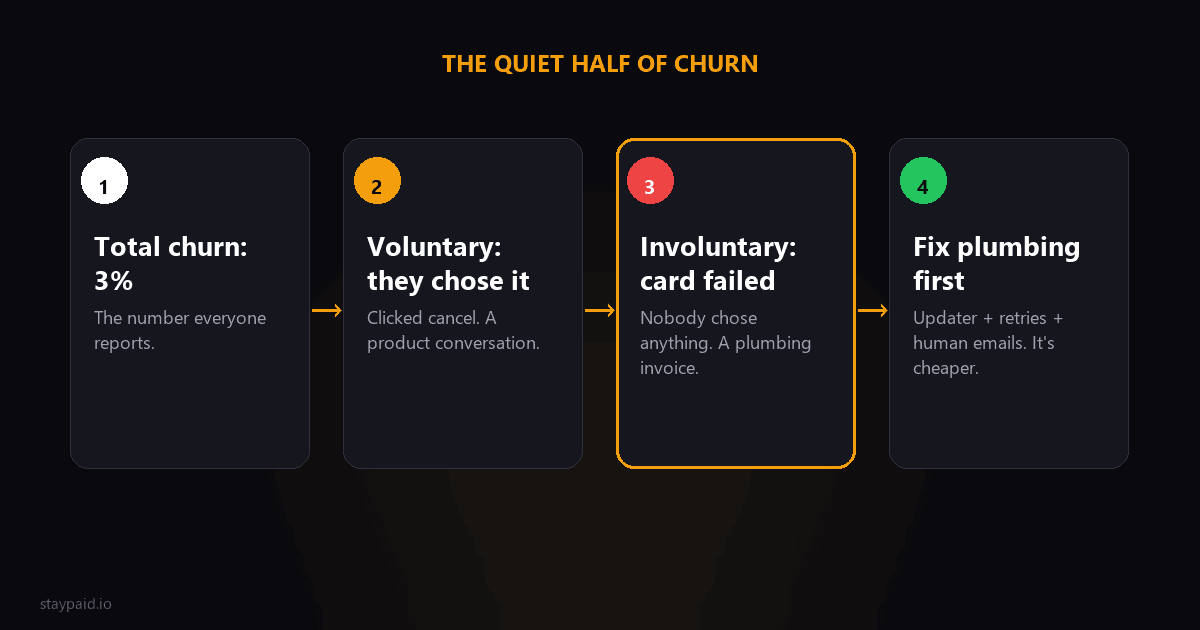
Worked example: 400 customers at the start of the month, 12 churned total, 5 of them ended after failed payments. Total churn is 3 percent. Involuntary churn is 1.25 percent. That 1.25 is 5 customers at, say, $45 MRR each: $225 a month, $2,700 a year, lost to plumbing.
Tracking it so the number stays honest
One month of involuntary churn tells you where you are. A trend line tells you whether you're winning. Set a monthly reminder, pull the same count from Stripe the same way each time, and log it somewhere dumb and visible: a spreadsheet is fine. What you're watching for is drift. Involuntary churn creeps up quietly as your customer base ages, because cards expire on a schedule and your dunning doesn't improve on its own.
If you want to get fancier, split the number by plan type. Annual plans concentrate the risk into one big renewal a year, so a single failed annual renewal can equal ten monthly ones. Founders with mostly annual billing sometimes discover their 'fine' involuntary churn rate was averaging over a monthly view that hid the annual cliff.
Why founders undercount it
Two traps. First, the recovery mask: a card fails, Stripe retries, the payment succeeds, and the whole episode vanishes from your churn report. Nothing churned, so nothing looks wrong. But the customers who recovered this month are the same profile as the ones who won't recover next month. A rising count of failed-then-recovered payments is involuntary churn warming up.
Second, the classification blur. A customer whose payment failed three times and who then clicks cancel: voluntary or involuntary? Most tools file it under voluntary because a human clicked a button. I'd argue the payment failures were the story and the click was the epilogue. However you classify it, be consistent, or your month-over-month comparisons are noise.
How it differs by business model
B2B SaaS usually sits at the low end: corporate cards, longer relationships, higher willingness to fix a payment. Consumer subscriptions run hotter: personal cards, tighter budgets, more expired and replaced cards. Usage-based billing adds its own twist, because charge amounts vary and variable amounts attract more bank declines than the same flat number every month.
Geography matters too. A customer base heavy in SCA-regulated regions will show more authentication-related failures, which behave differently from plain declines and respond to different fixes. If your involuntary churn looks high and your customers are mostly European, the SCA angle is worth checking before you touch anything else.
Three reasons. Stripe's default reporting emphasizes MRR movement, not loss reasons. Voluntary churn feels like the real problem because it's the one customers tell you about. And involuntary churn is quiet: no cancellation survey, no angry email, just a subscription that ends after retries give up. Silence doesn't show up in a weekly review unless you build the report yourself.
The levers that actually move the number
- •Card updater. Prevents the expired-card failures before they happen. This removes a whole failure category from the numerator.
- •Smarter retries. Retrying around decline type and payday timing recovers failures that a fixed schedule gives up on.
- •Emails that get opened. The recovery email is where most failed payments get fixed, and sender line plus timing decide whether it works.
- •Pre-dunning. Warning customers about expiring cards before the charge. Fewer failures means less to recover.
Notice what's not on the list: product improvements, pricing changes, better onboarding. Those move voluntary churn. Involuntary churn is a payments operations problem, and it responds to payments operations fixes, usually within one or two billing cycles.
Before you set a target, split the number one more way: involuntary churn on first renewal versus later renewals. Early failures often signal a checkout or card-capture problem you can fix once and benefit forever. Late failures are the steady-state plumbing cost of subscriptions. If your first-renewal slice is fat, fix onboarding before you touch dunning. If the long tail dominates, dunning and card updating are where the money is. Most teams discover their split is roughly half and half, which means two different fixes running in parallel rather than one big initiative. That framing also makes the fix list obvious: one owner for the first-renewal problem, one for the steady-state one, and a number each is accountable for. Both numbers improve faster when someone specific owns each of them.
What a good target looks like
Once you know your number, the goal isn't zero, because zero isn't available. Cards will always fail. A realistic target is cutting whatever you measure today by a third to a half over a quarter, using the levers above. The teams that hit that usually do it in the boring way: updater on, retries tuned, emails that sound like a person, measured monthly.
The compounding part is worth stating plainly. A customer recovered this month keeps paying next month, and the month after. Every point of involuntary churn you shave is not a one-time save. It's a permanent raise on your revenue base.
The one-line version
Split your churn number. Put the involuntary piece on a dashboard or a spreadsheet you actually look at monthly. If it's above 1 percent, the fix is operational and the ROI is boring to calculate because it's so obviously worth it. Our churn calculator will show you the annual dollar leak in about thirty seconds.
"Voluntary churn is a product conversation. Involuntary churn is a plumbing invoice. Fix the plumbing first, it's cheaper."
FAQ
What is a good involuntary churn rate for SaaS?
Under 0.5 percent of customers per month is strong. Up to 1 percent is common and fixable. Above 1.5 percent means failed payments are a top growth problem, not background noise.
How do you calculate involuntary churn rate?
Customers lost to failed payments in a month, divided by total customers at the start of that month, times 100. Keep it separate from voluntary churn or the number lies to you.
What percentage of total churn is involuntary?
Payments industry research from companies like Recurly and ProfitWell puts it at roughly 20 to 40 percent of total churn for subscription businesses.
How do I find involuntary churn in Stripe?
Filter canceled subscriptions by cancellation reason, or find subscriptions that ended after their invoices went uncollectible or past due. Those are the customers Stripe's retries gave up on.
Keep reading
Robert
Founder at StayPaid
Want to recover failed payments like a founder?
Start Free — First 3 recoveries