Delinquent Churn: What It Is, How It's Different From Normal Churn, and How to Stop It
Delinquent churn is what happens when failed payments quietly cancel your customers. What the term means, how it differs from voluntary churn, and the fix.
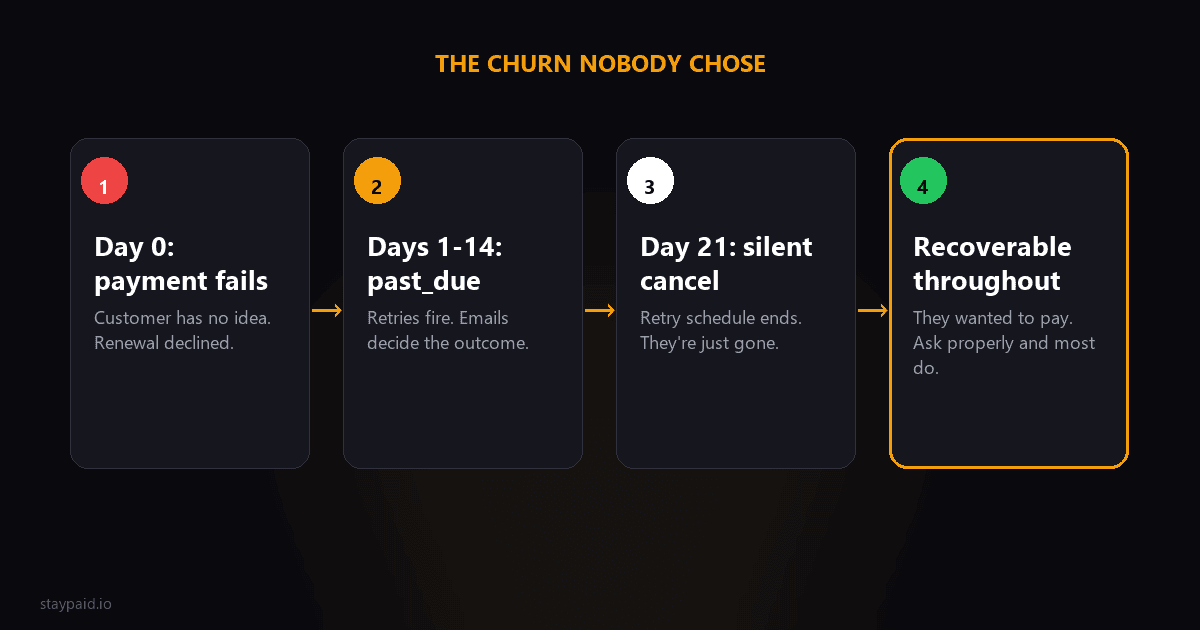
The plain-English answer
Delinquent churn is when you lose a customer because their payment failed and never got fixed. Not because they cancelled. Not because they hated the product. Their card expired, their bank declined the charge, or their account was empty on renewal day — and after a few failed retries, the subscription simply died.
If you've ever looked at a churned customer and thought 'wait, they didn't cancel... they just stopped paying,' you've met delinquent churn. It's the quietest leak in SaaS, and this post is about naming it properly, measuring it, and closing it.
Where the word comes from
'Delinquent' is borrowed from lending and accounting, where a delinquent account is one with overdue payments. Your credit card is delinquent if you miss the due date. The term migrated into subscription billing because the mechanics are identical: an amount was due, it wasn't paid, and now the account sits in a state that is neither active nor cancelled.
In Stripe you'll see this as a subscription in past_due status, or a customer flagged with an overdue invoice. That limbo — payment failed, retries still running, subscription not yet dead — is the delinquency window. What happens during that window decides whether you keep the customer.
Delinquent churn vs voluntary churn: the difference that changes your fix
- •Voluntary churn: the customer made a decision. They clicked cancel. The fix is product, pricing, or retention work — a better cancel flow, a save offer, a reason to stay.
- •Delinquent churn: the customer made no decision. Their payment method failed them. The fix is billing operations: retries, card updates, recovery emails.
Mixing these two in one 'churn rate' number is how founders end up depressed about a product problem they don't have. If a third of your churn is delinquent, your product might be fine — your payment recovery is what's broken. Different disease, different medicine. (If you want the full breakdown of the two types, we have a dedicated post on voluntary vs involuntary churn.)
How much of your churn is delinquent?
Pull last quarter's churned subscriptions and sort them into two piles: cancelled-by-customer and ended-unpaid. In Stripe, that's subscriptions cancelled by you or the customer vs subscriptions that died after exhausting the retry schedule on an unpaid invoice.
For a typical small SaaS, the unpaid pile is bigger than founders expect — often a meaningful slice of total churn. And here's the kicker: most of that pile was recoverable. Industry data on dunning consistently shows the majority of failed payments can be recovered with retries plus decent email follow-up. Which means most delinquent churn isn't churn at all. It's uncollected revenue wearing a churn costume.
The anatomy of a delinquent churn event
- •Day 0: renewal charge fails. Customer gets Stripe's default failure email (if you left it on) or nothing (if you turned it off).
- •Days 1-7: retries run on whatever schedule you configured. Soft declines sometimes resolve here. Hard declines never do.
- •Days 7-14: the window where recovery emails do the real work — or where silence does the real damage.
- •End of retry schedule: Stripe marks the subscription unpaid and cancels it, per your settings. The customer often doesn't notice for weeks. Sometimes they never notice — they just drift.
Notice what's missing from that timeline: a single moment where the customer chose to leave. Delinquent churn is churn by neglect — yours or the card's, but rarely the customer's.
How delinquency moves through Stripe (so you can measure it)
If you want to track delinquent churn properly, you need to know where it shows up. A renewal fails and the subscription flips from active to past_due — that's the start of the delinquency window. Stripe then runs your configured retry schedule. If a retry succeeds, the subscription returns to active and no harm was done. If the schedule exhausts, the subscription ends per your settings: it cancels, or it sits unpaid.
The measurement move: count subscriptions that ended after an unpaid invoice separately from subscriptions the customer cancelled. In your own database that means keying off the cancellation reason — Stripe records why a subscription ended, and 'payment failed' is a different reason than 'cancelled by customer.' That one field is the difference between knowing your delinquent churn rate and guessing it.
A worked example
Say you run a 400-customer SaaS at $30/month. Last month 20 customers churned. You dig in: 11 clicked cancel (voluntary), 9 ended unpaid after failed payments (delinquent). Your headline churn is 5%, but your voluntary churn is actually 2.75% — a very different product story. And of the 9 delinquent, say 6 had soft-decline codes that a smarter retry schedule plus one personal email would likely have recovered. That's $180 of monthly recurring revenue, $2,160 a year, lost to a process problem, not a product problem.
One more reason delinquent churn deserves its own line in your reporting: it's the only kind of churn that gets worse when you ignore it and better when you process it. Voluntary churn needs product work. Delinquent churn needs a system — prevention before the failure, retries and emails during, a clean write-off after. None of those require a single product change.
How to stop it (the short version)
- •Prevent: card account updater plus pre-dunning emails for expiring cards. This kills the boring failures before they happen.
- •Retry smart: soft declines get retried on a sensible schedule, hard declines don't waste attempts (and card networks penalize over-retrying dead cards).
- •Recover personally: the failures that survive retries need a human-sounding email from an address the customer can actually reply to. This is the highest-leverage step, and the one most setups skip entirely.
- •Measure it separately: delinquent churn in its own column, every month. What gets measured gets fixed.
Why the word itself matters
There's a reason billing systems borrowed 'delinquent' from credit instead of inventing a friendlier word: the behavior pattern is the same. A delinquent borrower isn't someone who refused the loan terms — it's someone whose payments stopped and nobody intervened early enough. SaaS delinquency works identically. The earlier you treat the missed payment as a conversation instead of a countdown, the more accounts come back. The later you intervene, the more the silence hardens into real churn.
It also matters for how you report. Investors and acquirers who know subscription businesses will ask for your involuntary or delinquent churn split. Having the number — and a system behind it — reads as operational maturity. Not having it reads as a leak you haven't looked at.
The takeaway
Delinquent churn is the customer loss nobody chose — failed payments that quietly aged out into cancellations while nobody was watching. It's recoverable in a way voluntary churn never is, because the customer still wants the product. All they need is a working card on file, and usually all that takes is someone asking properly.
That 'asking properly' part is what I built StayPaid for. When a payment fails, your customer gets a personal-sounding recovery email from your real address, with you able to review each one before it sends. Delinquent churn is the cheapest churn to fix — it just needs someone to show up and ask.
Where delinquent churn hides in your Stripe data
Stripe does not label anything delinquent churn, which is exactly why it goes unmeasured. The trail lives in subscription statuses. A subscription that goes past_due after a failed payment, then unpaid, then canceled for non-payment: that whole arc is one delinquent churn event. The incomplete_expired status is the quieter sibling: the very first payment never succeeded, so the subscription died before it started.
To size your problem, pull subscriptions canceled in the last 90 days and split them by whether the most recent invoice was paid or failed. In most SaaS accounts we look at, 30 to 50 percent of cancellations trace back to a failed payment, not a decision. If you have never run this split, your churn number is overstating how much people dislike your product and understating how much your payment recovery is failing.
FAQ
What is delinquent churn?
Delinquent churn is customer loss caused by failed payments — the customer's card didn't work, dunning didn't recover it, and the subscription lapsed. The customer never decided to leave; their payment method gave out. It's another name for involuntary churn from unpaid invoices.
What does 'delinquent' mean on a Stripe customer or invoice?
Delinquent means the customer has an unpaid, overdue invoice. In Stripe, a subscription goes past_due when a renewal fails and stays that way through your retry schedule until it either recovers or gets cancelled as unpaid.
Is delinquent churn the same as involuntary churn?
Essentially yes — delinquent churn is involuntary churn viewed from the billing side. 'Involuntary' describes the customer's intent (they didn't choose to leave); 'delinquent' describes the payment state that caused it (an overdue, unrecovered invoice).
How do I reduce delinquent churn?
The same stack that reduces involuntary churn: card account updaters and pre-dunning to prevent failures, smart retries for soft declines, and personal recovery emails for the failures only the customer can fix. Most delinquent churn is recoverable in the first week.
Keep reading
Robert
Founder at StayPaid
Want to recover failed payments like a founder?
Start Free — First 3 recoveries