Save Offers at Cancellation: When Discounts Work and When They Cost You Twice
Save offers recover real revenue or train customers to cancel for coupons. The economics of pauses, discounts, and downgrades, done right.
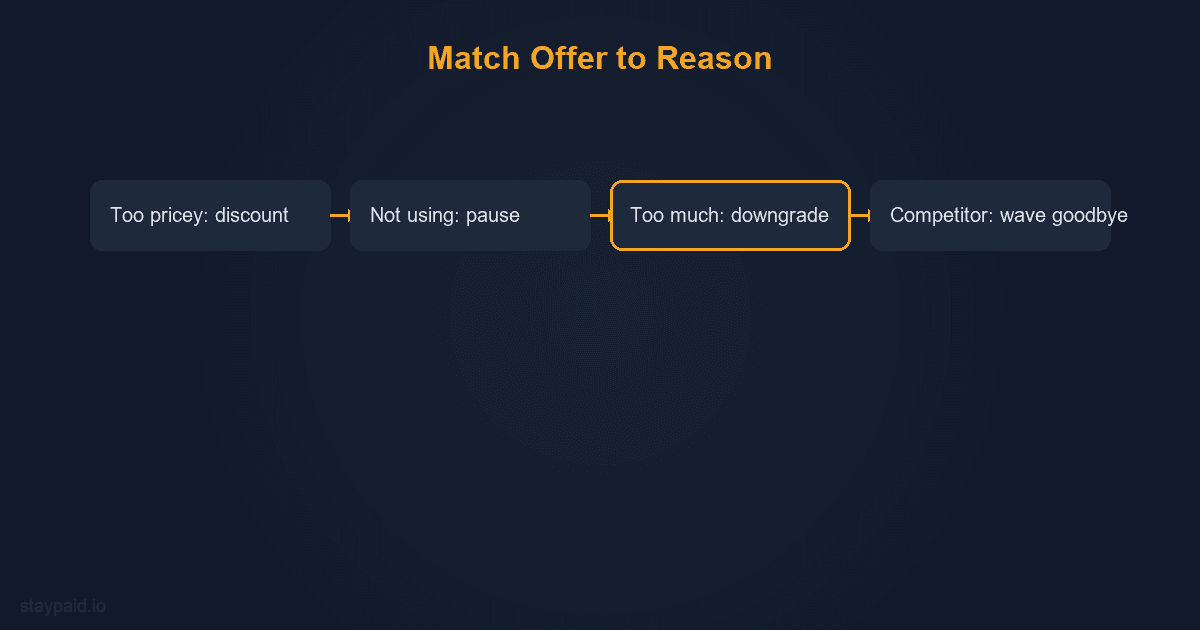
A save offer is an incentive shown inside your cancellation flow to keep a leaving customer: a pause, a discount, a downgrade, or a plan switch. Used well, save offers recover revenue that was walking out the door. Used badly, they train your entire customer base to click cancel for coupons. The difference is matching: the right offer for the stated reason, and hard limits on everything.
I want to walk through the four offer types, the actual economics of each, and the rules that keep them from being gamed. This is the offer menu your cancellation flow draws from; the flow design itself is a separate post.
The four offers, ranked by economics
- •Pause. Costs you zero discounted revenue. The customer stops paying for 1 to 3 months, keeps their account and card on file, and resumes automatically. Best offer in the stack for timing-driven churn, which is a huge share of cancellations at small SaaS.
- •Downgrade. Keeps the customer at a lower price. Revenue shrinks permanently, but the relationship, data, and habit survive. Right answer for 'more than I need' and for price-sensitive customers on annual plans you would rather keep at 60 percent than lose at 100.
- •Discount. Keeps the customer at reduced price for a fixed period, usually 2 or 3 months at 20 to 50 percent off. Powerful for genuine price objections, dangerous as a blanket offer, because it costs margin every month and teaches the cancel-for-coupon reflex.
- •Plan switch or feature unbundling. The customer keeps paying roughly the same but for a different package. Rarest and hardest to automate, but sometimes the real answer when the reason is 'paying for features I never use'.
The math founders skip
Every save offer has a cost, and the honest comparison is not 'offer vs full price'. It is 'offer vs zero'. A customer in the cancel flow is already gone; the baseline is losing them entirely. So a 3-month 30 percent discount on a $50 plan costs you $45 in margin. Compare that to what replacing the customer costs: if your blended acquisition cost is $150, the discount is cheap. If you are pre-product-market-fit and customers come free from one viral post, the discount is expensive.
Run the same math on the pause. A 2-month pause on a $50 plan costs you $100 of deferred revenue, not lost revenue, if the customer returns. If restart rates on pauses are decent, the pause dominates every other offer on expected value while costing no margin. That is why I rank it first, and why I wrote a whole post on the pause mechanics.
The failure mode to avoid: discounting customers whose reason was never price. Someone canceling for 'not using it' who accepts your 40 percent discount has not been saved. They have been delayed. They will churn in 2 or 3 months at the discounted price, and you will have paid margin for the privilege. A save that does not address the actual reason is an expensive postponement.
Matching rules: reason to offer
The matching table I would hard-code into any cancel flow:
- •'Too expensive' leads to a discount offer, once, time-boxed: 30 percent off for 3 months is the classic. Or a downgrade if your lower tier genuinely fits them.
- •'Not using it right now' or 'too busy' leads to a pause. This is the highest-converting match because the problem is temporary by definition.
- •'Missing a feature' or 'found a competitor' leads to no offer. Note the feature request, exit gracefully, feed the win-back list.
- •'Just testing' or 'project ended' leads to no offer either, plus a genuine thank-you. These customers boomerang more often than you think.
- •'Too complicated' or 'did not get set up' leads to a human: 'Can we help you get value in the next 7 days?' At indie scale this is a founder email, and it converts surprisingly well.
Notice that two of the five reasons get no offer at all. Restraint is a feature. A customer who sees a desperate coupon wall when leaving for a competitor remembers you as the product that begged. A customer who gets a graceful exit remembers you as the professional one, which is exactly the reputation your win-back campaign trades on later.
A worked example of the matching math
Say 20 customers enter your cancel flow this month on a $50 plan. Exit survey says: 6 are 'too expensive', 6 are 'not using it', 4 are switching to a competitor, 4 give other reasons. With no offers you lose all 20, that is $1,000 of MRR gone. With matched offers: 2 of the 6 price-sensitive ones take 30 percent off for 3 months (cost: $90 in margin, keep $70 of MRR during the discount and hopefully $100 after). Three of the 6 timing cases take a 2-month pause, and historically half of pausers restart, so expect 1.5 customers back at full price. The switchers and others leave cleanly.
Expected outcome: roughly $45 of recovered MRR during the discount window plus 1 to 2 full-price customers back within a quarter, call it $50 to $100 of monthly revenue that was gone, for $90 of margin cost. Now compare the blanket-discount version: offer everyone 40 percent off, 8 accept, you keep $240 of discounted MRR this month, but 6 of those 8 were never price problems, they churn within 3 months anyway, and you spent the margin plus taught 8 customers that canceling prints coupons. Matching wins on expected value every time the survey data is real.
Abuse controls that do not punish honest customers
Yes, some customers will game save offers. The fix is mechanical caps, not eliminating the offers. Three rules cover almost everything: one save offer per cancellation event, so no stacking a pause on a discount. One discount per customer lifetime, tracked on the customer record, so the cancel-for-coupon loop runs exactly once. And a maximum of one consecutive pause, after which the choice is resume or cancel.
Enforce these in the flow logic, never in support conversations. 'Our system only allows one discount' is a policy; a support agent saying no is a negotiation. You will also want to watch one metric for abuse: the share of new discounts claimed by customers who discounted before. If that number is not near zero, your lifetime cap is leaking.
What to measure
Per offer type, track three numbers monthly: how many eligible cancellers saw the offer, how many accepted, and how many of the accepters are still active and paying full price 90 days later. The third number is the truth serum. A discount with a high accept rate and a low 90-day survival rate is a churn deferral machine, and you would have been better off letting those customers go and spending the margin on acquisition.
"A save offer that does not match the reason is not retention. It is paying margin to reschedule a cancellation."
One more habit worth stealing: log every save offer outcome, not just the accepts. Six months of offer data tells you which cancellation reasons actually respond to which offers at your price point, and that dataset is worth more than any benchmark post, including this one. Run your churn through the churn calculator quarterly too, so you can see the offers moving the voluntary-churn line instead of trusting that they feel like they work.
The other half of churn does not see your offers
Save offers only reach customers who actively cancel. A large share of SaaS churn is involuntary: the card expired, the bank declined, the customer never chose anything, and no discount or pause would have caught them because they never entered your cancel flow. That churn needs retries and recovery emails, not offers. It is exactly what I built StayPaid for: smart retries plus personal emails from your own address, $29 a month flat. Save offers for the customers leaving on purpose, recovery for the ones leaving by accident.
FAQ
What is a save offer in SaaS?
A save offer is an incentive shown inside the cancellation flow to convince a leaving customer to stay: a pause, a discount, a downgrade, or a plan change. The effective ones are matched to the customer's stated cancellation reason. A discount for a price objection, a pause for a timing problem, a downgrade for an over-served customer.
Should I offer a discount to every customer who cancels?
No. Blanket discounts train customers to click cancel for a coupon, and they discount-keep customers who were leaving for non-price reasons, which just delays the churn at a lower price point. Only show a discount when the exit survey reason is price, and only once per customer lifetime.
What save offer has the best retention economics?
A pause. It costs you zero discounted revenue, keeps the card on file, and converts temporary cancellers into returning customers. Discounts cost margin every month they run. Downgrades keep revenue but shrink it permanently. The pause is the only offer that can preserve full price and full lifetime value simultaneously.
How do I stop customers from abusing save offers?
Three rules: one offer per cancellation event, one discount per customer lifetime, and a cap on consecutive pauses (usually one). Enforce them in the flow logic, not in support conversations. A small number of customers will always game offers; build for the honest majority and cap the downside mechanically.
Keep reading
Robert
Founder at StayPaid
Want to recover failed payments like a founder?
Start Free — First 3 recoveries