How to Reduce Involuntary Churn: The Full Stack (Prevent → Retry → Recover)
Reduce involuntary churn with three layers — prevent (card updater, pre-dunning), retry (smart timing), recover (personal emails). A founder's playbook.
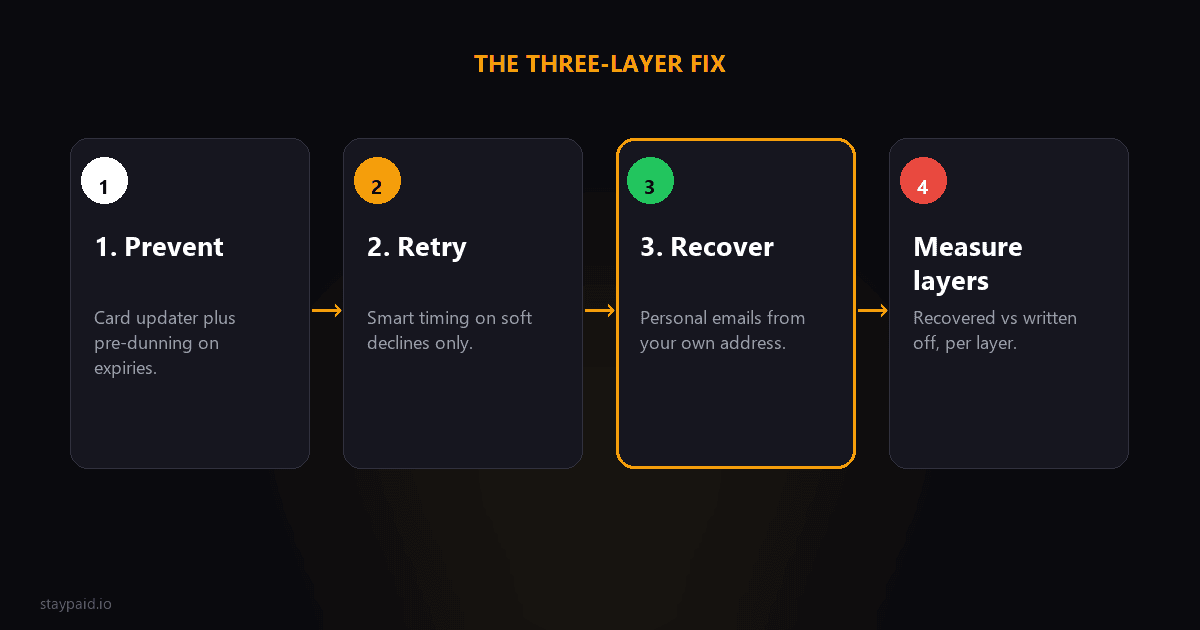
The three-layer answer
Involuntary churn doesn't drop when you buy one tool. It drops when you stack three layers — prevent, retry, recover — and each one catches a slice of the leak the previous one missed.
The reason a single fix fails is that involuntary churn isn't one problem. It's expired cards, reissued cards, insufficient funds, banks being moody, and customers who simply don't know they owe you money. No one layer catches all of those. Three, working in order, catch most of them.
This is the mental model I keep coming back to: each layer is a filter, and the revenue that gets past one gets caught by the next. Prevention stops it before it fails. Retry catches the ones that only needed time. Recovery brings back the ones that needed a person. Stack the filters and the leak shrinks fast.
Layer 1: Prevent — stop the failures that shouldn't happen
The first place to attack is the failures that are avoidable in the first place. Two fixes cover the biggest chunk:
- •Card account updates — Visa and Mastercard run updater programs that automatically push a customer's new card number to merchants who are enrolled. Stripe's automatic card updates wire this in, so a reissued card renews silently instead of failing. I dig into what it does — and what it can't — in this card updater explainer.
- •Pre-dunning on expiring cards — Stripe won't warn a customer that their card is about to expire. A single pre-dunning email thirty days out gets them to update it before the failure ever happens.
Here's why prevention matters most: it's the only layer that stops the revenue from ever being at risk. A recovered payment still took time and touches to win back. A prevented failure costs nothing.
Layer 2: Retry — catch the soft declines
Not every failure needs a human. Insufficient funds usually clears the next time a paycheck lands. A card at the bank's daily limit might succeed tomorrow. These are soft declines, and the right response is a well-timed retry, not an email — let alone a panic.
This is where Stripe's Smart Retries earn their keep. They check with the card network, estimate when another attempt might succeed, and schedule retries accordingly — typically over a day or two, without you doing anything. The math here is timing beats count: a few retries spaced across the payday cycle recover more than hammering a dead card five times in a day. I break down the full retry timing strategy here.
The rule that makes the retry layer work is knowing soft from hard. Soft declines (insufficient funds, generic decline) deserve retries. Hard declines (expired card, lost card) never get fixed by retrying — they only get fixed by a new card from the customer. Get this backwards and you either annoy banks with pointless retries or give up on payments that just needed one more day. If you're not sure which is which, my decline-code guide sorts it all out.
Layer 3: Recover — personally email the ones who want to stay
After prevention and retries, you're left with the failures that genuinely need a human: the customer whose card truly died, or who simply never saw that anything was wrong. This is the recovery layer, and it's where most founders leave the most money on the table.
The move is a short, personal email from you — your own address, not no-reply@ — telling them their payment failed and giving them a one-click way to fix it. Then a follow-up or two over the next week or two, each warmer than the last. The vast majority of these customers want to stay; they just need to know their card broke. Actual email copy you can steal lives in my dunning templates post.
The sequence is short on purpose: first email states the problem and gives the fix link. A few days later, a second email reminds them what they'd miss. A week after that, if it's still unresolved, a final warm email that makes clear their access will pause if they don't update the card. Nothing robotic, nothing scary — just a person checking in a few times. It's the single highest-impact layer, because it's the one that turns a technically lost customer back into a paying one.
"Nobody leaves a SaaS because their card expired. They leave because nobody told them, and the silence felt like the product was gone. A short personal email fixes most of it."
How to measure each layer's contribution
Setup is only half the job. If you don't know which layer is doing the work, you can't double down where it matters — or notice when one silently breaks. Split your failed payments into two buckets for every billing cycle:
- •Recovered — payments that eventually succeeded, and which layer caught them (prevented before failure, retried, or recovered by email)
- •Written off — the ones you gave up on, which become involuntary churn
That split tells you exactly where to invest. If most of your recovery comes from layer 1, your pre-dunning and updater coverage are carrying the load. If layer 3 recovers almost nothing, your emails aren't landing — fix the sender name before the copy. And don't keep pursuing a customer forever; there's a sane point to write a payment off, and it's worth having a rule for it.
A spreadsheet is enough to start — one column for each failed payment, one for which layer fixed it or none. After three billing cycles you'll have real signal instead of a guess. That's the difference between a founder who's optimizing and one who's just hoping.
The start-this-week order
You don't have to build all three layers at once. Here's the order that gets you the fastest return with the least setup, and I'd stack it across a single week:
- •Day 1 — turn on Stripe automatic card updates (twenty minutes, free)
- •Day 2 — set up pre-dunning so customers update expiring cards before they fail
- •Day 3 — confirm Smart Retries are on and stop emailing during the retry window
- •Day 4 — build one personal recovery email from your own address with a clear update-card link
- •Day 5 — add a follow-up email a few days later, then start staging what your recovery sequence looks like
That's it. No infrastructure. No code. Just five small moves that, together, plug most of the involuntary leak. You'll see the effect in a billing cycle or two, and every failure you prevent is revenue you never had to fight for. The work gets progressively easier from here, too — once the layers are in place, maintaining them is a few minutes a week, not a project.
The thing that makes the whole stack stick is keeping the human touch at the end of it. That's why StayPaid is built the way it is: the mechanics — updater coverage, retry timing, tracking — run automatically, but the recovery emails go out from your address, reviewed by you, with a P.S. note where it matters. The robots stop the bleeding. You're the one who actually keeps the customer — and honestly, that's the part customers remember.
FAQ
How do I reduce involuntary churn?
You stack three layers: prevent what you can (card account updates and pre-dunning on expiring cards), retry what's soft (smart retry timing that respects soft-versus-hard declines), and personally recover the rest with dunning emails from your own address. One tool rarely fixes it — the layers together do.
What's the first thing to set up to reduce involuntary churn?
Start with the cheapest, fastest wins: turn on Stripe's automatic card updates so reissued cards fail silently no longer, then set up pre-dunning so customers update expiring cards before they fail. Both take under an hour and attack the two largest causes of involuntary churn first.
Does Stripe handle involuntary churn automatically?
Partially. Stripe's Smart Retries retry failed charges automatically, and automatic card updates refresh some reissued cards. But Stripe won't email your customers from your own address or personally recover someone who wants to stay. That's the gap — the retry layer runs itself, but the recovery layer needs a human touch.
How long before I see results from reducing involuntary churn?
Typically within one to two billing cycles. Recovery shows up when the next renewal happens — if you fix a customer this month, their next charge succeeds and you see it in the following cycle. Prevention (card updater, pre-dunning) compounds quickly too, since every failure you avoid is revenue you never lost.
Keep reading
Robert
Founder at StayPaid
Want to recover failed payments like a founder?
Start Free — First 3 recoveries