Customer Exit Surveys: The Questions That Get Real Answers (and What to Do With Them)
One question, fixed options, optional comment. The exit survey setup that gets honest answers, and how to route each answer into a save or a segment.
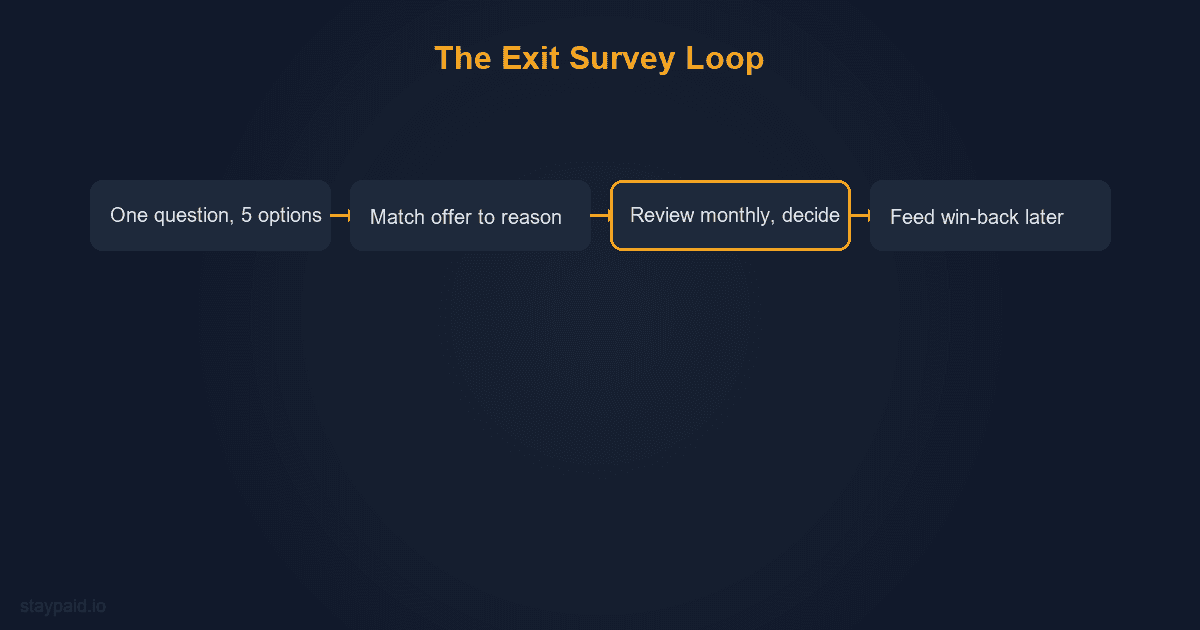
A customer exit survey is one question shown during cancellation: 'What made you cancel?' with fixed options and an optional comment box. Done right, about half of cancellers answer, and their answers tell you which saves to offer, what to fix, and how to win them back later. Done wrong, it is a seven-field form that nobody completes and everyone resents.
This is the survey I wish someone had handed me years ago: the exact question, the answer options that map to real actions, and what to do with each answer type.
The setup: one question, two seconds
Put the question inside the cancellation flow, after they click cancel but before it completes. One tap on a reason, one optional sentence, done. Do not require it. Do not paginate it. Do not ask for a rating, a likelihood-to-recommend, or their role. Every field you add trades response rate for data you will never act on.
The fixed options matter more than the question wording. Free-text-only surveys give you 'too expensive lol' and nothing to analyze. Fixed options give you a distribution: you learn that 40% of churn is price and 25% is 'not using it right now', which is a strategy. Free text gives you anecdotes.
The answer options that map to actions
- •Too expensive. Route to a downgrade or discount save. This reason also clusters before your pricing needs a look, especially if it trends up after a price change.
- •Not using it right now. Route to a pause offer. This is a timing problem, and a 1 to 3 month pause converts many of these into returning customers.
- •Missing a feature I need. Log to the roadmap list with the optional comment as the spec. When you ship it, this is your hottest win-back segment: they told you exactly what would bring them back.
- •Switching to a competitor. Ask which one in the follow-up text. This is your positioning data, straight from the people who voted with their cards.
- •Poor support or a bad experience. Escalate to a human reply within a day. Some of these customers cancel in frustration, not conviction, and a real conversation saves a surprising share.
- •Business closed or no longer needed. Thank them and part well. These are not saves; they are future referrals and boomerang customers. The exit experience is the product they remember.
- •Other, with a comment. The long tail. Read every single one; the surprises live here.
The follow-up question that doubles the value
After the fixed answer, one optional line: 'Anything else? One sentence is plenty.' Keep it optional and keep it small. The founders I know who do this well treat these comments as their highest-signal user research. Nobody performs in an exit survey comment. The politeness filter is off because the relationship is already over, and you get the honest version that active users will not give you.
Read them weekly, in a batch, with the distribution next to them. One painful comment is an anecdote. The same comment three times in a month is a pattern with a fix attached.
Routing answers into saves and segments
The survey is wasted if every answer leads to the same 'sorry to see you go' email. Build three routing rules at minimum. Timing answers trigger the pause offer immediately, inside the flow. Price answers trigger the downgrade path. Everyone else gets the clean, instant cancellation with a confirmation email, because friction you add at the exit converts into disputes and bad reviews, not saved accounts.
Then tag every canceled customer with their reason for the win-back list. A 'missing feature' customer gets an email when you ship it. A 'too expensive' customer hears about the new cheaper tier. A 'not right now' customer gets a note in their stated season. Win-back campaigns with reason-matched messages are a different sport from blasting everyone who ever left with the same 'we miss you' discount.
A quick word on timing and tone
Ask inside the flow, not in an email three days later. The in-flow ask catches people while the reason is fresh and the tap costs them nothing; the follow-up email catches almost nobody, because canceled customers owe you exactly zero attention. If you do send a follow-up, reserve it for the 'poor experience' segment, where a founder personally reaching out can still change the ending.
Tone matters more than tooling. The survey line should read like a person asking, not a form demanding. 'Before you go, mind telling me what pushed you out? One tap.' outperforms 'Please complete our cancellation survey' by an embarrassing margin. This is the same principle that makes human-sounding dunning emails recover more than robot ones: at every exit touchpoint, you are either a person they are leaving or a system they are escaping. Only one of those gets honest answers.
There is one more answer source most founders forget: the customers who never answer anything. Silence is data too. If half your cancellers skip the survey entirely, that usually means the cancel flow is long, the product relationship was already cold, or the ask looks like homework. A high skip rate is itself a finding worth acting on, because the customers who will not even tap a button are telling you the disengagement started long before the cancellation. Pair the survey data with a simple last-active-date pull and you will see it clearly: most churn is visible in usage weeks before it shows up in billing.
Set yourself a review ritual or the data will rot. Fifteen minutes on the first Monday of the month: the reason distribution, the three best free-text comments, and one decision per pattern. Not a committee, not a deck. One decision. 'Price complaints doubled, we are testing an annual discount.' 'Three people asked for the same integration, it goes on the roadmap.' The survey pays rent through decisions, not through dashboards. If a month goes by with no decision from the data, that is the signal to change the question or the options, because the answers have stopped teaching you anything new. Small inputs, sharp decisions, every month: that is the whole system, and it costs you one question and fifteen minutes.
What good looks like after 90 days
You will have a real churn-reason distribution instead of vibes. You will know your top save offer by volume, and whether it works. You will have a roadmap ranked partly by revenue lost, which is the ranking that matters. And your win-back list will be segmented by the exact reason each person left, which is the difference between a campaign and spam.
"An exit survey is not a form. It is your churn problem explaining itself to you, one tap at a time."
One last thing: some customers never tell you why they left, because they never meant to leave. Their card expired, the retries failed, and the subscription quietly died. That involuntary churn will not show up in any survey, and it is the half of the problem StayPaid handles: smart retries plus personal recovery emails sent from your own address. Fix the voluntary half with the survey, the involuntary half with recovery, and you are finally seeing the whole picture.
FAQ
What is a good exit survey response rate?
For a one-question survey embedded in the cancellation flow, response rates around half of cancellers are achievable, because the ask takes two seconds. Email follow-up surveys to already-canceled customers perform far worse, often in the single digits. Ask in the moment, not after.
Should the exit survey be required to cancel?
No, never. Forcing a form before cancellation creates rage, junk data, and in some jurisdictions legal exposure around cancellation friction. Make it one optional tap. You will get slightly fewer answers and infinitely better ones.
How many questions should an exit survey have?
One core question with fixed answer options, plus one optional free-text follow-up. That is the entire survey. Every additional question costs you more responses than the extra data is worth. If you want depth, invite a call after, do not stack fields.
What do I do with exit survey answers?
Route them. Timing problems get a pause offer, price problems get a downgrade or discount conversation, missing features go to the roadmap list, and everyone gets tagged for the right win-back segment later. An answer you do not act on is worse than not asking.
Keep reading
Robert
Founder at StayPaid
Want to recover failed payments like a founder?
Start Free — First 3 recoveries