Win-Back Emails for Canceled Subscribers: The Sequence That Starts at customer.subscription.deleted
Cancellation isn't the end. The win-back sequence triggered by customer.subscription.deleted — timing, tone, and the discount trap.
The 30-second answer
A win-back sequence is 2-3 emails sent after someone cancels: a same-day 'sorry to see you go' that keeps the door open, a check-in a week or two later, and optionally one final offer around day 30. The technical trigger is Stripe's customer.subscription.deleted webhook. The whole thing works because cancellation is often a moment, not a verdict — people cancel to pause spending, to test life without you, or in a moment of frustration that passes.
Most SaaS companies put all their email energy into dunning — the pre-cancel sequence — and send nothing after the cancellation except maybe a robotic 'your subscription has been canceled' receipt. That's leaving the cheapest reactivations on the table. These people know your product, already trusted you with money once, and cost you zero acquisition dollars to email.
Dunning ends where win-back begins
Worth being precise, because these two get confused constantly. Dunning runs while the subscription is alive but the payment is broken — you're recovering a failed charge. Win-back runs after the subscription is dead — you're recovering a relationship. Different moment, different psychology, different email. A dunning email says 'fix your card.' A win-back email says 'here's why coming back is worth it.' Never mix the two tones; a canceled customer who gets a dunning-style 'payment failed' email just gets annoyed.
The trigger: customer.subscription.deleted
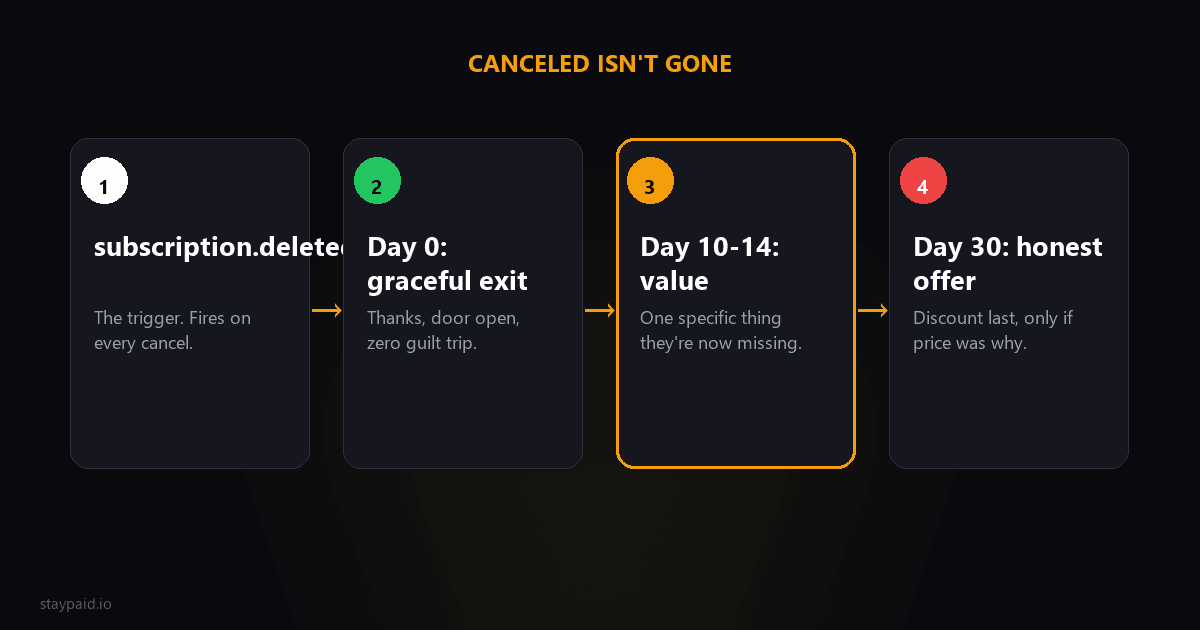
Stripe fires customer.subscription.deleted whenever a subscription actually ends — customer clicked cancel, you canceled them, or a dunning flow exhausted itself and Stripe closed it out. Wire your win-back sequence to this event. One implementation note: the event doesn't tell you WHY the subscription died, and the reason matters for tone. Someone you canceled after 14 days of failed payments needs a different email than someone who clicked cancel in a rage. If you can, pass that context through — 'your payment issue resolved?' hits different than 'miss us yet?'
The 3-email sequence
- •Email 1 — same day: the graceful exit. Confirm the cancellation, thank them genuinely, tell them their data/account is safe, and leave one clear door open ('if you ever want back in, it takes one click'). No guilt trip, no exit survey wall, no 'BUT WAIT.' This email isn't trying to win them back today — it's making sure the last impression isn't sour.
- •Email 2 — day 10-14: the value reminder. One specific thing they're now missing, framed as their benefit, not your loss. 'Your dashboard had 3 months of history in it' or 'the report you used to run monthly.' If you've shipped something relevant since they left, this is where it goes. Short email. One link back.
- •Email 3 — day 30-ish: the honest offer. If you're going to offer anything — a discount, a month free, a plan downgrade — it happens here and only here, and ideally matched to why they left. Price-sensitive canceler gets the annual discount. 'Not using it enough' canceler gets the cheaper tier. After this email, stop.
Three emails, then done. A win-back sequence that runs forever isn't a sequence, it's a drip campaign for people who already said no, and it burns the goodwill email 1 earned.
The discount trap
The instinct is to lead with money: 'Come back for 50% off!' Resist it. Customers learn fast. If canceling reliably produces a discount email, you've just built a coupon machine that charges your most loyal customers full price for the crime of not quitting. Discounts in win-back are a scalpel: deployed once, at the end, at people whose stated reason was price. Everyone else gets reminded of value, not offered a bribe.
"A win-back email isn't a sales pitch to a stranger. It's a note to someone who already chose you once and might, with a small nudge, choose you again."
What NOT to do
- •Don't send the generic win-back sequence to failed-payment churners. Someone who was canceled for non-payment needs 'your card issue is sorted, want back in?' — not 'we miss you.'
- •Don't ask 'why did you leave?' in every email. One exit question, once, is research. Asking repeatedly is neediness.
- •Don't fake urgency. 'Your account is being deleted in 48 hours!' when it isn't — customers check, and liars don't get second chances.
- •Don't keep emailing past the sequence. Someone who didn't bite on three well-timed emails isn't going to bite on the ninth. Move them to the newsletter list and let time work.
The meta-rule: you lost this customer once already. Every win-back email is graded on whether it respects that fact. Entitled, pushy, or dishonest emails confirm the cancel decision. Useful, honest, light-touch emails reopen it. You're asking for a second chance, not demanding one.
Measuring win-back without lying to yourself
Win-back has a measurement trap: some canceled customers would have come back anyway, emails or not. If you credit every reactivation to your sequence, you'll over-invest in it. The honest check: compare reactivation rates between canceled cohorts that got the sequence and earlier cohorts that didn't. Even a rough before/after beats counting every return as a win. If you have the volume, hold out a small slice of canceled customers from the sequence for a cleaner read.
Also decide what counts. A reactivation that churns again in 6 weeks is a different outcome than one that sticks for a year. If your win-back emails bring back chronic cancelers, the sequence isn't winning — it's borrowing. The fix is usually in email 2: the value reminder should be specific enough that people return for a real reason, not just because you asked nicely. Track 90-day retention of win-backs separately from organic reactivations.
One more number worth watching: reply rate. Win-back emails from a founder address get replies — 'loved the product, just tightening budget' — and those replies are roadmap gold. A sequence that generates conversations is doing work even when it doesn't generate reactivations. I read every one of those replies, and more than one has turned into a reactivated account within the week, sometimes with an apology note attached.
What actually goes in the emails
- •Write like a person, from a person's address. 'Robert from StayPaid' beats 'The Team' and anything from noreply@. These are former customers — they know there's a company in there.
- •One ask per email. Reactivate link OR feedback question OR offer. Never all three.
- •Reference their actual usage if you can. 'You ran 14 recoveries' beats 'you were a valued customer.' Specificity proves you noticed them as an individual.
- •Make reactivation genuinely one click. If coming back requires re-entering card details, re-picking a plan, and re-answering onboarding questions, your win-back email is marketing for your signup flow's abandonment rate.
A confession to close: I think about win-back a lot because StayPaid lives one step earlier in this story. Most of what we recover is the pre-cancel stuff — failed payments that would have become cancellations. But the same philosophy applies on both sides of the line: human email, sent from your real address, timed to the actual event, one clear ask. Whether someone is mid-dunning or three weeks post-cancel, the email that works is the one that reads like it came from a founder who noticed. Because it did.
FAQ
What is a win-back email sequence?
A short series of emails sent after a customer cancels, aimed at bringing them back. Unlike dunning (which runs while they're still subscribed), win-back starts after cancellation and focuses on the reason they left.
When should you send win-back emails after a cancellation?
A common cadence: a same-day confirmation that keeps the door open, a check-in around 1-2 weeks later, and a final offer around day 30. After that, move them to your regular newsletter list or leave them alone.
Should win-back emails offer a discount?
Only as a last step, and only if price was why they left. Leading with a discount trains customers to cancel for a better deal and cheapens the product for everyone who stayed.
What trigger starts a win-back sequence in Stripe?
The customer.subscription.deleted webhook event. It fires when a subscription is canceled — whether by the customer, by you, or at the end of a failed dunning flow — and it's the natural trigger for the first win-back email.
Keep reading
Robert
Founder at StayPaid
Want to recover failed payments like a founder?
Start Free — First 3 recoveries