Reactivation Campaigns: How to Bring Back Subscribers Who Lapsed on a Failed Payment
Reactivation campaigns for payment-lapsed subscribers: the timing windows, the offer ladder, and why lapsed churn converts better than cancels.
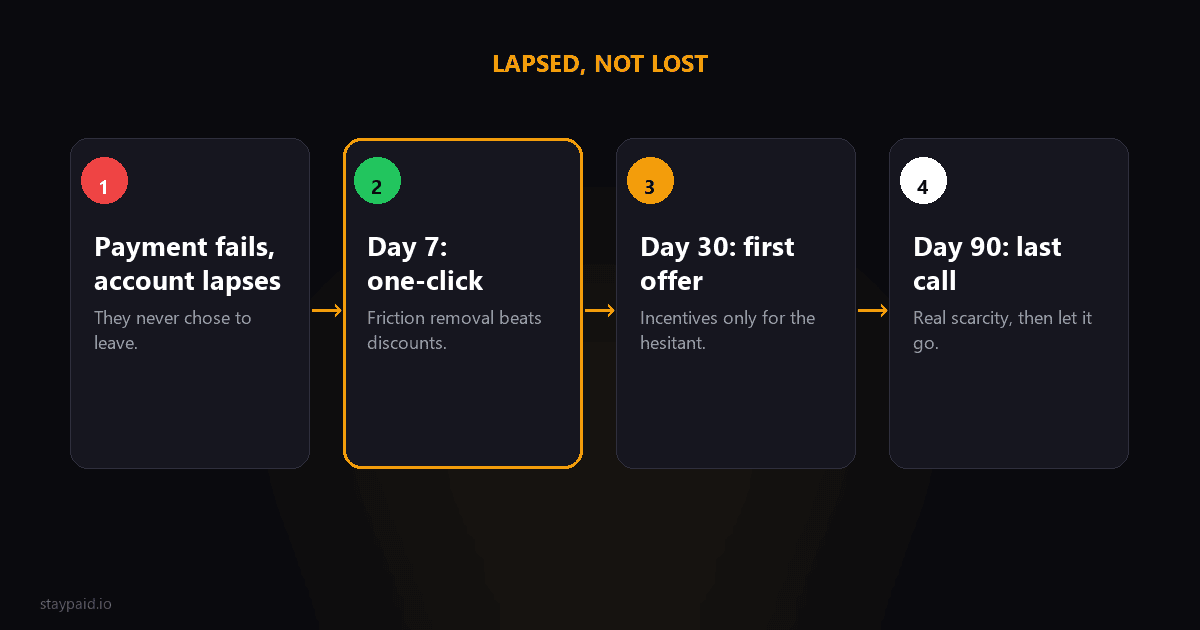
A reactivation campaign is the sequence you run after a subscription has already lapsed, to bring the customer back. Done right, it is one of the cheapest growth channels you have: these people already bought once, and the ones who lapsed on a failed payment never even decided to leave.
Most guides mash reactivation and win-back into one topic. They are different games, and mixing them up is why most campaigns underperform. Let's separate them properly, then build the actual campaign.
Lapsed vs cancelled: know who you are emailing
A cancelled subscriber made a decision. Something about the product, price, or their situation said "leave." Getting them back means changing that decision, which is persuasion.
A lapsed subscriber made no decision. Their card declined, the retries failed or never ran right, and the account quietly died. A large share of them still think of themselves as customers. Some do not even know the subscription ended until they hit a locked feature. Getting them back is not persuasion, it is friction removal.
Segment your lapsed list by this distinction before you write a single subject line. The two groups need different messages, different offers, and they convert at wildly different rates. Lapsed-on-payment subscribers are your gold: highest intent, zero persuasion needed.
The timing windows
Reactivation response rates decay fast, so the campaign front-loads the effort:
- •Day 3 to 7: the gentle nudge. "Your subscription lapsed, here's a one-click link to restore it." No discount, no drama. This touch converts the people who never noticed the failure, and it converts them at full price.
- •Day 14: the value reminder. What they are missing, what is new, what their data/history in the product is doing. Still no discount. You are rebuilding desire, not buying it.
- •Day 30: the first offer. Now a small incentive is fair game: a free week, a percentage off the next period. The full-price responders already responded; this touch prices in hesitation.
- •Day 60 to 90: the last call. Honest framing: "we'll stop emailing about this after today." Scarcity is real here, not manufactured, and it closes a final slice.
After the last call, move them to your general newsletter list and stop. A reactivation sequence that never ends is just spam with extra steps.
The offer ladder
The counterintuitive rule: your best offer is not a discount. For lapsed subscribers, the strongest lever is a link that restores everything in one click, account intact, history preserved, just add a working card. Convenience first. Discounts are the second rung, for the people convenience did not move. Deep discounts are the last rung, and honestly, if someone needs 50% off to return to a product they used daily, let them go.
Why this order matters: every discount you give a customer who would have returned at full price is margin you donated. Running the ladder cheap-to-expensive means each incentive only ever goes to the subscribers who actually needed it.
The message that works for lapsed churn
For the payment-lapsed segment, the tone is "something broke, here's the fix," never "please come back.":
"Your subscription lapsed a few days ago when the renewal payment didn't go through (banks, honestly). Your account and everything in it is still intact. If you want it back, this link restores it in about 30 seconds: [link]. No hard feelings either way."
Three things that message gets right. It names the actual cause so they do not wonder if you cancelled them. It leads with their stuff being safe, which is the real anxiety. And the "no hard feelings" close removes pressure, which is exactly what makes people click. Desperation is a repellent; calm confidence converts.
Segmenting by value and by lapse reason
Two more cuts sharpen the campaign. First, segment by plan value. A lapsed $299/month customer deserves a personal note from you, not a template, and maybe a direct offer to jump on a call. A lapsed $9/month customer gets the automated sequence and that is fine for everyone. Effort should scale with what a recovery is worth.
Second, segment by why they lapsed, because it changes the message completely. A card that expired is an admin task: "new card, 30 seconds." A string of do_not_honor declines suggests their bank never approved you, so lead with "a quick call to your bank fixes this." A customer whose payments failed right after a price increase is not a payments case at all; they hesitated at the new price, and the reactivation offer should address value, not billing. One campaign, three different first emails.
What happens after they come back
Reactivated customers are not finished work, they are a fragile cohort. Their second-tenure churn runs higher than average, because something already broke the relationship once. Two cheap moves protect them. Get a backup payment method on file during the restore flow, framed as "so this never happens again." And send one genuine check-in a few weeks later, not a survey, a human note. The customers who feel remembered after a lapse often become the most loyal segment you have; they have seen how you handle things going wrong.
The metric that tells you it's working
Track reactivation rate by days-since-lapse cohort: what percent of people touched at day 7 came back, versus day 30, versus day 90. Two things usually jump out. First, the early touches carry most of the total, confirming the decay curve. Second, the payment-lapsed segment outperforms the cancelled segment by multiples. If your own data shows anything like that, the conclusion writes itself: the highest-leverage move is not a better reactivation campaign, it is not letting payments lapse in the first place.
Deliverability: the part that decides everything
None of the above matters if the emails land in spam, and lapsed lists are deliverability landmines. Addresses decay fast after a lapse; people abandon mailboxes. A few rules: prune anyone whose last three touches bounced, never blast the whole lapsed list in one send (warm up in batches so a bad batch does not torch your sender reputation), and send from the same address your normal customer email comes from so the reputation carries over. If you have not emailed these people in six months, consider verifying the list before the first send.
On subject lines for this segment, boring beats clever. "Your [product] account lapsed" outperforms every witty variant I have tried, because the reader's only question is whether this concerns something they care about. Clever makes them decide if they are interested; boring tells them exactly what happened.
And one honest caveat: reactivation is a salvage motion, not a growth strategy. If your lapsed list is growing faster than you can reactivate, the campaign is not the problem; the leak upstream is. Fix the recovery layer, keep the campaign for the stragglers, and let the lapsed list shrink to what it should be: a short list of people worth one more good email.
That is the honest pitch for handling recovery properly before it becomes reactivation. StayPaid exists for exactly that: it catches failed renewals, retries them sanely, and emails customers from your real address while the relationship is still alive. Reactivation campaigns are for the ones that got away. Good recovery means far fewer of them ever do.
FAQ
What is a reactivation campaign?
A planned sequence of messages and offers aimed at customers whose subscription ended, designed to bring them back. For payment-lapsed churn specifically, it picks up where dunning stops: the retries failed, the account closed, and now you are running a timed win-back motion instead of a live recovery one.
How is reactivation different from win-back?
Timing and intent. Win-back usually targets customers who actively cancelled (a decision you need to reverse). Reactivation in the payment sense targets subscribers who lapsed involuntarily: their card failed, they never chose to leave. The message is completely different because there is no decision to argue against.
How long after a lapse should I wait before reactivation emails?
Start fast, then slow down. A light touch at day 3 to 7 ("your account lapsed, one click to restore"), a stronger offer around day 30, and a final last-call message around day 60 to 90. Response rates decay steeply with time, so the earliest touches carry the most value.
What offer works best for reactivating lapsed subscribers?
For payment-lapsed churn, friction removal beats discounts: a one-click link that restores the account and collects a working card outperforms coupon codes. Save discounts for the day-30+ stage. For customers who actively cancelled, the offer has to answer why they left, which is a different playbook.
Keep reading
Robert
Founder at StayPaid
Want to recover failed payments like a founder?
Start Free — First 3 recoveries