Failed Payment Recovery: What It Is and How to Actually Do It
What failed payment recovery actually means, why 5-10% of your renewals fail every month, and the four-lever system that gets 50-70% of it back.
What failed payment recovery actually is
Failed payment recovery is everything you do after a subscription charge gets declined: retrying the card, telling the customer, giving them a way to fix it, and measuring what came back. It's the difference between losing that revenue silently and getting most of it back.
Here's the part most founders miss. Failed payments aren't an edge case. For a typical SaaS, somewhere between 5 and 10 percent of renewal charges fail in any given month. At 200 customers paying $50, that's $500 to $1,000 at risk every single month. Not hypothetically. Every month, on repeat.
And the failure usually isn't the customer's decision. Their card expired. Their bank flagged a weird charge. They hit a limit. Payments industry data from companies like Recurly and ProfitWell has consistently put involuntary churn at roughly 20 to 40 percent of total churn. These are customers who want to pay you and currently can't. Recovery is just removing the friction between them and your bank account.
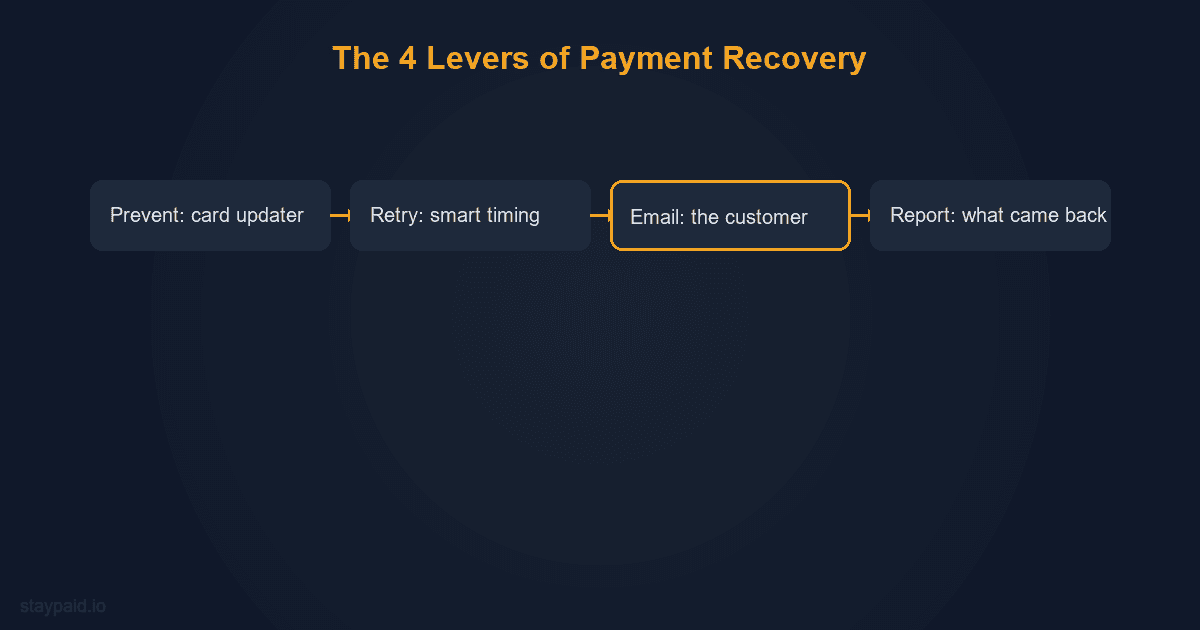
The four levers of recovery
Every failed payment recovery system, from a founder with a spreadsheet to enterprise software, pulls the same four levers. The only difference is how many of them you pull and how well.
- •Prevention. Card updater services (Visa and Mastercard run them, Stripe taps into them) quietly refresh expired card numbers before the charge ever fails. This is the cheapest lever because it stops failures upstream.
- •Smart retries. Charging the card again at better times. A card declined for insufficient funds on the 1st might clear on the 15th. Retry timing matters more than retry count.
- •Customer emails. Telling the customer their payment failed and handing them a one-click fix. This is where most recovered revenue actually comes from, and where default tooling is weakest.
- •Reporting. Knowing how much failed, how much came back, and what's still at risk. Without this you're guessing whether the other three levers work.
If you take one thing from this post: emails beat retries. A retry asks the same broken card to work again. An email gets the customer to give you a working card. The best systems do both, in the right order, without you babysitting either.
The math: what recovery is worth to you
Run your own numbers. Take your subscriber count, multiply by average monthly revenue, multiply by your failure rate. That's your monthly at-risk number. Now multiply by 12. That's the annual leak if your recovery rate is zero.
Concrete example. 300 subscribers at $40 average MRR is $12,000 a month. At a 7 percent failure rate, $840 is at risk every month, about $10,000 a year. Stripe's defaults might claw back a quarter of that through retries alone. A real recovery setup, good emails plus smart retries plus card updater, typically gets 50 to 70 percent. The gap between default and done-right on these numbers is roughly $2,500 to $4,500 a year. For a tool that costs $348 a year flat, that trade isn't close.
If you want your exact number instead of my example, our free churn calculator takes your customer count, MRR, and failure rate and shows the annual leak in dollars. Thirty seconds, no email required.
What Stripe gives you out of the box
Stripe is not nothing. Smart Retries uses Stripe's data across millions of transactions to pick retry times, and it's genuinely good at that one job. You can also flip on basic failed-payment emails in your Stripe settings. For a brand-new SaaS with 30 customers, this is honestly enough.
The limits show up as you grow. The default emails come from Stripe's address, look like receipts, and can't carry your voice. You can't change the copy, add a personal note, or see a clean report of what recovered versus what's still bleeding. Smart Retries optimizes the charge. Nobody optimizes the customer.
There's also a subtle gap most founders only discover later: Stripe's recovery flow and your app's access logic don't talk to each other by default. Stripe retries in the background while your app still serves the customer, or worse, cancels them on the first failure if you wired the webhooks naively. Recovery works best when retries, emails, and access state move together as one system, and that coordination is the part defaults leave to you.
The recovery sequence that actually works
After watching this flow across a lot of subscription businesses, the shape that works is boring and consistent:
- •Day 0: charge fails. Retry in the background. Do NOT email yet if the decline looks like a soft bank issue that a retry will fix. Don't cry wolf to the customer over nothing.
- •Day 1 to 3: if retries haven't cleared it, first email. Short, human, one clear link to update the card. This email recovers more revenue than everything else combined.
- •Day 5 to 7: second email with a touch more urgency. Access mention, not threat. Meanwhile retries continue at smart intervals.
- •Day 10 to 14: final email. Plain language: subscription cancels on this date unless the card updates. Most people who will act have acted by now.
- •After that: cancel gracefully, keep the door open, and count it. Write-offs are data too.
Two details separate good recovery from spam. First, the emails should come from you, a human, at your company's address. Not no-reply@. People fix cards for people. Second, every email needs exactly one job and one link. The moment your recovery email also tries to upsell an annual plan, you've lost.
The mistakes that kill recovery rates
Same levers, wildly different results. The gap is almost always one of these:
- •Emailing from no-reply@. Recovery is a conversation. Messages from a robot address get the engagement a robot deserves.
- •Retrying at the same time every day. If the bank declined at 3am on the 1st, 3am on the 2nd probably looks the same to them. Vary retry timing across days and hours.
- •Waiting too long for the first email. Every day of silence makes the customer colder. The first touch should land within a few days of the failure, not after two weeks of background retries.
- •Making the customer log in to fix the card. Every extra step loses people. A direct, signed update link beats a settings page behind a login wall.
- •Cancelling access instantly. Cut someone off on day one and you've removed their reason to pay. Grace periods recover more revenue than walls.
None of these are technical problems. They're respect problems. Recovery emails work when they read like a person who noticed a problem and wants to help, not a system generating a demand.
When to DIY and when to get a tool
Under roughly 50 paying customers, do it yourself. A Stripe email filter plus a personal note from the founder converts better than any software. I did this myself and the reply rate was almost embarrassing. People are not used to a founder noticing their card declined.
Somewhere between 50 and 200 customers, manual breaks. Failures go from monthly to weekly. You forget one, then three. That's the moment to systematize. And yes, this is the part where I mention StayPaid: it runs exactly the sequence above, retries plus human-sounding emails sent from your own address, with a founder-in-the-loop option so you approve what goes out. Flat $29 a month, no percentage of your recovered revenue. But tool or no tool, the four levers don't change. Pull all four and you keep money that was already yours.
FAQ
What is failed payment recovery?
The process of getting a declined subscription payment to go through: retrying the charge, emailing the customer to update their card, and tracking how much revenue comes back.
What is a good failed payment recovery rate?
Well-run recovery setups get 50 to 70 percent of failed payments back. Stripe's default settings alone typically land closer to 20 to 30 percent, because retries without good customer emails leave money on the table.
Does Stripe recover failed payments automatically?
Partially. Stripe Smart Retries re-attempts the charge and Stripe can send a generic failed-payment email. It does not send emails from your address, let you write your own copy, or give you real recovery reporting.
How long should failed payment recovery take?
Most recoverable payments come back within 7 to 14 days of the first failure. After two to three weeks of retries and emails with no response, the revenue is usually gone and you're deciding whether to cancel the subscription.
Keep reading
Robert
Founder at StayPaid
Want to recover failed payments like a founder?
Start Free — First 3 recoveries