Failed Payment Recovery Rate: What's Actually 'Good' for an Indie SaaS?
Everyone claims 70%+ recovery rates. Here's what recovery rates really look like for small SaaS — and the levers that move yours.
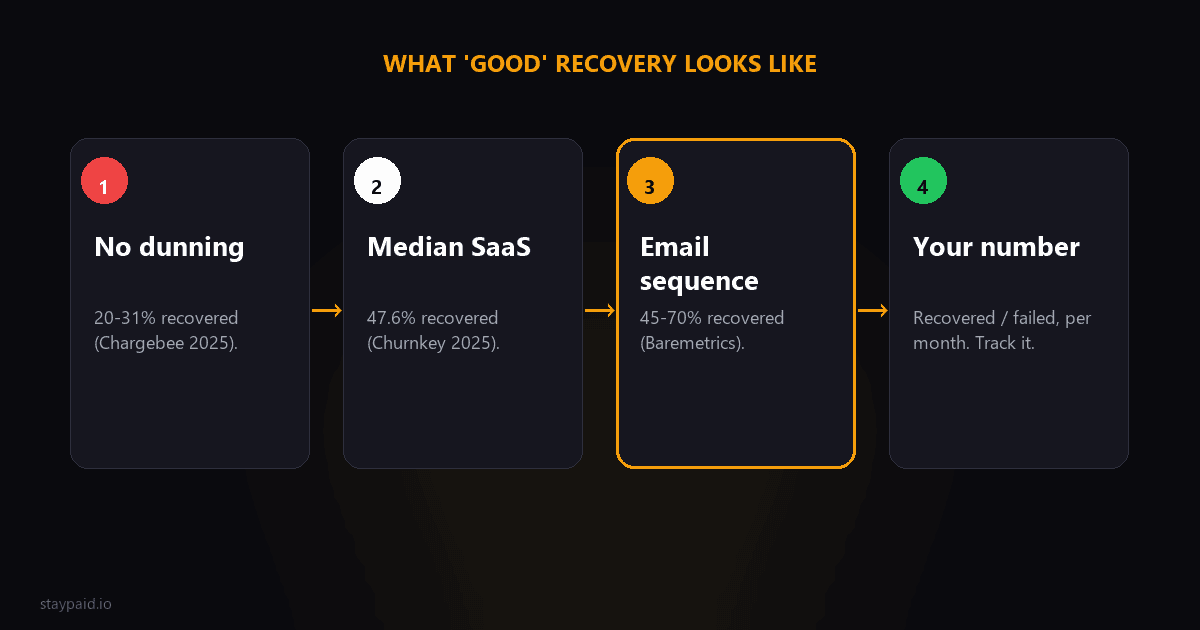
Is a 47% recovery rate good enough for your SaaS? For most indie founders, yes — that’s around the median, and it’s a lot better than the nothing most bare-bones setups recover. But the honest answer is that “good” depends on what you’re doing to chase the money, and the heroic percentage on a vendor landing page is not the number to measure yourself against. Here’s what the benchmarks actually say, how to calculate yours, and where you probably sit today.
Why everyone quotes a different number
Spend an afternoon reading recovery-rate marketing and you’ll see 70%, 80%, even 90%-plus. None of it is lying, exactly. It’s all measuring different things. Some vendors count a mechanical retry success as “recovered by us.” Some exclude failures that would have sorted themselves out anyway. Some measure revenue recovered, some measure count of customers, some measure only the customers who explicitly click a link. Your own failed payments are a mix of hard declines, soft declines, expired cards, and people who just didn’t update their card. How you count those dramatically changes the number. Before you panic-compare your figure to anyone’s case study, decide what you’re actually measuring.
The sourced numbers, and how to read them
There are real numbers out there, and they’re all vendor-reported, so take the usual grain of salt. But they’re the best publicly available benchmarks, and three of them roughly agree with each other:
- •The median failed-payment recovery rate is about 47.6% — that’s from Churnkey’s State of Retention 2025, and it’s the closest thing to “what the middle of the pack does.”
- •Companies with no dunning automation recover about 20–31% of failed payments — from Chargebee’s 2025 benchmark. That’s your floor if you’re doing nothing structured.
- •A 4-email dunning sequence typically recovers 45–70% — from Baremetrics. Notice how that range overlaps the median — emailing people a few times is the single biggest, cheapest lever you have.
- •Payment failure rates run 5–15% on first attempt — from GoCardless. That’s the size of the pond before any recovery happens.
The takeaway from these four numbers: doing nothing leaves 70–80% of that 5–15% on the table, and a basic email sequence pulls most of it back. The gap between “no automation” and “a few decent emails” is huge. The gap between “a few emails” and “the top of the 45–70% range,” meanwhile, is all craft — timing, sender, and voice.
How to calculate your own number
The formula is simple: recovery rate = recovered failed payments ÷ total failed payments. Pick a period (a month is good), count every payment that initially failed, then count how many of those customers eventually paid — whether through an automatic retry, a card update, or an email follow-up. Divide and you’ve got your rate.
- •Say 40 payments failed last month.
- •Between Stripe’s smart retries and your emails, 19 of those customers paid.
- •19 ÷ 40 = 0.475, so your recovery rate is 47.5%.
- •At a $30/month average plan, that’s 19 × $30 = $570 recovered each month, or $6,840 a year — just from not giving up on the first attempt.
Double-check my math if you want — I did. The point is that the same formula works whether you recover two of twenty or two hundred of four hundred. Track it monthly and you’ll see which changes actually move the needle, instead of guessing from a dashboard.
The trap is inconsistency. If you count “recovered” as a payment that came in within 48 hours of a retry, you’ll always look better than someone who counts “recovered” as a customer who paid at any point in the next 30 days. Pick one definition, write it down, and use it every single month. A low number you can trust beats a high number you can’t reproduce — you can only improve what you can actually see.
Why your number looks low even when you’re doing fine
Before you jump to “my emails are broken,” check these. They’ll quietly crush a recovery rate that has nothing to do with your dunning:
- •Your failure mix. Hard declines — stolen or invalid cards — are essentially unrecoverable, and if your customer base skews that way, your ceiling is lower no matter what you do. Don’t compare your hard-decline-heavy book to a vendor’s soft-decline-heavy case study.
- •Plan type and ticket size. A $9 consumer plan and a $5,000 annual B2B contract recover at completely different rates. Compare yourself to your own last quarter, not to an aggregate median.
- •When you send. An email a week after a failed charge is a different tool than an email within the hour. Timing quietly moves your number as much as crafting does.
- •How you count a win. Did a retry that auto-succeeded count as “recovered” or as “never failed”? That choice alone can swing your reported rate by ten points.
Where you probably are right now
Be honest with yourself. Most indie SaaS founders I talk to are accidentally in one of these buckets:
- •The “Stripe does it” bucket — you rely on smart retries and nothing else. Realistic recovery: the 20–31% Chargebee floor. Dead cards stay dead, and you never email anyone.
- •The “handful of emails” bucket — you set up a basic dunning sequence and forgot about it. Realistic recovery: the 45–70% band, depending on how good those emails are.
- •The “founder actually reviews this” bucket — a human reads the failures, writes a personal note, and sends it as a person rather than an autoresponder. Realistic recovery: the top of that Baremetrics range, because you recover the customers, not just the charges.
If you’re at 20–30%, the fix is almost always “email people a few times.” If you’re at 45% and stuck, the fix is usually voice and speed, not more emails. That diagnostic is worth more than any single benchmark.
The three levers, ranked by what they’re actually worth
- •Retry-only: banks approve a surprising share of automatic retries, but this caps out fast. You’ll never clear the 20–31% floor with retries alone.
- •Retry plus a designed email sequence: this is where recovery jumps toward 45–70% (Baremetrics). Speed matters — an email within an hour of the failure beats one a week later — and so does a single, working card-update link.
- •Retry plus founder-personalized follow-up: same timing, but sent from a person, with a real P.S. These pull in the hesitant customers who ignore the robo-billing-department tone. It doesn’t need to be every single one — one human touch on your churniest plans goes a long way.
I’ve seen founders obsess over retry timing and smart-retry windows while half their customers never get one email. That’s backwards. The cheapest, fastest jump in your recovery rate is almost always just emailing people — quickly, and like a human.
"Your recovery rate isn’t a grade. It’s a diagnostic. Low number, high effort? Your emails are the problem. High number, low revenue? Your failures — the ones you never saw — are the problem."
The only benchmark that matters
Vendor medians are useful context, not a target. A 47.6% median includes B2B enterprise AR teams with card updaters and CS reps; it’s not where you’re graded. Compare yourself to your own last quarter. If this month beat last month, you’re winning — whether the absolute number is 31% or 62%. These are vendor-reported figures on top of that, so treat them as honest ranges, not gospel.
StayPaid puts your recovery rate, revenue recovered, and churn prevented right on the dashboard — calculated from your real Stripe data, with a founder in the loop on the emails that go out. Because the benchmark that matters isn’t anyone else’s — it’s whether you got more of your own customers back this month than last.
FAQ
What is a good failed payment recovery rate?
Medians sit around 47.6% for recovery-focused companies (Churnkey). A 4-email dunning sequence typically recovers 45–70% (Baremetrics), while businesses with no automation at all recover roughly 20–31% (Chargebee). Most small SaaS founders land somewhere in the 30–50% band.
How do you calculate payment recovery rate?
Divide recovered failed payments by total failed payments in a given period. If 40 payments failed and 19 customers eventually paid, your rate is 19 ÷ 40 = 47.5%. Just make sure you measure count and revenue consistently, or the number is meaningless.
What is the average failed payment rate for subscriptions?
Industry-wide, 5–15% of card transactions fail on the first attempt (GoCardless). In subscriptions that translates to a constant drip of lost revenue every billing cycle, which is why dunning matters at all.
Does dunning actually improve failed payment recovery?
Yes, measurably. Companies with no dunning automation recover about 20–31% of failed payments (Chargebee), while a simple 4-email sequence can push recovery to 45–70% (Baremetrics). The closest lever to brand-new is just emailing customers at all.
Keep reading
Robert
Founder at StayPaid
Want to recover failed payments like a founder?
Start Free — First 3 recoveries