Annual Churn Rate: How to Calculate It (and Convert Monthly to Annual)
Annual churn rate explained: the formula, the monthly-to-annual conversion table, SaaS benchmarks, and why annual plans change everything.
Annual churn rate, defined
Annual churn rate is the percentage of customers or revenue you lose over twelve months: what you lost during the year divided by what you started the year with. It answers the question every founder eventually gets from an investor, a buyer, or their own anxiety: out of everyone who was paying you in January, how many are gone by December? The formula is simple. The traps around it are not.
You can measure it in customers (logo churn) or in dollars (revenue churn). This post focuses on the calculation itself and the part almost every guide skips: converting between monthly and annual numbers without lying to yourself.
The basic annual churn formula
Annual churn rate equals customers lost during the year divided by customers at the start of the year, times 100. If you began the year with 400 customers and ended with 320 (having added none, to keep the math honest), you lost 80: 80 divided by 400 is 20 percent annual churn.
Real businesses add customers all year, which muddies the simple version. The cleaner approach: track your starting cohort. Of the 400 customers you had on January 1st, how many remain on December 31st? New customers you acquired during the year get their own cohort next year. This is cohort-based churn, and it's the version that doesn't flatter you.
The dollar version works identically. Start-of-year MRR from existing customers versus what that same group pays at year-end, divided down to a percentage. Revenue churn usually runs lower than logo churn for one simple reason: the customers most likely to leave are often the smallest ones. If your revenue churn is higher than your logo churn, that's a red flag worth investigating, because it means your bigger customers are the ones walking out.
One more decision to make before you compute anything: how do you count customers who churn and come back within the year? The honest answer is to count the churn when it happens and count the return as a reactivation, separately. Folding win-backs into the churn number makes it look better and makes it useless. Two clean numbers beat one comfortable one.
Converting monthly churn to annual (the part people get wrong)
The naive move is multiplying monthly churn by twelve. It's wrong for the same reason compound interest works: each month, churn applies to a smaller base. The correct formula is annual churn = 1 minus (1 minus monthly rate) to the power of 12.
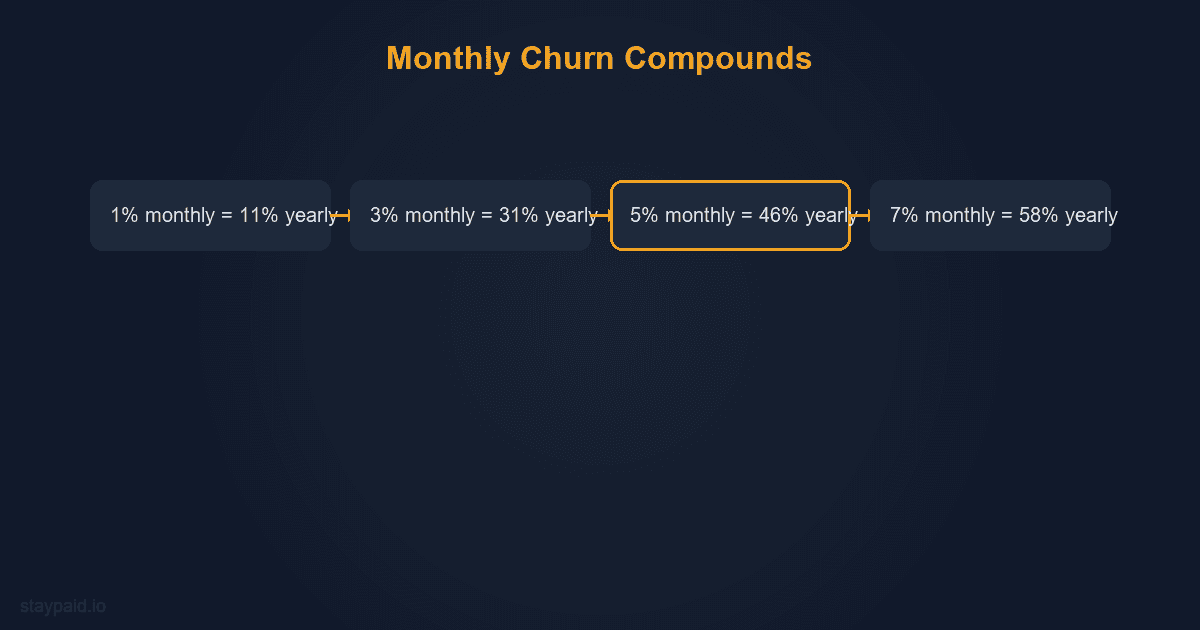
- •1% monthly churn -> 1 - (0.99)^12 = about 11.4% annual (not 12%)
- •2% monthly churn -> 1 - (0.98)^12 = about 21.5% annual (not 24%)
- •3% monthly churn -> 1 - (0.97)^12 = about 30.6% annual (not 36%)
- •5% monthly churn -> 1 - (0.95)^12 = about 46.0% annual (not 60%)
- •7% monthly churn -> 1 - (0.93)^12 = about 58.1% annual (not 84%)
Two takeaways. First, the naive multiplication always overstates annual churn, so if you've been doing it, your retention is better than you thought. Second, look at how savage the compounding still is: a monthly churn rate that sounds small, 5 percent, quietly burns almost half your customer base in a year. Small monthly leaks are big annual holes. This is the math behind every 'we need to fix retention before we scale acquisition' conversation, and now you can run it yourself in ten seconds.
Converting annual churn back to monthly
The reverse matters too, mostly for comparing yourself against benchmarks published in the other unit. Monthly churn = 1 minus (1 minus annual rate) to the power of (1 divided by 12). So a 20 percent annual churn rate works out to about 1.84 percent monthly. A 40 percent annual rate is about 4.17 percent monthly.
Bookmark this one conversion rule: to compare two churn numbers, they must be in the same unit, the same basis (customers vs revenue), and ideally the same cohort logic. Most 'our churn is better than industry average' slides fail at least one of the three.
Common annual churn calculation mistakes
- •Multiplying monthly churn by 12. Churn compounds; the correct conversion is 1 - (1 - m)^12. The naive version overstates annual churn at every rate above zero.
- •Counting customers acquired mid-year in the starting base. Churn should be measured on the cohort you started with, or your growing denominator hides real losses.
- •Mixing customer churn and revenue churn. Losing ten $10 customers and one $1,000 customer is 11 logos but wildly different dollars. Pick a basis and label it.
- •Comparing monthly-plan churn against annual-plan benchmarks. Annual plans can't churn for twelve months, so their 'annual churn' is structurally lower. Different sport.
- •Letting involuntary churn pose as product churn. Expired cards and bank declines land in the same number as rage-quits unless you split them out.
Get these five right and your annual number becomes trustworthy. Skip them and every benchmark comparison, investor update, and retention decision sits on sand.
What's a good annual churn rate for SaaS?
Orientation, not gospel. SMB-focused SaaS commonly sees 20 to 30 percent annual customer churn; under 20 percent is strong for that segment. Enterprise SaaS with multi-year contracts often runs under 10 percent. Consumer subscriptions can be far higher and still be healthy businesses, because acquisition is cheap.
One structural lever dominates the annual picture: annual plans. A customer on an annual plan physically cannot churn for twelve months, so businesses heavy on annual billing show much lower annual logo churn. That's partly real retention (pre-commitment filters for intent) and partly arithmetic. When you compare your annual churn to a benchmark, check whether the benchmark mixes monthly and annual plans. The comparison is meaningless otherwise.
This is also why pushing annual plans is such a common churn play. Offer two months free on annual and two things happen: your annual churn number improves mechanically, and the customers who take it are the ones who intended to stay anyway. That said, annual plans don't fix involuntary churn, they concentrate it. When an annual renewal fails, it's twelve months of revenue failing at once. Annual-plan payment failures need their own recovery playbook, and we wrote one.
The churn that hides inside the annual number
Annual churn has a blind spot: it's slow. You can have a terrible February and not feel it in the annual figure until much later. Worse, a chunk of your churn isn't a decision at all. Payments industry research from companies like Recurly and ProfitWell has consistently put involuntary churn, failed renewals from expired cards and bank declines, at roughly 20 to 40 percent of total churn for subscription businesses.
That slice shows up in your annual number the same as a rage-quit does, but it's not a product problem. It's plumbing. Retries, card updaters, and recovery emails fix it. Before you redesign your onboarding to move annual churn, check how much of it is just declined cards. It's usually the cheapest churn you'll ever recover.
If you don't know your monthly number yet, start there and convert up. Our churn calculator takes customer count, MRR, and churn rate and shows you the annual impact in dollars, thirty seconds, no signup. Annual clarity starts with an honest monthly number.
The monthly-to-annual conversion table
Annual churn compounds, so the conversion is not multiplication. The formula is 1 minus (1 minus monthly churn) to the power of 12. Here is what common monthly rates actually turn into over a year:
- •1% monthly churn = 11.4% annual churn
- •2% monthly churn = 21.5% annual churn
- •3% monthly churn = 30.6% annual churn
- •5% monthly churn = 46.0% annual churn
- •8% monthly churn = 63.2% annual churn
- •10% monthly churn = 71.8% annual churn
The gap surprises people every time. A 5% monthly rate sounds manageable until you realize it means replacing almost half your customer base every year just to stand still. That is why investors ask for the annual number, and why founders who only track monthly churn systematically underestimate their problem.
FAQ
How do you calculate annual churn rate?
Divide customers (or revenue) lost during the year by the number you started the year with, then multiply by 100. To convert a monthly churn rate, use 1 minus (1 minus monthly rate) to the power of 12.
How do you convert monthly churn to annual?
Annual churn = 1 - (1 - monthly churn)^12. A 3% monthly churn rate compounds to about 30.6% annually, not 36% — churn compounds just like interest.
What is a good annual churn rate for SaaS?
For SMB-focused SaaS, 20 to 30 percent annual customer churn is common and under 20 percent is strong. Enterprise SaaS often runs under 10 percent. Annual plans typically churn far less than monthly plans.
Why is my annual churn higher than 12 times my monthly churn?
It usually isn't — compounding makes annual churn lower than 12x the monthly rate, because each month you lose a percentage of a shrinking base. If your measured annual number exceeds the converted one, churn is accelerating, not steady.
Keep reading
Robert
Founder at StayPaid
Want to recover failed payments like a founder?
Start Free — First 3 recoveries