Failed Payment Subject Lines That Actually Get Opened
The subject lines that recover payments share three traits. What they are, the sender-name effect, and 5 examples you can steal.
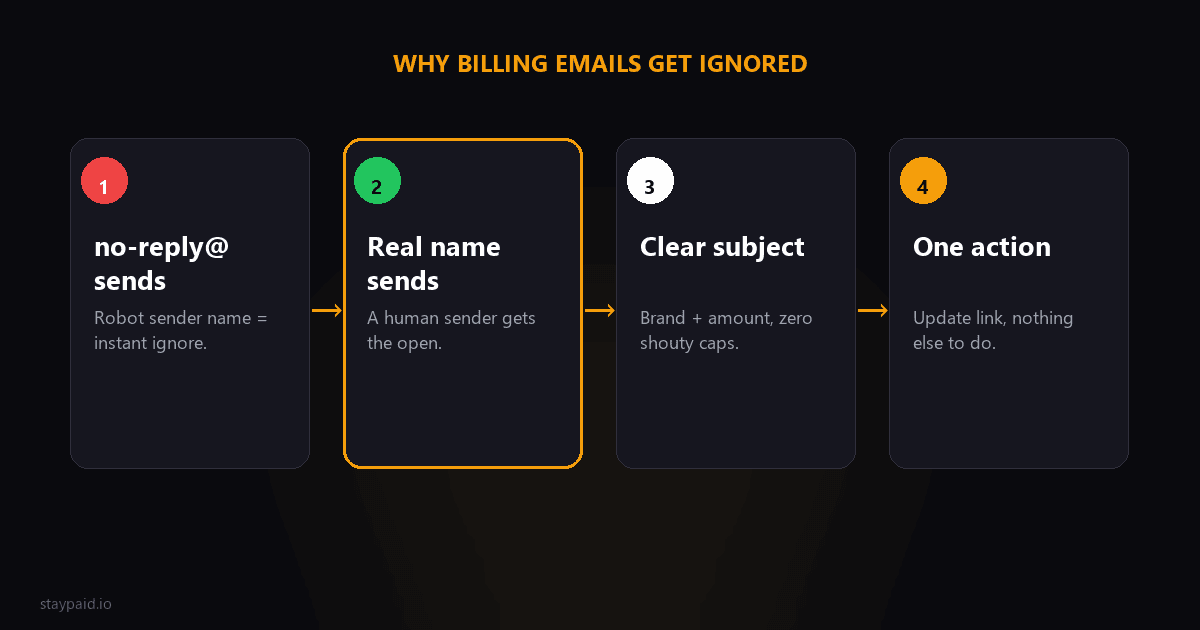
Why your billing emails get ignored
Your failed-payment emails get ignored because they look like robot mail — and the sender name, not the subject line, is what makes people decide that in half a second. Change who it's from and the subject line suddenly has room to work.
Think about your own inbox. A message from no-reply@support.somecompany.com gets one glance, and it lands in the pile you clear without reading. The same email from a real person — someone you've exchanged words with, or at least a founder whose name you recognize — gets treated like a human wrote it. That's not sentimentality. It's how attention works in email.
This is the piece most subject-line advice misses. Every guide drills into word choice and character count, then completely ignores that customers decide whether to open your email before they ever read your subject line carefully. The subject matters. But it's fighting for attention that the sender name has already won or lost.
The sender name and preview text come first
In most mobile inboxes, what the customer sees is a sender name, a subject, and a one- or two-line preview — often shown together in a tight row. The sender name is the honest signal of who's talking. A personal founder name says "a person, about my account." A no-reply@ address says "a system, unreadable."
The preview text is the second most underrated lever. It's the snippet that continues the story when your subject was trimmed. Use it to finish the sentence your subject started: "...so I'd love to help you fix it in one click." A subject line plus a preview that work together reads like a short note from a human, which is exactly what you're trying to be.
This is the heart of the founder-in-the-loop idea. When the email comes from your own address with your name on it, it doesn't need to shout — it's already different from the forty other no-reply@ billing emails the customer ignored this month.
Subject-line principles for failed payments
For billing email specifically, a few principles beat everything else. Clarity over cleverness. Recognition over surprise. Calm over alarm. A failed-payment subject should tell a customer what it is and why it's worth opening — not win a creativity award.
- •Clarity over cleverness.
- •Name the problem plainly. A customer who can't tell what the email is about won't open it, and if they do, they're annoyed.
- •Mention the amount or the product.
- •Recognition drives opens. "Your $29 payment" or "your StayPaid renewal" tells the customer this is about them, specifically.
- •No shouty spam triggers.
- •ALL CAPS, multiple exclamation marks, and "URGENT!!" look like spam and can hurt deliverability. Stay calm.
- •Write a statement, not a question.
- •A clear statement beats a vague question in billing. "Your card was declined" is honest; "Did you forget something?" is game-playing.
Subject lines that work (and why)
Here are subject lines that pull their weight, written in a founder voice. Each one gets a line on why it works. Tweak the bracketed bits to fit your product:
- •"Your [product] payment didn't go through"
- •— clear, specific, and calm. Says exactly what happened and invites a click to fix it.
- •"Quick fix: your [product] card was declined"
- •— the word "quick" lowers the perceived effort, and "fix" tells them the resolution is simple.
- •"Your [product] renewal failed — one click to fix"
- •— names the stakes (renewal) and promises a one-step resolution, which reduces anxiety.
- •"[Amount] from [date] didn't process"
- •— the dollar amount does the recognition work for customers who track their spending closely.
- •"Heads up — [product] needs a working card"
- •— friendly founder tone that treats the customer like a human, not a deadbeat.
Notice what none of these do: none begs, none threatens, none guilt-trips. They state the problem, signal it's fixable, and name the customer's own product back to them. That combination reads as helpful, not hostile.
Don't be precious about the exact wording — test and iterate. Your audience is small enough that you'll notice quickly which subjects get replies and which get ignored. Track open rates per subject, keep the winners, and retire anything that reads as desperate. Over a few months you'll converge on the two or three phrasings that your customers actually respond to.
A simple subject-line formula
Don't start from a blank page every time. Almost any good failed-payment subject fits the same skeleton: a clear problem statement, your product's name for recognition, and a hint that it's fixable in one step. Fill those in and you're most of the way there.
"[What happened] + [your product] + [easy fix]"
- •What happened:
- •the payment didn't go through, the card was declined, the renewal failed.
- •Your product:
- •Stripe, StayPaid, your SaaS name — the word that tells them this is about their account.
- •Easy fix:
- •one click, update your card, quick fix, no hassle.
Slap those three onto a few product names and you can generate a clean, on-brand subject in seconds without overthinking. The variation between good subjects is mostly tone — friendly founder vs. more formal — not structure. Find the tone that matches your brand and keep the skeleton.
What to avoid at all costs
The subject line can't save an email if what's inside reads like a legal threat or a guilt trip, and the subject itself can turn people off before they get that far. Steer clear of these on the first touch:
- •Guilt trips.
- •"We noticed you tried to skip out on us" makes a customer defensive, not helpful. Assume good faith.
- •Legal-sounding threats on email one.
- •Reserve the hard consequences language for a late final notice, never the first touch.
- •Fake "re:" prefixes.
- •Faking a reply thread to trick someone into opening is a trust killer and easy to spot.
- •Sale energy.
- •This isn't a promo blast. Don't write it like one, with victory emoji and exclamation marks.
Timing is part of the subject too
A subject line is only as good as the moment it lands. An email sent at 2 a.m. — the instant a failed payment fires — sits at the bottom of an inbox by morning, buried under everything else. By the time the customer looks, the urgency is gone and the message reads like background noise. Send it at a sensible hour instead and it's near the top, fresh, and read with intent.
Don't fire five variations at a customer in one day, either. That's panic, and it reads as panic. Pair your subject strategy with your retry timing instead: send the first honest subject a few hours after the failure, when a person can actually see it. If nothing changes, let the subject escalate gently — a second, more direct version a day or two later reads as a human following up, not a machine spamming. The subject line works hardest when it arrives while someone is actually there to read it.
If you want the full email bodies to go with these subject lines, my dunning email templates walk through complete messages you can adapt. The subject is the doorway. The body is where you keep the customer. Both matter, but the subject — and the real person's name beside it — decides whether the door ever opens.
FAQ
What subject line should I use for a failed payment email?
Use something clear and personal that names the practical stakes, like "Your [product] payment didn't go through" or "Quick fix needed: your [product] card declined." Clarity beats cleverness in billing. Avoid guilt trips and screaming ALL CAPS, and never use a fake "re:" prefix to trick someone into opening it.
Should I say "payment failed" in the subject line?
Yes, generally. Being clear about what the email is costs little and sets the right expectation — people would rather open a boring, honest subject than a clever one that hides a billing problem. The main caveat is to keep it calm and helpful, not alarming or accusatory.
Do emoji work in billing emails?
Occasionally, but tread carefully. A single relevant emoji in the body can soften a message, but emoji in the subject line of a billing email risk looking unprofessional, can hurt deliverability with some filters, and often read as spammy. If your brand is playful, test it; if you're not sure, leave them out of the subject.
What's the best sender name for dunning emails?
A real human name — ideally the founder — beats a company or no-reply address every time. "Robert [from StayPaid]" or a personal name plus brand is the sweet spot. The sender name and preview text matter more than the subject because that's what the customer actually sees first in their inbox.
Keep reading
Robert
Founder at StayPaid
Want to recover failed payments like a founder?
Start Free — First 3 recoveries