Past Due Invoice Email: 5 Templates That Actually Get You Paid
Five copy-paste past due invoice email templates, from friendly nudge to final notice, plus the timing and tone rules that get invoices paid.
The mindset before the templates
A past due invoice email has one job: get the invoice paid without wrecking the relationship. Most late invoices aren't refusal. They're admin chaos, a departed approver, a card that bounced, a mailbox that ate your PDF. So the ladder below starts warm and gets firm gradually. Skip steps and you look aggressive. Never climb and you look optional. Every stage below includes copy you can steal as-is.
Three rules apply to every template here. One: every email contains the invoice number, the amount, and the days overdue, because the person reading it shouldn't have to dig. Two: one clear payment link or instruction per email. Three: send from a person's address and sign a person's name. Invoices get paid to humans, not to billing@.
A fourth rule, quieter but just as important: always re-attach the invoice. Half of late invoices are 'I can't find the PDF.' Make the next step effortless and you'll be amazed how many 'difficult' clients turn out to be busy ones.
Template 1: The friendly nudge (3-7 days past due)
"Subject: Quick check on invoice #1042 Hi Sarah, Hope the project's treating you well. Invoice #1042 for $1,800 went past due on Tuesday — probably just crossed wires on someone's desk. Here's the payment link again: [link] If there's anything blocking it on your side (PO number, wrong contact, missing W-9), tell me and I'll fix it today. Thanks, Alex"
Why it works: it assumes good intent out loud, restates the facts, and offers to remove obstacles. Offering to fix a PO problem isn't weakness; it flushes out the real reason the invoice is stuck, which is the thing you actually need to know. Send it as a reply to the original invoice email thread, so the whole history sits in one place and nobody can claim they never saw it.
Template 2: The direct follow-up (14 days past due)
"Subject: Invoice #1042 is 14 days past due Hi Sarah, Following up on invoice #1042, $1,800, now two weeks past due. I haven't heard back, so flagging it again. Can you confirm a payment date? Even a rough one helps me plan. Payment link: [link] Best, Alex"
The warmth drops a notch, the ask gets sharper: a payment date. Asking for a date converts vague avoidance into a commitment. Note what's not here: apologies, 'just bumping this,' or three paragraphs of context. Short and plain reads as confident, and confident reads as 'this person will keep following up.'
Template 3: The firm notice (21-30 days past due)
"Subject: Final reminder before escalation — invoice #1042 ($1,800) Hi Sarah, Invoice #1042 for $1,800 is now 28 days past due, and my previous emails haven't gotten a response. Per our agreement, late balances accrue [X% monthly / a late fee of $X]. I'd much rather not apply that — the fastest way to close this is the payment link: [link] If I don't hear back by [date], I'll need to pause current work and escalate collections. Regards, Alex"
Only mention late fees or work pauses if your contract actually supports them, and only here, at the third touch. Consequences stated early are threats. Consequences stated now are facts. Give a specific deadline; 'as soon as possible' is not a deadline.
Template 4: The final notice (30+ days)
"Subject: Final notice: invoice #1042 ($1,800, 38 days overdue) Hi Sarah, This is my final notice on invoice #1042, $1,800, now 38 days past due. If payment isn't received by [date, 7 days out], I'll hand the balance to [collections agency / legal counsel] and close the account. I'd still rather resolve this directly. Payment link: [link] Regards, Alex"
Keep it three sentences of substance. Anger feels good and pays badly. State the fact, the deadline, the consequence, and the off-ramp. Then actually do what you said. An escalation threat you don't execute teaches every future client that your invoices are negotiable.
Template 5: The subscription version (failed renewal)
"Subject: Your card declined — quick fix inside Hey Sam, Your renewal for [product] just failed — usually that's an expired card or a cautious bank, not anything you did. Takes 30 seconds to update: [link] Your account stays fully active while we retry. Nothing is cancelled. Alex, founder"
If your 'invoices' are Stripe subscription renewals, the game changes: the customer didn't refuse an invoice, their card declined a charge. The tone shifts from 'you owe' to 'heads up.' This is the dunning email, and it's a different craft — our dunning email templates post covers the full sequence. The shared DNA: one job, one link, sent from a human.
When they go completely silent
Sometimes the ladder runs out and the client has ghosted. Before collections, try two last moves. First, change the channel: if email isn't landing, a short phone call or a message to a different contact at the company often unsticks an invoice in five minutes. Approval chains break quietly; the person you email might have left the company months ago. Second, send a statement of account, a plain list of every open invoice and the total. It reads as accounting hygiene, lands on a different desk than your reminders, and regularly surfaces 'we never received this' situations.
And know when to stop. Chasing a $400 invoice into week eight costs more in your hours than it recovers. Small claims and collections both make sense at some number; only you know yours. Set the write-off threshold in advance so the decision is a policy, not a weekly source of resentment.
Subject lines that get opened
The templates live or die by the subject line. Clever loses to clear every time. Patterns that work:
- •'Invoice #1042 is 7 days past due' — facts only. The number and the days do the work.
- •'Quick question about invoice #1042' — soft opener for the first touch, reads like a person.
- •'$1,800 due Friday — invoice #1042' — amount plus deadline for the firm stage.
- •'Final notice: invoice #1042' — only when you mean it, and only once.
What to avoid: ALL CAPS, fake 'RE:' prefixes, and guilt-tripping. Anything that looks like a trick gets the invoice department's delete reflex, and anything that humiliates the recipient gets the invoice paid last, if ever. We went deeper on subject-line patterns in the failed payment subject lines post — same rules, different inbox.
Timing and escalation: the whole system on one screen
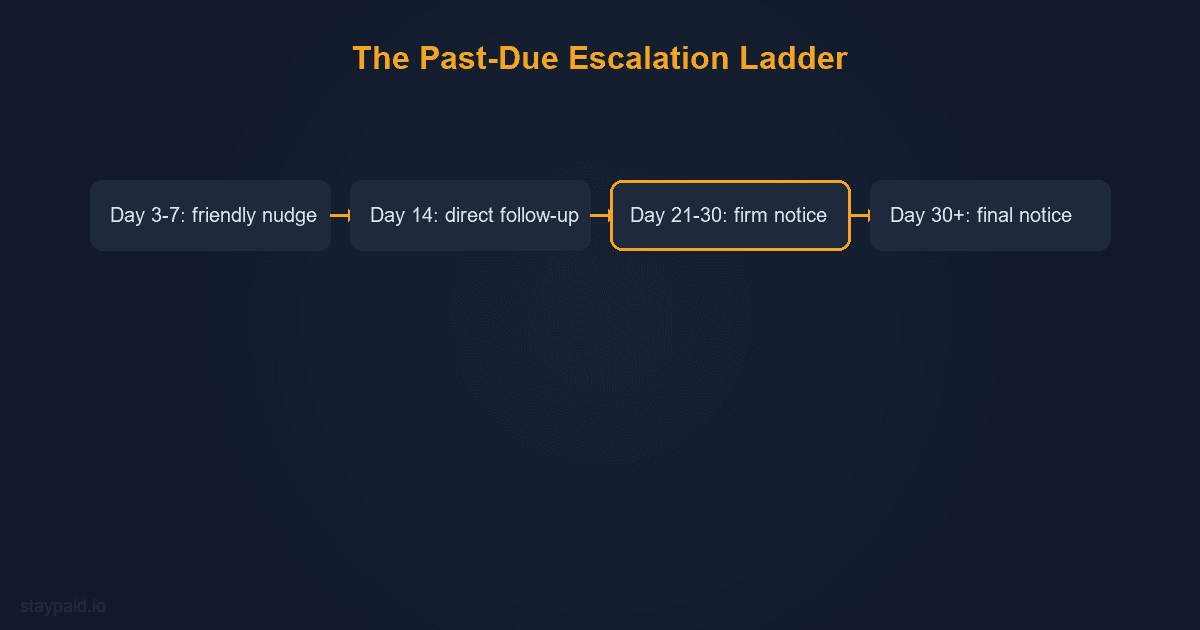
- •Day 1 past due: automated receipt-style reminder if you have invoicing software, or just calendar a note.
- •Days 3-7: Template 1, friendly nudge.
- •Day 14: Template 2, direct follow-up, ask for a payment date.
- •Days 21-30: Template 3, firm notice with contractual consequences.
- •Day 30+: Template 4, final notice, then do what you said.
And the highest-leverage move isn't an email at all: prevention. Take cards upfront, use invoicing that auto-reminds, and for subscriptions, let a card updater refresh expired numbers before the charge fails. If you run a SaaS on Stripe, that's the entire pitch behind what we build at StayPaid: failed renewals retried and chased with human-sounding emails from your address, so most 'past due' situations never reach your outbox. Fewer invoices to chase beats better chasing.
FAQ
What do you say in a past due invoice email?
State the invoice number, the amount, how many days it's overdue, and give one clear way to pay. Keep the tone matter-of-fact, not apologetic and not aggressive. Most late invoices are admin slips, not refusals.
How many reminder emails should you send for an unpaid invoice?
Three to four: a friendly reminder at 3-7 days past due, a firmer follow-up around day 14, a final notice around day 30, and only then escalation. Most invoices get paid after the first or second touch.
Should you charge late fees on past due invoices?
Only if your contract or terms stated them upfront. Surprise late fees damage relationships and are hard to enforce. Mentioning an existing late-fee clause in a reminder, however, is a legitimate nudge.
What is the best subject line for an overdue invoice email?
Plain and specific wins: 'Invoice #1042 is 7 days past due' beats cleverness. The goal is open-and-pay, not open-and-admire. Include the invoice number and amount when possible.
Keep reading
Robert
Founder at StayPaid
Want to recover failed payments like a founder?
Start Free — First 3 recoveries