The Founder-in-the-Loop Approach to Failed Payment Recovery
Founder-in-the-loop means a human reviews recovery emails before they go out. Here's why that beats pure automation for small SaaS.
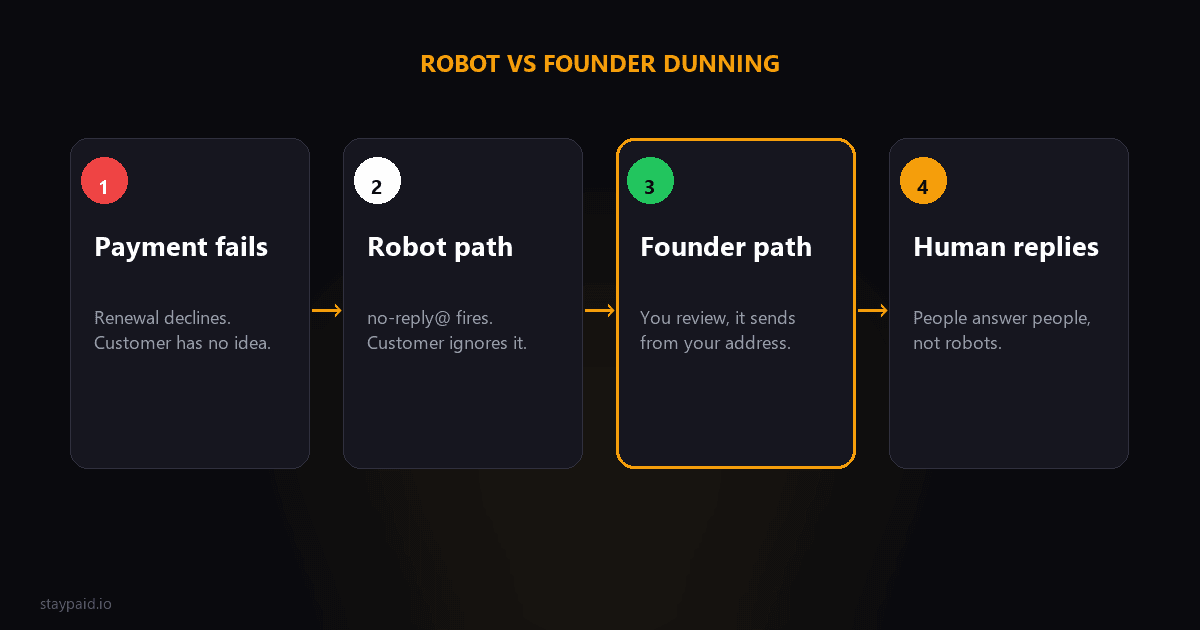
Founder-in-the-loop means a real human — usually the founder — reviews and approves your failed-payment recovery emails before they go out, sends them from their own address, and adds a personal note when it matters. It's the differentiator StayPaid is built around, and it's the reason customers reply to us instead of ignoring us.
A failed payment is often the last human moment you get before a customer churns. If you hand that moment entirely to a robot, you're not saving revenue — you're spending the last bit of goodwill you had.
Where pure automation goes wrong
Let me be fair first: full automation works on paper. You set up a sequence, the tool retries the card, fires off emails, and some percentage of payments come through. The dashboard goes green. Revenue is saved. Case closed.
Except it isn't. The numbers hide what the customers feel.
Think about the last time your card got declined for a subscription you actually wanted. Now picture the follow-up: an email from no-reply@yourproduct.com with a perfectly even subject line, retried exactly on schedule, signed by nobody. Yes, some people fix their card. But how many feel like they're being processed by a billing department rather than helped by a person?
"Robotic dunning doesn't feel like a reminder from a friend. It feels like a debt collector."
That's the failure mode of pure automation. It recovers the payment and quietly kills the relationship. The customer stays — for now — but they've filed you under 'impersonal software I tolerate.' And tolerated customers don't refer, don't forgive, and don't stick around when a competitor sends them a nicer note.
Where pure manual goes wrong
The opposite extreme isn't better. If you insist on personally handling every failed payment forever, you will drown.
Here's the math nobody wants to hear. Every failed payment costs you real founder time: check the dashboard, open the customer record, figure out what went wrong, write an email, remember to follow up in three days, remember to follow up again. For a handful of customers a month, that's a few minutes each and it's genuinely worth it. Every conversation teaches you something about your product. I loved that phase.
- •Manual is incredible until it isn't — it stops scaling around double-digit failed payments a month.
- •Inconsistency creeps in: Monday-you writes a great note, Friday-you rushes and forgets the human touch.
- •Follow-ups get forgotten at 2am, and a forgotten follow-up is the same as never emailing at all.
- •You start to resent the work, and resentment shows up in your tone.
Manual doesn't scale because your attention doesn't scale. You can't be in two conversations at once, and at some point recovery emails stop being the best use of your day.
What founder-in-the-loop actually looks like in practice
Here's the part everybody gets wrong. Founder-in-the-loop doesn't mean you hand-write every email. It means you stay in the decisions that matter while software handles the repetitive work.
- •You scan the dashboard each morning and see who's at risk before anything fires.
- •You review the recovery emails about to go out and approve them — or adjust them.
- •You add a personal note when the situation calls for it, and skip the ones that don't.
- •You reply when customers write back, because the email came from your own address.
- •You decide which payments go fully automatic and which ones need your eyes first.
The tool handles detection, timing, and delivery. You handle voice, judgment, and the follow-through. That's the whole balance. Automation buys you back the hours; the loop keeps your name attached to the outcome.
What a founder actually reviews in two minutes
When someone tells me founder-in-the-loop sounds like a time sink, I point to what actually happens. It's not writing a novel for every customer. It's a two-minute sweep.
- •Who is this person, and how long have they been a customer?
- •Is this a one-off blip or a pattern?
- •Does this customer deserve a personal note, or is the standard email fine?
- •Is the tone right for who they are — a weekend hobbyist vs a serious power user?
- •Anything in the decline reason that changes the message?
Most recoveries are routine. You glance, you approve, you move on. But the ones that aren't routine are exactly where the founder's judgment pays for itself ten times over.
A power user who's had a rough month deserves a different note than someone who signed up yesterday and may have just changed cards. No algorithm can make that call. You can, in about fifteen seconds.
Why customers reply to a person but ignore a robot
This is the part you can't fake. A message from a person gets treated like communication. A message from a system gets treated like a notification.
When the email is from no-reply@, the only action available is 'fix the card in silence.' When it's from robert@, the customer has options: reply, ask a question, say 'I'm canceling but thanks for checking,' or tell you their wife just lost her job and they need another week. That last one doesn't happen with a robot. It happens all the time with a person.
"People don't reply to a billing department. They reply to a person who gave them an opening."
Those replies are worth more than the recovered subscription. They're product feedback, churn signals, and relationship repair, all delivered straight to your inbox. A robot never brings you any of that.
Why I'd rather recover 70% personally than 80% automatically
This is going to sound counterintuitive, so hear me out.
A 70% recovery rate with a personal touch is worth more to me long-term than an 80% rate from a robot. The customers who come back because a person reached out stick around longer. They refer. They forgive you when something breaks. They remember that you treated them like a human being when their card declined.
The 80% recovered by a robot looks better on a spreadsheet. But some of those customers feel processed, not cared for. And processed customers churn quietly six months later — which none of your dashboards will ever show you.
"The best metric isn't recovery rate. It's how many customers still want to talk to you after the recovery."
The hybrid is the answer
Neither extreme works. Pure automation burns relationships. Pure manual doesn't scale. The answer for indie and small SaaS is the hybrid: software handles detection and timing, a human handles voice and judgment.
That's the whole philosophy behind StayPaid. It's why the tool starts you in the loop rather than locking you out of it, and why you get to opt into automation per payment instead of being forced to accept it everywhere. We handle the repetitive work so you can spend your two minutes where they count. The automation is real — it's just not allowed to speak for you.
If every other dunning tool is set-and-forget, StayPaid is look-and-approve. The difference feels small on paper, but your customers can feel it. That's what founder-in-the-loop means, and it's the reason we'll keep it even when it would be easier not to.
Frequently asked questions
What does founder-in-the-loop mean?
It means a human founder reviews and approves failed-payment recovery emails before they go out, sends them from their own address, and adds a personal note when it matters — instead of letting a fully automated system talk to customers unattended.
Is founder-in-the-loop slower than full automation?
Marginally, and only for the emails that need a human. For most recoveries the review takes a glance and a click. You trade a few minutes of founder time for a dramatically better customer experience and replies you'd never get from a no-reply address.
Does founder-in-the-loop work for bigger products, or just small SaaS?
It's most natural for indie and small SaaS where the founder still knows the customers. At larger scale you can keep the same principle by assigning a person to review high-value or at-risk recoveries instead of automating every single one. The loop shrinks, but it doesn't vanish.
What's the best recovery email to send a customer?
The one that sounds like a person and gives the customer an easy way to reply. A gentle, honest note from the founder's own address about a failed payment — with a clear fix and a real P.S. — recovers more relationships than a perfectly timed robot sequence. We've written out the approach in more detail in our guide to a payment recovery email that works.
FAQ
What does founder-in-the-loop mean?
A human — usually the founder — reviews and approves every failed-payment recovery email before it sends. The email goes out from the founder's own address, often with a personal note, instead of an anonymous no-reply robot sequence.
Is automated dunning bad for customer relationships?
Not inherently, but pure automation sends robotic no-reply emails that feel like a debt collector. It can recover the payment while quietly damaging the relationship — customers fix the card but file you under 'impersonal software I tolerate.'
How much time does founder-in-the-loop dunning take?
About two minutes per failed payment. You scan the decline reason and customer context, approve or tweak the email, maybe add a one-line P.S. The system handles detection, timing, and follow-ups — you handle the judgment.
When should a SaaS switch from manual to automated dunning?
When failed payments pass roughly ten a month, or when follow-ups start slipping. Below that, pure manual works and every conversation teaches you something. Above it, you need automation for the timing — but keep a human on the voice.
Keep reading
Robert
Founder at StayPaid
Want to recover failed payments like a founder?
Start Free — First 3 recoveries