AI Dunning Agents: What They Actually Do, Where They Break, and the Middle Ground That Works
AI dunning agents promise fully autonomous failed-payment recovery. Here's what they're genuinely good at, where they break, and what actually works.
What an AI dunning agent actually is
An AI dunning agent is software that handles failed payments end to end without asking you first. It watches for declines, decides when to retry, writes the recovery email, and sends it under your name. The word agent means it makes the decisions, not just the deliveries.
This category barely existed two years ago. Now every billing vendor has an AI agent slide in their deck. Some of that is real capability. Some of it is a cron job with a marketing budget. Here's how to tell the difference, and where these things genuinely help.
What agents are genuinely good at
The honest case for automation is strong, and I say that as someone who sells a human-in-the-loop product:
- •Watching. An agent never misses a failed payment. You will. It catches the 2am decline on a Sunday the same as the 2pm one on a Tuesday.
- •Timing. Retries timed to decline type and payday patterns beat a fixed try-again-in-3-days schedule. This is pure math and machines do it better.
- •Speed. The first hours after a failed payment matter most. An agent reacts in minutes. You react after your morning coffee, if you notice at all.
- •Consistency. Every customer gets the same prompt follow-up. Nobody falls through the cracks because you had a launch week.
If a vendor's AI pitch is basically these four things, good. That's the part worth paying for.
Where full autonomy breaks
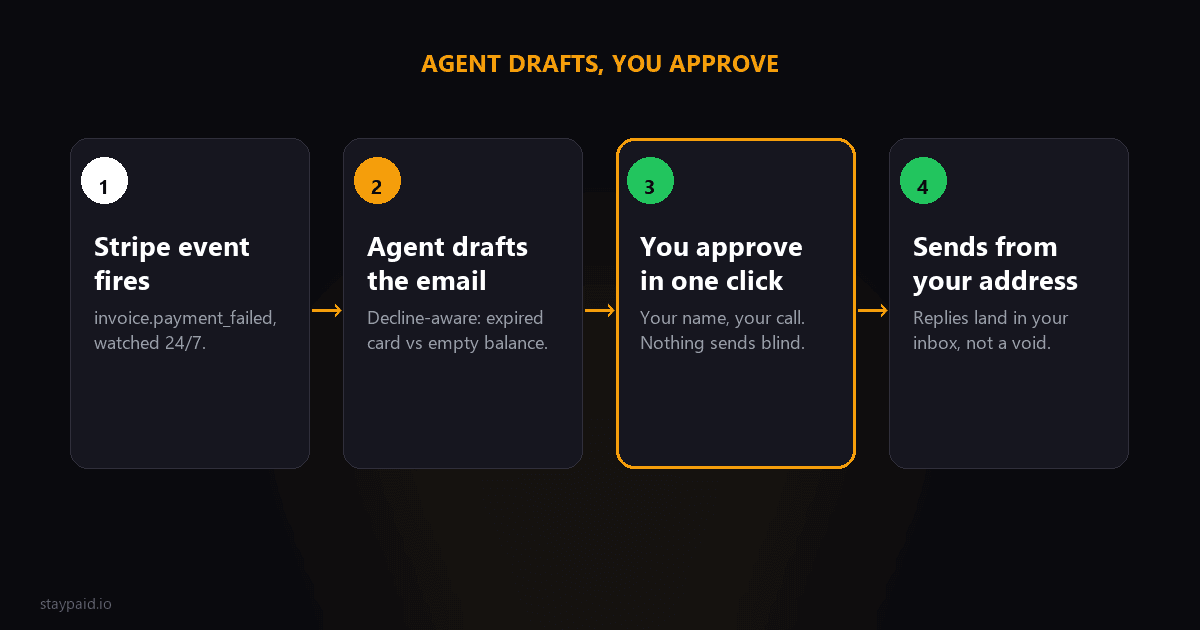
What the agent layer adds on top of plain automation is judgment about sequence and tone. A dumb system sends the same template to everyone on day one, three, and seven. A decent agent notices that this customer's decline was insufficient funds, which usually resolves after payday, so the first email can wait a day and stay gentle. Or it sees card_expired, which never fixes itself, so the update-card link goes out immediately. Same plumbing underneath, very different customer experience on top.
And the parts that need zero intelligence still deserve automation: watching every invoice, tracking which decline codes recur, measuring recovery rate week over week. That's bookkeeping, machines do bookkeeping perfectly, and founders doing it by spreadsheet always have stale numbers.
Now the part the demos skip. A dunning email isn't a password reset. It lands in front of a paying customer, at the exact moment their card just failed, wearing your company's name. Get the tone wrong and you didn't just fail to recover revenue. You created a churn reason.
Agents don't know that this customer emailed you last week about a bug and deserves a softer touch. They don't know the annual client whose card fails every January because their bank flags it. They don't know your loudest advocate is also your most embarrassing account to hit with a robot template. Context is the whole game in recovery emails, and context is exactly what autonomous systems lack.
Then there's the reply problem. Customers reply to recovery emails. They ask questions, they negotiate, they say actually I meant to cancel. A fully autonomous agent either ignores the reply, which is terrible, or answers it, which is terrifying. Neither builds the business you want to run.
A quick reality check on the marketing
When a vendor says AI dunning agent, ask which part is actually AI. Retry scheduling is math, not intelligence. Drafting a polite email is LLM territory, and fine. The word agent usually just means the tool sends without showing you first. That's not intelligence. That's just less supervision.
The middle ground that actually works
The setup I've landed on, and built StayPaid around: let the machine do the watching, the timing, and the drafting. Keep a human on the sending. The agent spots the failed payment, prepares the email, and queues it. You glance at it, maybe tweak a line, hit approve. Thirty seconds of human time, zero missed payments, no robot embarrassing you in front of a customer.
Founders hear review every email and picture a chore. At small scale it's a few emails a week, and they're the highest-ROI emails you'll ever send. Each one is worth at least a month of that customer's subscription, recovered.
What a good week actually looks like
Concretely, here's the founder-in-the-loop week. Monday, the agent flags two failed payments from the weekend and has drafts ready. You open one, it says 'Hi Sarah, your payment for the Pro plan didn't go through', and you know Sarah just renewed annually, so you add 'ignore this if your bank already sorted it'. Send. Wednesday, a retry succeeds on its own, no email needed, the agent stands down. Friday, one more draft, this one fine as-is, ten seconds, approve.
Total human time: maybe four minutes. Total missed payments: zero. Total robotic moments in front of customers: zero. That's the whole thesis.
Compare that with the two failure modes on either side. Fully manual: you notice the failure nine days later, or never. Fully autonomous: Sarah gets a template that ignores her context, and your biggest fan starts wondering if there's a human behind the product at all.
One more thing before the checklist: demand numbers, not adjectives. Ask any vendor for their median recovery rate, how they define recovered, and what happens to the customers they don't recover. A tool that recovers 40 percent of failed payments and alienates 5 percent of the rest can be net negative. The vendors worth trusting will show you the ugly cohort table. The ones who won't are selling the word agent, not the outcome. If the demo can't produce that table, or the answer is a case study instead of a cohort, walk away. Serious vendors answer in numbers. Everyone else answers in adjectives, and adjectives don't recover revenue.
How to evaluate an AI dunning agent
- •Ask what it does when a customer replies. If the answer is vague, the autonomy is a liability.
- •Ask if you can see and edit messages before they send. If not, you're handing customer relationships to a black box.
- •Ask about edge cases: annual plans, paused subscriptions, customers mid-dispute. Real products have answers. Demos don't.
- •Check whether it sends from your address or theirs. no-reply@vendor.com is where recovery emails go to die.
Full autonomy is the right call for some businesses. High-volume, low-touch product, customers as numbers? Automate away. But if your customers know your name, keep a hand on the wheel. The agent should work for you, not instead of you.
One more tell worth mentioning: how a vendor talks about mistakes. Every system misfires eventually. The good ones log it, show it to you, and make it easy to correct. The bad ones bury it in a dashboard you'll never open. Ask to see the mistake-handling before you ask to see the AI.
The bottom line
AI dunning agents are real, useful, and oversold, all at once. The watching, timing, and drafting deserve full automation. The sending deserves thirty seconds of your judgment. Any tool that respects that split will recover most of what's recoverable. Any tool that doesn't will eventually send the email you wish it hadn't.
"The best dunning system isn't the one that sends the most emails. It's the one your customers can't tell is automated, because a human actually read it first."
FAQ
What is an AI dunning agent?
Software that handles failed subscription payments autonomously: it detects the decline, decides when to retry, writes the recovery message, and sends it without asking you first.
Can AI write dunning emails?
Yes, and the first drafts are decent. The risk isn't writing quality, it's sending without context about the customer relationship. Reviewing before send is cheap insurance.
Is automated dunning risky?
The retry side is safe. The email side carries the risk: a robotic or badly timed message to a paying customer can cause the exact churn you were trying to prevent.
What is founder-in-the-loop dunning?
A setup where automation handles detection, timing, and drafting, but a human approves the customer-facing message before it sends. A few minutes a week in exchange for zero robotic misfires.
Keep reading
Robert
Founder at StayPaid
Want to recover failed payments like a founder?
Start Free — First 3 recoveries