Manual vs Automated Dunning: What Actually Works in 2026
Automation scales. Manual follow-up converts. Here's how to use both without annoying your customers.
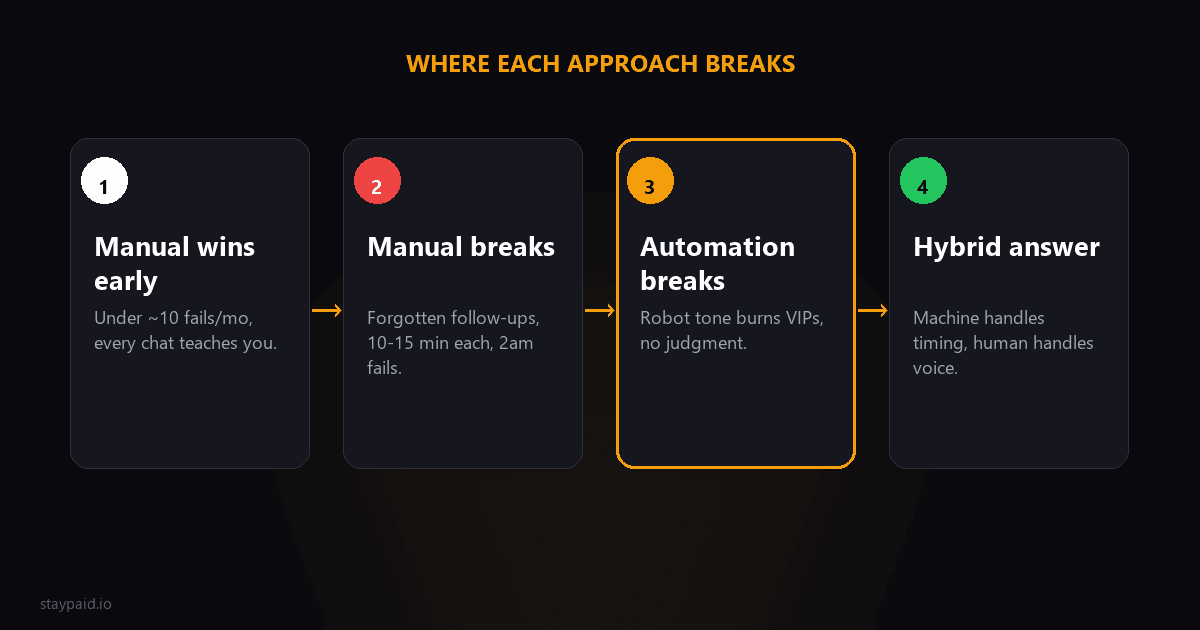
Go fully manual and you'll drown the moment you get traction. Go fully automated and you'll recover payments while quietly burning the relationships the payments came from. The real question isn't manual or automated — it's what to automate and when to hand the wheel to a human. Here's the decision framework I actually use.
Most of what's written about this topic is aimed at enterprise accounts-receivable teams where thousands of invoices are on autopilot. That's a different job. If you're an indie or small Stripe SaaS founder, your dunning problem is smaller, weirder, and way more personal. You need a different answer.
What manual follow-up actually costs you
Let's be honest about the real price of the manual path, because everyone romanticizes it and nobody runs the numbers.
Every failed payment costs you real founder time. You've got to check who failed, open the customer record, figure out the decline reason, draft an email, remember to follow up in a few days, and follow up again if they don't reply. Do it properly and you're looking at ten to fifteen minutes a payment.
- •Ten failed payments a month is roughly two and a half hours of your week.
- •Thirty is a full workday — every month, forever.
- •And that's before the two-way replies that turn into full conversations.
At a handful of customers a month, that time is the best investment you can make. At scale, it's the thing keeping you from building your product. The math flips somewhere, and it's worth knowing exactly where.
Where manual wins (and you should keep doing it)
Manual follow-up isn't a failure state. There are clear situations where it's genuinely the right call.
- •You're below roughly ten failed payments a month — the volume is manageable.
- •You're high-touch B2B, where one awkward automated email can cost you a six-figure account.
- •You're early-stage, and every recovery conversation is teaching you about your product and your buyers.
- •Your customers expect a person — agency clients, enterprise, or anyone who paid you real money.
In those cases, manual isn't overhead. It's the best market research you'll get for free. Failed payments are a rare moment where a customer who's usually silent will actually tell you what's wrong — with their card and with your product. I learned more about my first hundred customers from recovery emails than from any survey. I'd never trade that phase away, and if you're early, don't automate it away either.
There's also a subtler reason manual wins down here: it forces you to notice patterns. When you personally touch every failed payment, you start to see that the same three customers fail on the first of the month, or that one payment method keeps dying silently. Those patterns are alive for you in a way they never are when a dashboard just shows you a green recovery number. The automation can tell you the what. Only your own hands on the work will tell you the why.
Where manual breaks down
But manual has a ceiling, and it's made of three things: volume, inconsistency, and your sleeping brain.
Volume is the obvious one. You can only hand-write so many emails. The sneaky killer is inconsistency. Monday-you writes a thoughtful note. Friday-you, buried in a bug, rushes and sends something flat. Customers notice the difference even when you don't.
And then there's the forgotten follow-up. You're going to bed, remember you meant to check on that customer at 2am, and decide it can wait till morning. It never gets followed up on. A forgotten follow-up is the same as never emailing at all — you just also wasted the effort of the first message.
"Manual doesn't scale because your attention doesn't scale. You can't be in twenty conversations at once, and at some point the recovery work stops being the best use of your day."
Where full automation wins
Automation is genuinely great at the parts humans are bad at. And not just 'fine' — categorically better.
- •Detecting the failed payment the second it happens, no matter the hour.
- •Hitting the right timing window consistently, without ever forgetting.
- •Sending the first email instantly, while the failure is fresh.
- •Tracking opens, replies, and who still needs a nudge without a spreadsheet.
For most customers, the first automated email is all it takes. They see it, update the card, and everyone moves on. No founder should be hand-typing 'hi, your card declined' forty times a month. That part should absolutely run on rails.
Where full automation burns you
Here's what the automation evangelists skip. Set-and-forget dunning gets the timing right and the voice wrong.
An email from no-reply@yourproduct.com with a perfectly even subject line, sent exactly on schedule, signed by nobody — it gets the job done for some customers and quietly alienates the rest. It feels like being processed by a billing department, not helped by a person. You recover the payment and spend down goodwill doing it.
- •No context: it doesn't know a customer just reported a bug, or that they're your biggest account.
- •No judgment: it treats a VIP who's been with you for three years the same as a two-day trial.
- •No tone control: robotic follow-ups land like debt collection, not customer care.
The dumbest failure I keep seeing is the tool that keeps emailing someone after they've already replied to a human. The sequence doesn't pause, so it fires off a follow-up to a customer who's literally mid-conversation with you. You look clueless, and all the automation in the world won't fix that.
And automation struggles with the timing window that actually matters. The first few hours after a failure are golden — the customer is still at the checkout mindset and fixing the card feels easy. Too many tools fire on a generic multi-day calendar instead of that window, or they clump every retry together so Stripe's own retry logic and your emails end up fighting each other. Worse, some keep hammering a card that's genuinely dead, week after week, which looks less like persistence and more like a broken tollbooth.
The hybrid: automate the mechanics, keep the human voice
So what's the actual answer? It's the split that nearly every small SaaS founder eventually stumbles onto: let software handle the detection and timing, and keep a person on the voice and the judgment.
- •Automation catches the failure and hits the timing window perfectly, every time.
- •Automation fires the routine first email without you lifting a finger.
- •A human reviews the cases that matter — high-value accounts, long-tenure customers, anyone who already replied.
- •A human writes the notes that need a judgment call and answers when customers write back.
You get most of the efficiency of full automation and most of the warmth of doing it by hand. It's not either or. It's both, at the right moments. The trick is knowing which is which — and that's a founder decision, not a software decision.
Where the line is
Here's the simple version I come back to: below about ten failed payments a month, do it manually, because every conversation is teaching you something. Above that, let automation own the detection and timing — but never let it own your voice. Hand it the repetitive parts, keep the judgment for yourself.
"Automation should handle the obvious. Humans should handle the important. The trick is knowing which is which."
That's the exact split we built StayPaid around. The tool handles the detection, the timing, and the routine sends. You stay on the emails that matter and keep your name and your personality attached to the outcome. In 2026, the best dunning isn't a robot and it isn't a to-do list — it's a robot with a human backstop. That's the model that keeps both your revenue and your relationships.
FAQ
When should I stop doing manual dunning and automate?
When you're handling more than roughly ten failed payments a month, or when follow-ups start slipping because there simply isn't enough of you to go around. Below that threshold manual is usually better — every conversation teaches you something. Above it, you need automation for the detection and timing, but keep a human on the voice.
How much does manual payment follow-up really cost a founder?
About ten to fifteen minutes per failed payment once you count checking who failed, opening the customer record, drafting the email, and remembering to follow up. At a handful of customers a month that's fine. At dozens it quietly eats your whole week.
When is manual dunning actually better than automation?
In high-touch B2B, at very low volumes, and in early-stage companies where every recovery conversation teaches you something about your product and your customers. There it's not a cost — it's the best market research you'll ever get for free.
What's the biggest mistake automated dunning tools make?
Treating every customer the same. They fire the same email at a VIP who's been with you for years and someone who signed up yesterday, with no sense of context, timing, or tone. The recovery works, but it grinds down the relationship while it's doing it.
Keep reading
Robert
Founder at StayPaid
Want to recover failed payments like a founder?
Start Free — First 3 recoveries