Customer Retention Cost: The Formula, the Math, and Why It Beats Acquisition
Customer retention cost explained with real math: the CRC formula, worked examples vs CAC, and why recovered payments are the cheapest retention.
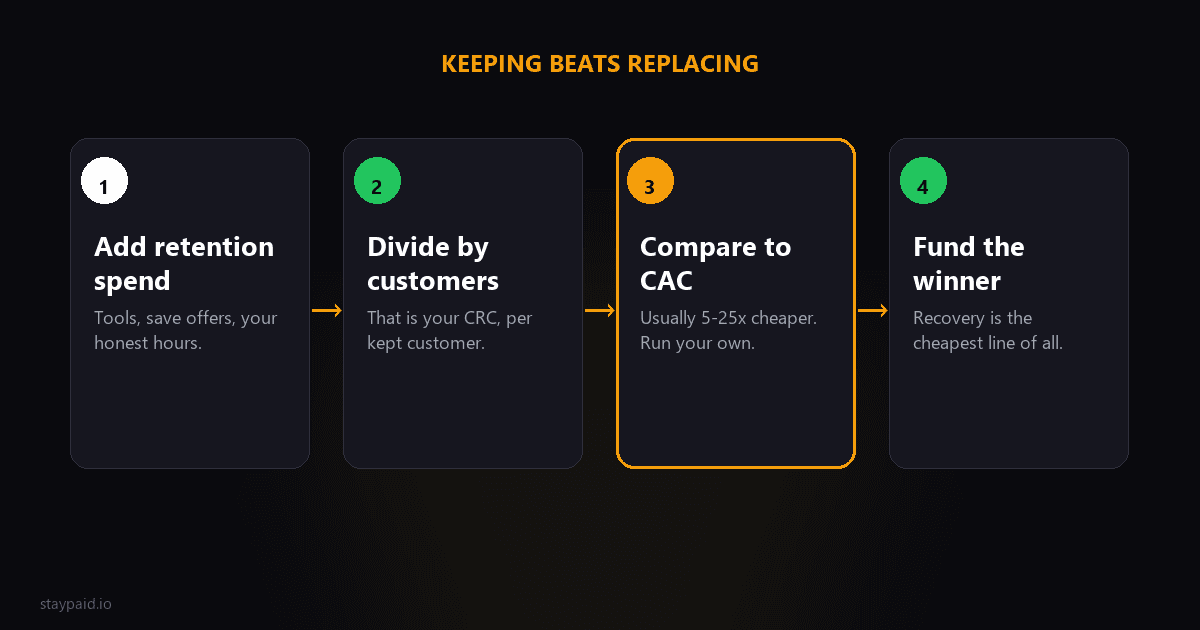
Customer retention cost (CRC) is what you spend to keep the customers you already have: total retention spend in a period divided by customers kept. Founders track CAC to the decimal and have never once calculated this number, which is strange, because it is usually the better deal by an order of magnitude.
Let's fix that. Formula first, then real arithmetic, then the part where this changes how you think about failed payments.
The formula
CRC = total retention costs in a period / number of customers retained in that period.
Retention costs are everything that exists to keep customers rather than get new ones:
- •Customer success and account management salaries (or your own hours, priced honestly)
- •Retention tooling: dunning and recovery tools, churn analytics, NPS/survey software
- •Save offers, loyalty discounts, and win-back incentives
- •Support time spent on renewal and billing issues
The line items founders forget are the small software subscriptions and their own time. Include both or the number is fiction.
Worked example, real numbers
Say you run a $50/month SaaS with 800 customers. Last quarter:
- •You spend 10 hours a week on retention-ish work; price your time at even $50/hour, that is about $6,500 for the quarter.
- •Tools: recovery/dunning, analytics, survey stack, call it $600 for the quarter.
- •Save offers and win-back discounts redeemed: $900.
- •Total retention spend: $8,000.
You started the quarter with 800 customers, lost 60, ended with 740 from the base (ignore new adds). You retained 740. CRC = $8,000 / 740 = about $10.80 per customer kept.
Now compare. If your CAC is $150 (ads, content, your time, all in), then keeping a customer costs you 7% of replacing them. Even if the popular Bain & Company framing (acquisition costing 5 to 25 times retention) feels abstract, your own ledger just told you the same story in your own numbers. Run it. Almost everyone who does this math the first time finds the ratio embarrassing.
Why the gap is so big
Acquisition pays for skepticism. A stranger does not know you, does not trust you, and needs ads, content, sales calls and time before money moves. Retention pays for a relationship that already exists. The customer already crossed every one of those thresholds. Keeping them is cheaper because the expensive part already happened.
Bain's research adds the second half of the punchline: retained customers buy more over time and refer others, so a 5% improvement in retention compounds into profit gains far larger than 5%. Retention is not defense. It is the highest-leverage growth spend you have.
The cheapest retention dollar: the recovered payment
Now the part of CRC nobody writes about. Within your retention spend, the highest-ROI line is failed payment recovery, and it is not close. Here is why: an involuntary churner is a customer who never decided to leave. Their card declined. There is no persuasion required, no save offer to fund, no CS call to schedule. You just have to retry intelligently and send an email that gets read.
Put numbers on it with the example above. Say 30 of your 60 losses last quarter were involuntary. That is $1,500 of MRR that left without a single customer choosing to go. If your recovery tooling is $29 a month and a slice of your email time, call it $500 a quarter generously, and it saves even half of those, you kept 15 customers at roughly $33 each, versus $10.80 average CRC and $150 CAC. It is the best number on the entire retention ledger because the customer was never actually leaving.
This reframes the whole category. Payment recovery is not a collections function, it is the cheapest acquisition channel you will ever have: customers at 7% of CAC, or less, who already know the product works.
What to do with this
Three concrete moves. First, calculate your CRC this week, with honest inputs, and put it next to your CAC. Second, split last quarter's churn into voluntary and involuntary, and cost them separately. Third, make sure the involuntary pile has a real system behind it, not a default Stripe retry and a hope.
The mistakes that distort the number
Three CRC traps worth avoiding. First, counting only the obvious retention line items. If your tool spend and your own hours are missing, your CRC is flattering fiction, and the honest number is the one that makes decisions. Second, mixing periods: retention spend in Q1 partly protects customers who would have churned in Q2, so compare CRC and CAC over quarters, not weeks. Third, using it as a vanity ratio. The point of CRC is not to have a low number; it is to know what a kept customer costs so you can judge whether a new retention initiative (a save-offer flow, a recovery tool, a CS hire) beats putting the same money into ads.
A quick sensitivity check makes this concrete, and it is worth doing with your own numbers rather than mine. Take the example above and imagine your recovery setup saves 20 involuntary churners a quarter instead of 15. That is $1,000 of MRR kept, $12,000 a year, from a few hundred dollars of tooling and some emails. To get the same $12,000 from acquisition at $150 CAC, you would need to spend $12,000. Same outcome, 20x the spend. Once you have run your own version of this math, the budget conversation with yourself is over.
Where retention spend goes next
Once you have the number, the natural question is where the next retention dollar should go. Order the candidates by what a kept customer is worth versus what the thing costs. Payment recovery tooling almost always tops that list because its targets never chose to leave. Save-offer flows come next. A dedicated CS hire is usually the most expensive per kept customer until your base is big enough to justify one, which is fine, as long as you know that is the trade you are making. CRC turns "we should probably do more retention stuff" into an actual budget conversation with numbers in it.
A closing note on honesty: CRC only works if your retention spend actually retains. If you are funding a loyalty program nobody uses or a CS motion customers route around, the formula will not save you, it will just price the waste. Review the line items once a quarter and cut whatever is not visibly keeping customers. Retention spend is an investment portfolio; rebalance it.
If you want one number to put in your head before you close this tab, make it the ratio: CRC divided by CAC. Below 0.2 is normal for a healthy subscription business. Above 0.5 and something structural is off, usually retention spend on things customers do not value. Compute it once a quarter and it will quietly steer every budget decision you make about where the next dollar goes.
Full disclosure on that third one: it is why StayPaid exists. For $29 a month it retries failed payments on a sane cadence and emails customers from your actual address, founder voice and all, so the cheapest retention dollars on your ledger actually get collected. On the math above, it pays for itself if it saves one customer a year. It will save more than that.
FAQ
What is customer retention cost (CRC)?
The total you spend to keep existing customers, divided by the number of customers you kept. Add up customer success salaries, retention tooling, loyalty discounts, win-back and recovery spend for a period, then divide by the number of customers retained in that period. It is the retention-side twin of CAC.
Is retaining a customer really cheaper than acquiring one?
Yes, by a wide margin in most businesses. Research popularized by Bain & Company puts acquisition at 5 to 25 times more expensive than retention, and increasing retention by 5% can lift profits 25% or more. The exact ratio varies, but the direction is one of the most replicated findings in business.
What should I include in retention cost?
Everything that exists to keep customers: your CS team, retention and dunning tools, save-offer discounts, loyalty programs, the support hours spent on renewal issues. Be honest and include the tooling line items; founders routinely undercount by forgetting the $200/month of software doing retention work.
What is a good CRC to CAC ratio?
There is no universal benchmark, but the useful test is internal: if your CRC per kept customer is a fraction of your CAC per new customer (it usually is), then every dollar moved from acquisition to retention buys you more net customers. Run both numbers for the same period and compare.
Keep reading
Robert
Founder at StayPaid
Want to recover failed payments like a founder?
Start Free — First 3 recoveries