Churn Buster Alternatives: Stripe Dunning Tools Compared Honestly (2026)
Churn Buster alternatives for Stripe, compared honestly: automation-first, platform-locked, free-but-silent, and founder-in-the-loop dunning approaches.
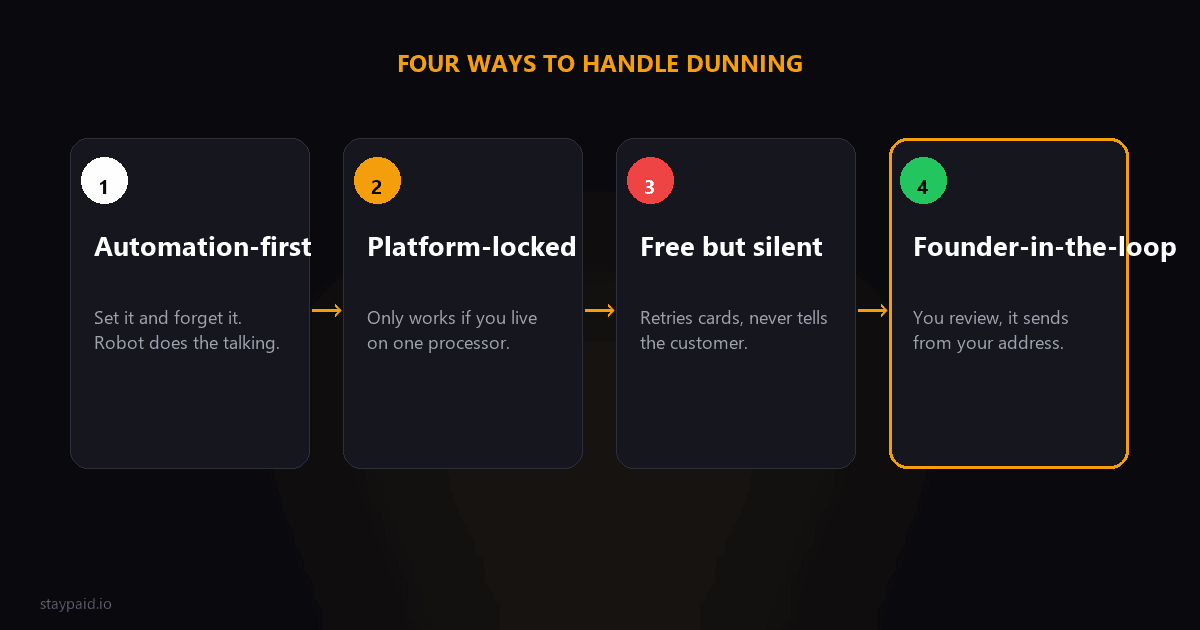
Most 'dunning tool' comparisons read like the vendor wrote them
People search 'Churn Buster alternatives' for a few honest reasons: they want more control, they hate robot emails, or they're frustrated that the tool doesn't feel like it's theirs. This is a straight comparison of the approaches on the market — no pricing, no invented weaknesses, just who each one is for.
Why people go looking for alternatives at all
Nobody searches for an alternative to a recovery tool because their recoveries are going great. The motivations are usually one of these: you want your hands on the customer conversation instead of handing it to a sequence, you're tired of emails that read like they came from a machine, or the setup doesn't fit how your business is actually run.
Those are all valid. Dunning isn't a set-and-forget problem — it's a customer-relationship problem wearing a payments costume. So the right tool is the one whose philosophy matches how you want to talk to your customers.
It helps to separate the two jobs any dunning tool does. Job one is retrying the charge on a sensible schedule so the bank is more likely to approve it. Job two is telling your customer what happened and giving them a way to fix it. Plenty of tools do the first job well and ignore the second — and job two is usually where the revenue actually comes back.
The four approaches, compared honestly
Automation-first (Churn Buster, Baremetrics Recover)
These tools are built around a smart retry schedule plus an email sequence that goes out automatically when a payment fails. They give you templates, some control knobs, and a dashboard of what's being recovered.
Who it's for: founders who want the recoveries handled with minimal daily attention, and who are comfortable letting the templates speak for the brand. If your time is worth more than chasing a dozen failed payments a month, this is the trade you're making.
Platform-locked (Paddle Retain)
Paddle Retain only works if you process through Paddle, which handles your invoicing, tax, and payments for you. It's less of a standalone tool and more a feature of being on their platform.
Who it's for: businesses already all-in on Paddle's merchant-of-record model. If you're on Stripe and want to stay, it's not really in the running — which is exactly the point of a platform-locked option.
Free but silent (Stripe Smart Retries)
Stripe's built-in Smart Retries automatically retries failed payments on a machine-learned schedule, at no extra cost. It's genuinely smart and genuinely free.
Who it's for: founders who want the retry half handled and don't mind that there's no customer communication. It will not email your customers. A silent recovery tool recovers a fraction of what a tool that actually talks to people recovers — that's the honest trade.
Founder-in-the-loop
A newer approach that puts the founder back in the middle: you get notified when a payment fails, you review and approve each recovery, and the emails go out from your own address with your name on them — not from no-reply@. Automation is there if you want it, but the default is a human deciding.
Who it's for: founders who see recovery emails as part of the relationship, not a chore to offload. The trade is you're more involved — and the payoff is customers feel like a real person reached out to them. The reason I built this direction is a pattern I kept seeing: a subscription fails at 2am, the automation-first tool fires its sequence, and three days later the customer gets a polite, perfectly templated email from a no-reply@ address asking them to update their card. It's competent. It's also completely impersonal — and it reads as exactly that to the person on the receiving end.
A failed payment is almost never a choice to leave. It's a dead card, a closed account, a bank being difficult. The customer is usually happy to stay — they just need to know there's a problem and have an easy way to fix it. That's a conversation, not a broadcast. And a conversation needs a person on one end of it, which is exactly what a no-reply@ address can't give you.
A quick way to think about the trade
- •Automation-first: you hand the retries and the emails to a robot. Great for scale, weaker on personal connection.
- •Platform-locked: clean and simple, but only if you're already committed to that platform.
- •Free-but-silent: you get retries for nothing, but nobody tells your customer what happened.
- •Founder-in-the-loop: you keep the relationship, at the cost of being more hands-on.
What to check before you switch
Switching tools is a real project, so spend the setup energy once and pick well. Beyond the obvious (does it do retries and email), dig into the details that determine whether it'll actually fit how you operate.
- •How it connects. Confirm the tool works through Stripe OAuth and can read your subscriptions and the events you need — invoice.payment_failed, charge.failed, and so on.
- •Where the email comes from. Can you send from your own verified domain and address, or are you locked to the tool's sender? This decides how personal your recovery emails can be.
- •How retries are scheduled. Is the retry logic automatic, configurable, or something you approve first? Some founders want to review, not just let it run.
- •What happens to a payment you can't recover. Make sure you can see exactly which invoices are recovered versus written off, so you know if the tool is earning its keep.
And test the human side before you commit. Send a test recovery email to yourself and read it the way a customer would. Does it sound like a person you'd trust with your money, or a form letter? Does the reply-to actually go somewhere you'll see? That one detail — who's at the other end of the email — is where most tools quietly differ, and it's the difference between recovering a customer and losing them to a dead inbox.
The takeaway
There's no single best tool, only the approach that fits how you run your business. If you want recoveries handled quietly at scale, the automation-first and free-but-silent options are legitimately good. If you want your customers to hear from a human, the personal approach wins — you just have to stay in the loop. The expensive mistake is picking the philosophy that sounds impressive on a landing page and then discovering it doesn't match how you actually want to talk to people.
Whatever you choose, set a baseline first so you can tell if it's working. Note how many failed payments you were recovering before you switch, then compare after a couple of billing cycles. A tool that adds nothing measurable isn't earning its place in your stack, no matter how polished its dashboard is — numbers don't lie about whether a recovery tool is actually recovering.
StayPaid exists for that last group. It's the tool I wished I had as a founder: recovery emails that go out from your own address, reviewed by you before they send, with a real P.S. instead of a no-reply@ signature. Same retries and recovery math as the robots — just with your name on the message, and you in the middle of every recovery deciding what happens next.
FAQ
Is there a free Churn Buster alternative?
Yes, in the sense that Stripe Smart Retries is free and built into every Stripe account. It automatically retries failed payments on a smart schedule. The catch is it's silent — it doesn't email your customers. So it's a free partial alternative, not a full replacement.
What does Churn Buster actually do?
It's a dunning tool for Stripe: it monitors failed subscription payments, automatically retries them on a smart schedule, and sends email to customers asking them to update their card, with customizable templates and some human-approval options.
Can I just use Stripe Smart Retries instead of a dunning tool?
For retries, yes — it's free and automatic. But it only retries charges. It doesn't send the personalized email that tells a customer their card failed and how to fix it. Most recovered revenue comes from that human touch, which is what dunning tools add on top.
What makes a founder-in-the-loop tool different?
Automation-first tools fire a scheduled retry and an email sequence on autopilot. A founder-in-the-loop approach keeps you in control: you get notified, review each recovery before it goes out, and the emails come from your own address with your name on them rather than a no-reply@ robot.
Keep reading
Robert
Founder at StayPaid
Want to recover failed payments like a founder?
Start Free — First 3 recoveries