Churnkey Alternatives: An Honest Comparison for Small SaaS Teams
Churnkey is a strong retention suite, but it's priced for bigger teams. An honest look at who it's for and the alternatives worth considering.
What Churnkey actually is
Churnkey is a retention suite: cancel flows with save offers, plus failed-payment recovery, built for subscription companies with enough churn to justify a dedicated tool. Third-party reviews put the starting price around $250 to $300 a month, scaling with your churn volume.
Full disclosure before we go further: I build StayPaid, which competes in the failed-payment corner of this space. I'll be as honest as I can about where Churnkey is genuinely strong, because pretending otherwise helps nobody, including me.
Where Churnkey is genuinely strong
Churnkey's core product is the cancel flow: the screen your customer sees when they hit cancel, with save offers, pause options, and exit surveys. This is voluntary churn territory, and Churnkey does it well. If your churn report says most losses are customers actively choosing to leave, this category of tool is the right conversation.
They also do dunning, and by most accounts competently. If you're a bigger team, say 500k or more in ARR with churn across both categories, a suite that handles cancel flows and failed payments in one place has real appeal.
Where it's the wrong fit
If you're an early-stage SaaS where the actual leak is failed payments, Churnkey is a lot of tool for the job. You're paying for a retention suite when you need a dunning layer. At a few hundred dollars a month, the math only works if you have serious churn volume to attack.
There's also the automation philosophy. Churnkey's model is set-it-and-forget-it: flows run, emails send, you watch dashboards. Some founders want that. Others want to see what their customers are being sent before it goes out. Know which one you are before you pick.
Who Churnkey is right for
To be fair to them: if you're a subscription business past roughly half a million in ARR, losing meaningful revenue to both cancellations and failed payments, and you want one vendor for both, Churnkey is a defensible pick. The cancel-flow product in particular is the part of their suite I'd point at and say yes, that solves a real problem for teams at that stage.
The mismatch happens one stage earlier. A 50 to 500 customer SaaS doesn't have a retention department. It has a founder, a Stripe dashboard, and a leak. That company needs the failed-payment hole closed this week, at a price that doesn't require a spreadsheet to justify.
The alternatives, honestly
- •Churn Buster. The focused dunning tool, roughly $29 to $249 a month depending on volume. Email-based recovery with years of iteration behind it. The closest thing to a category default for pure failed-payment recovery.
- •Baremetrics Recover. Around $50 a month and up, and the obvious pick if you already pay for Baremetrics analytics. Solid basics, less depth than a dedicated tool.
- •Stripe Smart Retries plus native emails. Free and already in your dashboard. Covers machine retries and a generic notification. No custom messaging, no personal sender, no real reporting, but the price is right at zero.
- •StayPaid. My tool, $29 a month flat, Stripe-native. The difference: recovery emails go out from your own address and you approve them before they send. Automation watches and drafts, a human keeps the relationship. Built for founders who don't want a black box talking to their customers.
The switching question
If you're on Churnkey today and reading this because the price stings, the practical question is migration risk. Good news: dunning tools are mostly additive. They watch Stripe and send emails; they don't hold your data hostage. You can run a cheaper tool alongside the expensive one for a month, compare recovered revenue, and cancel the loser. The customers never notice either way.
What you can't easily migrate is the cancel-flow layer, if you use it. Those save-offer screens are embedded in your cancellation UX. So make the decision in two parts: is the cancel flow earning its keep, and is the dunning side? Different answers point to different tools, and unbundling is allowed.
On pricing specifically, it's worth saying the quiet part out loud. Churn reduction tools price against the revenue they save, not the cost of delivering the service. That's rational for them and occasionally irrational for you. A $300 monthly tool that saves you $900 is a deal. The same tool saving you $350 is a treadmill. Before any demo, know your monthly involuntary churn in dollars and your voluntary-at-cancel number in dollars. Those two numbers are the entire negotiation, and vendors respect founders who walk in with them. There's also an organizational cost people forget: suite tools want ongoing attention, someone owns the cancel-flow experiments and the offer testing. If that someone is you, a founder with forty other jobs, the honest comparison isn't Churnkey versus a cheaper tool. It's Churnkey versus a tool that mostly runs itself and asks for your approval instead of your afternoons. None of this makes Churnkey a bad product. It makes it a specific product for a specific stage, and the alternatives exist because most subscription businesses aren't at that stage yet. Buy for the churn you have, not the org chart you imagine.
How to choose between them
The honest decision framework is three questions. First: where is your churn actually coming from? If you don't know, that's step one, and our churn calculator plus an hour in your Stripe dashboard will tell you. Second: what's the monthly dollar value of the problem? A $300 tool needs to recover $300+ monthly to break even, and if your total failed-payment volume is $400, the math is tight. Third: how much do you want to touch it? Set-and-forget suites and approve-before-send tools are different relationships with your customers.
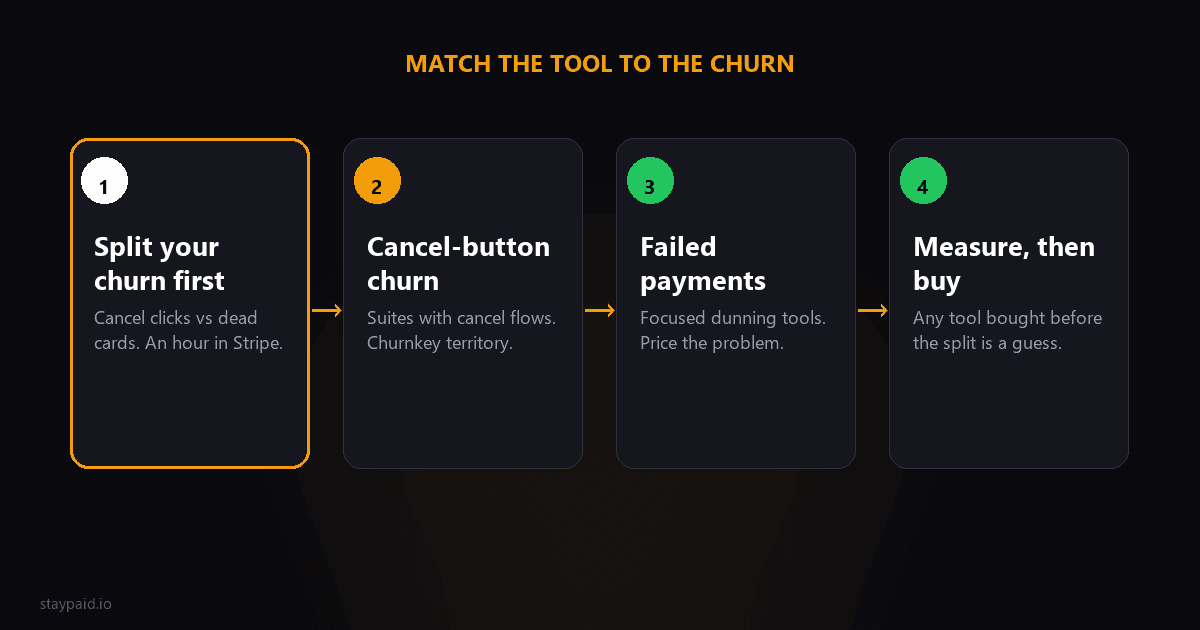
- •Under 500 customers, mostly failed payments: a focused dunning tool. Price the problem, not the suite.
- •Losing customers at the cancel button: a cancel-flow tool, possibly Churnkey itself.
- •Both problems, real scale, team to run it: the full suite starts to make sense.
- •No idea which problem you have: measure first, buy second. Any tool purchased before the measurement is a guess.
One question worth asking any vendor on a demo call, Churnkey included: show me the exact email my customer receives on their worst day, card declined, renewal failed, slightly embarrassed. If the demo dodges that email, the product is optimized for your dashboard, not your customer. That one question filters the field faster than any feature comparison table.
Start with one question: what does your churn actually look like? Pull your cancellations and split them. Customers who clicked cancel are voluntary churn. Subscriptions that died after failed payments are involuntary. The split tells you which tool category you even need.
Mostly voluntary churn, decent scale, budget available? Look at Churnkey seriously. Mostly failed payments, early stage, want control over customer-facing emails? A focused dunning tool is the right shape, and the cheapest one that fits your workflow wins. At $29 a month with no card required to try, I'd argue StayPaid is the lowest-risk way to find out how much you're leaving on the table. But I would argue that. Run your own numbers first, the churn calculator takes thirty seconds.
"The right churn tool is the one that matches your churn. Anything else is paying a suite price for a point problem."
FAQ
How much does Churnkey cost?
Churnkey doesn't publish simple flat pricing. Third-party reviews put the starting point around $250 to $300 a month, with pricing that scales by churn volume and feature set.
Is Churnkey worth it for a small SaaS?
If voluntary churn is your main problem and you have the budget, its cancel-flow tooling is genuinely strong. If your problem is failed payments and you're under a few thousand MRR in churn exposure, it's usually oversized.
What's the difference between Churnkey and Churn Buster?
Churnkey is a retention suite: cancel flows, save offers, and dunning. Churn Buster focuses on failed-payment recovery. Churnkey covers more surface area at a higher price; Churn Buster is narrower and cheaper.
Does Churnkey work with Stripe?
Yes, Churnkey integrates with Stripe for both its cancel flows and its failed-payment recovery features.
Keep reading
Robert
Founder at StayPaid
Want to recover failed payments like a founder?
Start Free — First 3 recoveries