Paddle Retain Alternatives: When Revenue Share Stops Making Sense
Paddle Retain takes a cut of your recovered revenue and lives in the Paddle ecosystem. The flat-fee alternatives for Stripe founders, with real math.
The best Paddle Retain alternatives for a Stripe-based subscription business are StayPaid ($29 per month flat), Churn Buster (established, mid-priced), and Churnkey (broader retention platform, higher price). The reason to look for an alternative at all comes down to two things: Retain's revenue-share pricing scales against you as you grow, and the product now lives inside the Paddle ecosystem, which is built around Paddle billing, not Stripe.
Let me walk through the math and the trade-offs, because 'percentage of recovered revenue' sounds harmless until you run it against real numbers.
What Retain actually is now
Retain started as ProfitWell's dunning product: automated failed-payment recovery with emails and retry logic, sold alongside ProfitWell's free metrics dashboard. After Paddle acquired ProfitWell, the products moved under the Paddle brand. The metrics side became part of Paddle's analytics story, and Retain became Paddle Retain.
The pricing model is the important part: a percentage of recovered revenue, commonly reported in the 8 to 10 percent range, with no big flat fee. For a founder recovering $200 a month, that is a rounding error and genuinely good value. The trouble is what happens when the product works.
The revenue-share math nobody runs
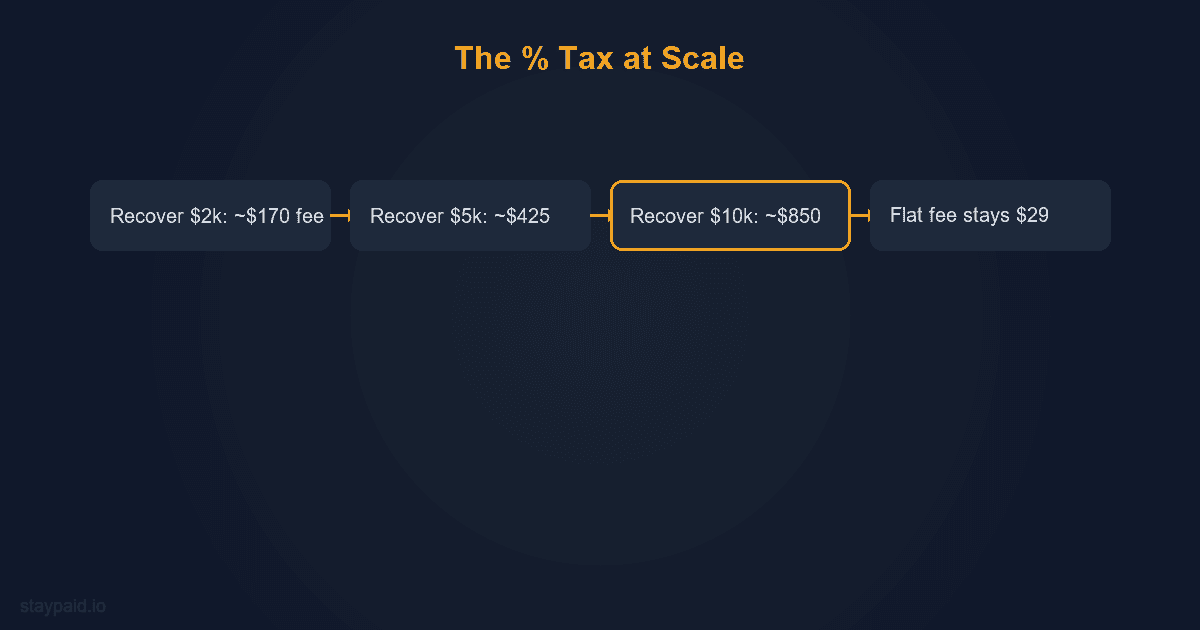
Say your dunning flow recovers $2,000 a month in failed payments. At 8 to 10 percent, Retain takes $160 to $200. Every month. That is already more than most flat-fee tools cost, and you pay it forever, on revenue the product helped you keep but did not create.
Now grow. At $5,000 a month recovered, the cut is $400 to $500. At $10,000, it is $800 to $1,000 a month, or roughly $10,000 to $12,000 a year, for email sequences and retry schedules that every serious tool in this category provides. Revenue share feels aligned at small numbers and becomes your most expensive vendor line at real ones. Worse, it scales with your success: the better your recovery performs, the more you pay, with no ceiling.
There is also a measurement subtlety worth knowing. 'Recovered revenue' attribution is generous in every tool's dashboard. A customer who would have updated their card anyway, after any reminder, still counts as recovered. You pay the percentage on the tool's own attribution math.
The ecosystem question
Paddle is a merchant of record: it wants to be your entire billing layer, handling payments, tax, and compliance in exchange for a cut of everything you sell. Retain makes the most sense for companies already inside that world. If your billing runs on Stripe, you are adopting a recovery tool whose parent company would prefer you migrated your whole billing stack to them. Roadmap priorities follow the parent strategy, not your setup.
Stripe-native founders are usually better served by a tool built Stripe-first: deeper webhook handling, faster support for Stripe-specific edge cases like SCA retries and network tokens, and no quiet incentive to move you off Stripe.
The alternatives, honestly
- •StayPaid. $29 per month flat, no cut of recovered revenue, Stripe-only. Smart retries plus a 4-email sequence sent from your own address, written like a person, with a founder-in-the-loop option before anything goes out. Built by me, so obviously included, but the pricing model is the honest argument: your recovery growing does not grow your bill.
- •Churn Buster. The original dedicated dunning tool, around a decade in the market. Solid retry logic and campaign reporting, priced on tiers that scale with volume. More expensive than StayPaid, less broad than Churnkey.
- •Churnkey. A full retention platform: cancel flows, exit surveys, dunning, analytics. Genuinely good if you want the whole suite. Overkill and priced accordingly if you only need failed payments fixed.
- •Stripe Smart Retries, native. Free and built in, and for tiny MRR it is the right answer. Its limits: generic retry timing, Stripe's own emails that customers ignore, and no control over the message. Most founders outgrow it once failed payments cost more than a tool would.
The switching cost question
Founders hesitate to switch recovery tools because it feels like open-heart surgery on billing. In practice it is closer to changing a bandage. Your recovery flow runs on webhooks and emails, not deep infrastructure: disconnect the old tool's Stripe connection, connect the new one, port your email copy (you did keep your email copy, right?), and run both dashboards side by side for a couple of weeks while the new flow takes over. The failed payments happening this month get handled by the new tool, and the tail of the old tool's sequences finishes on its own schedule.
The only genuinely sticky part is historical attribution. If your current tool claims it recovered $40,000 for you last year, you will not be able to verify or carry that number anywhere. Treat it as a sunk marketing stat and start measuring cleanly from day one on the new setup: failed revenue in, recovered revenue out, month over month. That baseline is worth more than any vendor dashboard's lifetime total.
While you evaluate, keep one bias in check: every tool in this category will show you a demo where recovery looks effortless, because demos use best-case data. Ask instead for the two things that reveal the real product. First, a full sample of the actual customer-facing emails, start to finish, because those emails go out under your brand and their tone is your tone. Second, the pricing in writing at your projected recovery volume, not your current one. A tool that looks great at $1,000 a month recovered and terrible at $8,000 is telling you something about who it is built for.
One honest caveat about flat-fee tools, since I sell one: the model only wins if the recovery quality is there. A cheap tool that recovers nothing is expensive. Judge any option, mine included, on recovered dollars per month after a real billing cycle, not on the pricing page. The nice thing about flat fees is that the math stays simple while you find out.
If you are leaving Paddle Retain specifically, one extra step belongs in your plan: export everything before you disconnect. Your recovery history, your email templates, and any customer-level notes you have accumulated are easier to grab while the account is active than to reconstruct later. Migration takes an afternoon when you prepare for it and a week when you do not. The same goes for your Stripe data itself: your decline reasons, retry history, and recovery rates live in Stripe regardless of which tool sat on top, so your ground truth survives every switch.
How to choose
Run three numbers before you switch anything. First, your monthly failed revenue: Stripe shows this in the invoice and payment views. Second, your realistic recovery rate: across the industry, well-run dunning commonly recovers somewhere around half of failed payments, with wide variance by customer mix. Third, the fee under each model: revenue share on your expected recovered amount, versus flat fees.
If failed revenue is under a few hundred dollars a month, stay on Stripe's native retries and send the emails yourself. Above that, a flat-fee tool pays for itself quickly, and the revenue-share model starts punishing you precisely when things go well. And whatever you pick, read a sample of the emails it sends. Recovery is a communication problem wearing a payments costume. The tools that talk like humans recover more than the ones that talk like systems, and that difference compounds every single month.
FAQ
What happened to ProfitWell Retain?
Paddle acquired ProfitWell and folded its products into the Paddle ecosystem. Retain, the dunning and failed-payment recovery product, now lives under the Paddle brand. The standalone ProfitWell direction faded, which is why many Stripe-native founders started looking elsewhere.
How much does Paddle Retain cost?
Retain has historically been priced as a percentage of recovered revenue, commonly reported in the 8 to 10 percent range, rather than a flat monthly fee. That sounds cheap when you recover little and gets expensive fast as recovery grows. Check Paddle's current pricing page, because packaging under Paddle has shifted over time.
Do I need to use Paddle billing to use Retain?
The product has its deepest integration with Paddle's own billing stack. If you are a Stripe-native business, you are effectively a second-class citizen in an ecosystem built around Paddle as merchant of record, which is a strong reason to pick a Stripe-first recovery tool instead.
What is the best flat-fee alternative to Paddle Retain?
For Stripe subscription businesses that want flat pricing and human-sounding recovery emails, StayPaid is $29 per month flat with no cut of recovered revenue. Churn Buster and Churnkey are the other established options, at higher price points with broader feature sets.
Keep reading
Robert
Founder at StayPaid
Want to recover failed payments like a founder?
Start Free — First 3 recoveries