What Is Smart Dunning? The Difference Between a Retry Timer and a Recovery System
Smart dunning means adapting retries and emails to why the payment failed — not blasting every customer on the same fixed schedule. Plain-English guide.
The one-sentence definition
Smart dunning is failed-payment recovery that changes its behavior based on why the payment failed, who the customer is, and what has already been tried — instead of running every failure through the same fixed retry timer and the same three emails.
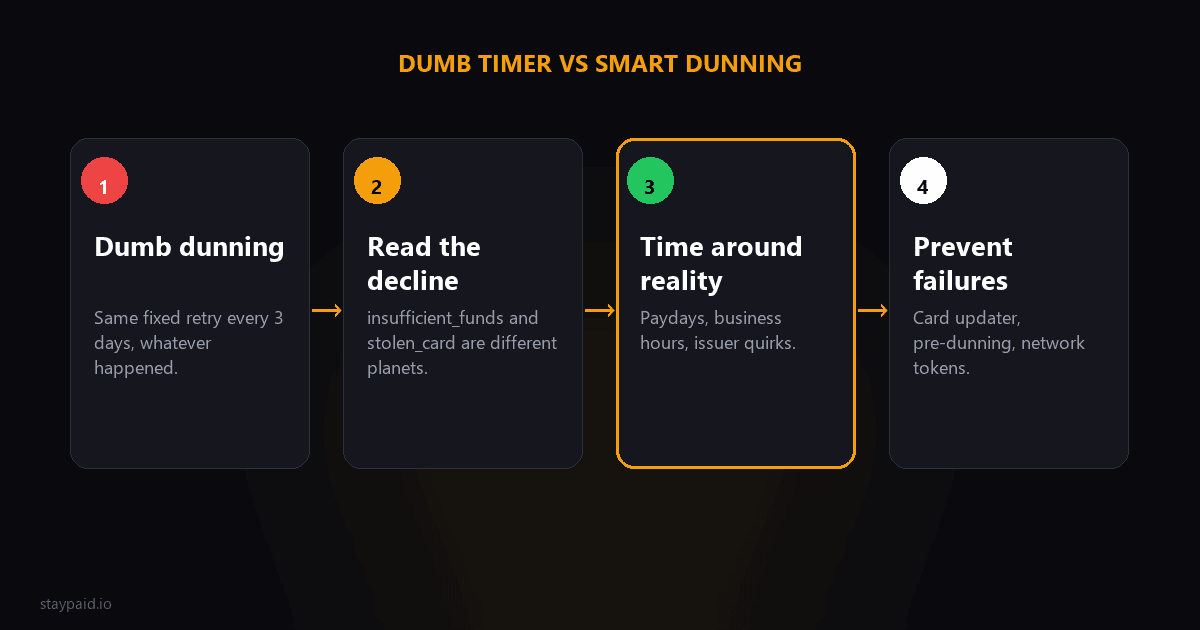
Every dunning vendor on the internet claims to be 'smart.' The word has been marketed into mush. So let's pin it down: there are four specific capabilities that separate actual smart dunning from a cron job with a logo.
1. It reads the decline reason before reacting
A failed payment is not one event. It's dozens of different events wearing the same trench coat. Insufficient funds is a timing problem — the money might be there Friday. A closed account is a dead end — retrying it is ringing a disconnected doorbell. An authentication_required is a missing human — no schedule fixes it.
Dumb dunning treats all three identically: retry in three days, send template number two. Smart dunning branches: retry the soft decline on a payday-aware schedule, email the hard-decline customer immediately because only they can fix it, and send the SCA customer a link to authenticate.
The test: does your system know the difference between insufficient_funds and card_velocity_exceeded, and does it act differently? If not, it's a timer, not a system.
2. It prevents the failures it can see coming
The cheapest failed payment is the one that never happens. Two prevention mechanisms are table stakes for anything calling itself smart:
- •Card account updater coverage: Stripe and the card networks quietly refresh reissued cards. A smart setup tracks how many updates it's actually getting instead of assuming full coverage.
- •Pre-dunning: cards that will expire before the next renewal are visible in advance. A short heads-up email before the charge fails converts absurdly well, because the customer isn't annoyed yet — nothing has gone wrong.
A system that only reacts to failures is, by definition, leaving the easiest recoveries on the table.
3. It times retries around reality
Retry timing used to mean 'try again in 3 days, then 5, then 7.' Smarter versions consider when money is likely to be in the account: end-of-month and mid-month paydays, business hours for the card-issuing region, and the card network's own retry limits (retry a hard decline too many times and networks start fining you).
Stripe's Smart Retries does a version of this with machine learning across its whole network, for free. That's a genuine floor-raiser. What it can't do is the context Stripe never sees: your customer relationship, your plan structure, the fact that this particular customer always pays after the second reminder because their accountant processes cards on Tuesdays. Smart dunning starts with Stripe's defaults and layers your own knowledge on top — it doesn't replace one with the other.
There's also a hard ceiling on retry intelligence: card networks penalize excessive retries on the same dead card, and issuers start treating you as a bad merchant. Smart dunning knows when to stop retrying and start emailing. That boundary — machine first, human second, machine stops on time — is the whole architecture in one sentence.
4. The emails adapt — and sound like a person
This is the piece vendors underinvest in, because it's the hardest to automate. Smart communication means:
- •The first email is gentle and assumes innocence — cards fail for boring reasons, and the customer is usually embarrassed, not malicious.
- •Later emails change tone with context: a customer on attempt four with a dead card needs 'your card on file was closed, can you add a new one,' not another copy of 'oops, your payment failed.'
- •High-value customers get a human. A $500/month account deserves an actual email from an actual founder. A $9/month account gets the automated track, and that's fine.
- •Everything comes from an address a human monitors. Replies to no-reply@ go into a hole, and customers with billing problems reply more than any other segment.
A side-by-side: one failed payment, two systems
Same event, two setups. A $49/month customer, 14 months of clean history, renewal fails with insufficient_funds on the 27th. The timer system: retries in three days (the 30th, still before payday, fails again), sends 'Payment Failed — Action Required' from a no-reply address on day one, day three, and day seven, identical each time. The customer opens none of them. On day fourteen the subscription cancels. Nobody at the company notices until the churn report runs.
The smart system: reads the decline code, sees a soft decline, holds the retry until the 1st — when the account is likely to be funded. Sends one short email from the founder's address on day one: 'Hey, your card declined today, happens all the time — here's a 30-second fix.' The customer updates the card that evening because the email read like a person. Retry on the 1st succeeds. Total recovery time: four days, one email, zero churn.
Nothing in the second system required exotic technology. It required reading the data Stripe already gives you and behaving like a human with it. That's the whole discipline.
Smart dunning vs the tools, honestly
Here's the part the vendor pages won't tell you: the fundamentals of smart dunning are mostly free. Card updater — built into Stripe. Retry intelligence — Stripe Smart Retries, free. Pre-dunning — one webhook and one email template. The part that isn't free is doing the communication well at scale, which is either your time or a tool's fee.
So when a platform charges $249/month for 'smart dunning,' ask which of the four capabilities it's actually adding beyond what you already have. Sometimes the answer is real (battle-tested sequences, deep analytics). Sometimes the answer is a dashboard that makes a cron job feel premium.
A smart-dunning checklist you can run tonight
- •Check your Stripe dashboard: is Smart Retries on, and what does your retry schedule look like?
- •Pull last month's failed payments and group them by decline code. How many were retryable soft declines vs dead cards?
- •Count how many customers got a pre-expiry warning before their card failed. If the answer is zero, that's your first fix.
- •Read the last dunning email your system sent. Would you reply to it? Would you even open it?
- •Find one customer worth $200+/month who failed recently. Did a human reach out, or did they get template three?
The takeaway
Smart dunning isn't a product category. It's a standard: read the decline reason, prevent what's preventable, time retries around reality, and talk to customers like a person who knows their situation. Any setup that does those four things is smart. Any setup that doesn't is a timer with a marketing budget. And when you evaluate a tool that claims the label, make it show you the difference: how does it treat a hard decline versus insufficient_funds, and what does its first email actually sound like? If the demo can't answer both, the word on the landing page is decoration.
StayPaid exists because the fourth one — the human-sounding part — is where recovery actually happens. Stripe handles the plumbing; StayPaid sends recovery emails from your own address, with you approving each one. Smart where software helps, human where it matters.
FAQ
What does smart dunning mean?
Smart dunning is failed-payment recovery that adapts to the situation: it reads the decline reason, times retries around when money is likely to be there, prevents failures it can see coming, and changes the message based on the customer. Dumb dunning is a fixed schedule that treats every failure the same.
Is smart dunning the same as Stripe Smart Retries?
No. Stripe Smart Retries is one feature — machine-learning retry timing for failed charges. Smart dunning is the whole discipline: prevention (card updaters, pre-dunning emails), intelligent retries, and personalized recovery communication working together.
What makes a dunning email 'smart'?
Three things: it references the actual situation (amount, card, decline reason), it comes at the right point in the retry sequence, and it sounds like a person rather than a billing system. A template blasted on day 1, 3, and 7 regardless of context is not smart, it's scheduled.
Do small SaaS companies need smart dunning?
Yes, but they don't need expensive software to get it. The core moves — a card updater, sensible retry timing, a personal email for hard declines — are cheap or free to implement. Enterprise platforms add scale, not the fundamentals.
Keep reading
Robert
Founder at StayPaid
Want to recover failed payments like a founder?
Start Free — First 3 recoveries