How Much Does Stripe's Card Updater Cost? The Fee, the Fine Print, and the Savings Math
Stripe's card updater pricing isn't obvious. What it costs per update, how to check your account, and the math on what one saved renewal is worth.
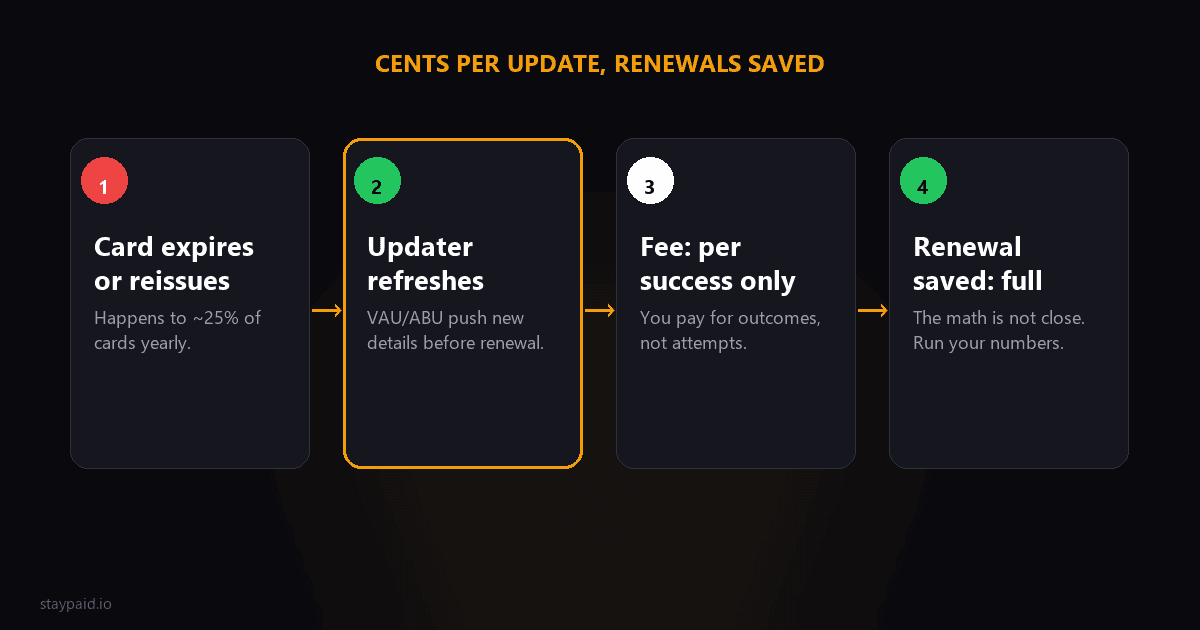
The short answer on cost
Stripe's card account updater is listed on Stripe's pricing page under individually priced features, so the honest answer is: check your own account. The commonly reported figure is around $0.25 per automatic card update for accounts where it isn't bundled into their pricing.
There's no monthly fee and no toggle. It either runs on your eligible saved cards or it doesn't, and if Stripe charges your account per update, you'll see it as a small line item per updated card. Founders usually discover this one of two ways: they spot the fee on an invoice, or they notice a customer's card magically updated itself and go looking for an explanation.
What you're paying for, mechanically
When a customer's bank reissues their card, new number or new expiry, Visa and Mastercard's updater programs notify the networks' participating merchants and processors. Stripe receives the new credentials and updates the saved payment method automatically. Your next renewal charge uses the new card. No email, no customer action, no failed payment.
That per-update fee, if your account has one, is Stripe passing along the cost of participating in those network programs. It only applies when an update actually happens. A month where no customer cards get reissued costs you nothing.
How to check your own account
Two places. First, your Stripe pricing details, either on the pricing page while logged in or in your contract if you're on custom pricing, will show whether card account updater carries a per-update fee for you. Second, your invoice line items will show updater charges if any occurred.
To see it working rather than paying, watch a customer's payment method after their bank reissues a card. The expiry date or last four digits change without the customer typing anything. That silent save is the product.
The savings math that makes the fee irrelevant
Here's the only calculation that matters. Say 100 of your subscribers get reissued cards this year. Without an updater, a chunk of those renewals fail, and you chase each one with emails and retries. Recovery on those is never 100 percent, so some of those customers are just gone.
At $30 average MRR, losing 10 of those 100 customers costs you $300 a month, every month, until you win them back, which you mostly won't. The updater fee on 100 updates, even at the reported $0.25, is $25. Once. You'd pay $25 to prevent $300 a month in losses every single time. The fee isn't a cost question, it's a rounding error next to one saved renewal.
Who actually participates, and who doesn't
The updater works through Visa and Mastercard's network programs, so coverage depends on the customer's bank opting in. Large US and European issuers mostly participate. Smaller banks, some prepaid products, and certain regions don't. American Express runs its own version. The practical takeaway: expect it to catch a majority of reissued cards, not all of them, and treat the rest as a job for your retry and email flow.
One more boundary worth knowing: a closed account has no new card to update to. When a customer switches banks entirely, the updater can't help, and that renewal will fail no matter what. Those cases are recoverable only by reaching the human.
What the updater doesn't fix
This is where founders overestimate the feature. The updater handles exactly one failure mode: the bank reissued the card and participates in the updater program. It does nothing for insufficient funds, which is the most common decline. Nothing for closed accounts, since there's no new card to update to. Nothing for cards from non-participating banks. Nothing for customers who meant to cancel and let the card die on purpose.
Think of it as the first line of defense, not the defense. Prevention for the failures it can prevent, silently. Everything else still needs retries timed right and emails that actually get opened.
What about third-party updater services?
Standalone account updater services exist and typically charge per successfully updated card too, sometimes with batch or monthly pricing. They make sense when you process across multiple gateways and want one updater layer above all of them. If you're Stripe-only, Stripe's built-in participation is almost always the simpler answer, and you're already paying for it either way.
The one scenario worth a second look: if your own data shows a high share of customers at banks that don't participate in the network programs, a third-party service with direct issuer relationships can cover gaps the networks miss. That's an edge case, and you'll only know it matters once you're measuring which cards fail to update.
How to tell whether it's working for you
You don't have to take the updater on faith. In the Stripe dashboard, look at your failed payments report filtered to card_expired and reissued-card decline codes over the last quarter. If the updater is catching its share, that slice should be small relative to your total failures. If expired cards are still a top-three decline reason, either your banks don't participate much or something in your account config is off, and that's worth a support ticket.
The cleaner signal is in the events themselves. When Stripe updates a card, the customer's default payment method changes and you can see the new expiry date on the card object. A monthly glance at how many cards changed without a failed payment in between tells you exactly how many renewals the updater saved before they ever became a problem. Those saves never appear in any recovery metric, which is why prevention tools are chronically undervalued.
Run the math at a couple of sizes so the fee stops being abstract. At 200 subscribers, maybe 60 to 80 cards change hands per year through expiry and reissue. If the updater catches half, that's 30 to 40 updates at the per-update fee, a rounding error annually, against several recovered renewals worth far more. At 5,000 subscribers the absolute fee grows, but so does the prevented churn, roughly in proportion. The ratio between cost and saved revenue barely changes with scale, which is why this is one of the few Stripe add-ons that's easy to justify at any size. And if you want the other side of the equation, the annualized leak from failed payments at your size, our churn calculator does that math in about thirty seconds. Knowing both numbers turns this from a pricing question into an obvious one. And remember the fee only applies when an update actually succeeds, so you're paying for outcomes, not attempts, which is more than most SaaS tooling can say.
The real cost question
The founders who agonize over a per-update fee are usually missing the actual leak. Open your failed payments from last quarter, count how many were expired or reissued cards, and multiply by average MRR. That number is the cost of the problem. The updater fee is the cost of the solution. In every version of this math I've ever run, the problem is orders of magnitude more expensive than the solution.
"A quarter per updated card feels like a fee until you price the alternative: a failed renewal, a recovery sequence, and a customer who might not come back."
FAQ
Is Stripe's automatic card updater free?
It depends on your plan and agreement. Stripe lists card account updater among its individually priced features, and some accounts report around $0.25 per automatic update. Check your own Stripe pricing page or invoice to be sure.
How much does Stripe charge per card update?
The commonly reported figure is about $0.25 per automatic update for accounts where it isn't bundled. Standalone third-party updater services typically charge per updated card as well.
How do I check if Stripe card updater is enabled?
It runs automatically on eligible saved cards with no toggle to flip. You can spot it working when a customer's card gets a new expiry date or number without them entering it, visible in the payment method history.
Does Stripe card updater work on every card?
No. It covers cards from participating issuers through Visa and Mastercard's updater programs. Cards from non-participating banks, and closed accounts, don't get updated.
Keep reading
Robert
Founder at StayPaid
Want to recover failed payments like a founder?
Start Free — First 3 recoveries