Pre-Dunning: How to Stop Failed Payments Before They Happen
Pre-dunning catches expiring cards and stale billing details before a Stripe renewal fails. Here's the simple playbook to stop failed payments early.
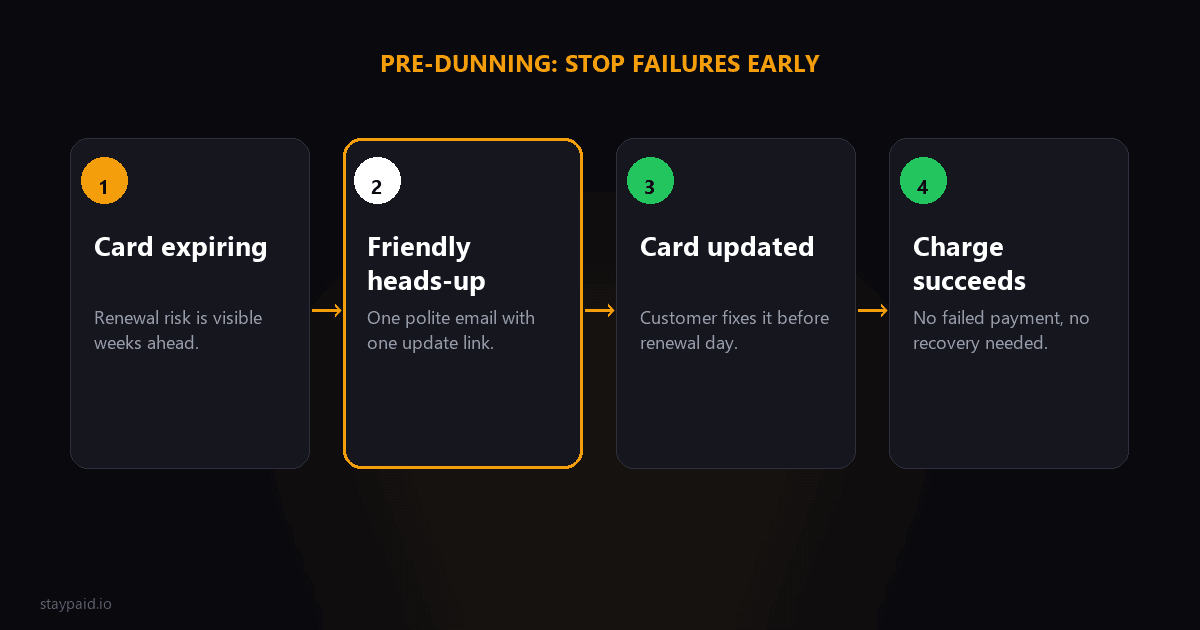
Dunning is what you do after a payment fails. Pre-dunning is what you do before it fails — catching the expiring cards and outdated billing details while there's still time to fix them without any drama. It's the most underrated lever in failed payment recovery, mostly because when it works, nothing happens. And nothing happening is hard to celebrate.
The short answer
Pre-dunning means watching for cards that are about to expire and sending a friendly update link before the renewal charge runs. It prevents the easiest failures, keeps your dunning queue smaller, and saves the recovery emails for the problems you cannot predict.
Why prevention beats recovery
Every recovered payment still costs you something: a failed charge, an anxious customer, a sequence of emails, a few days of limbo. A pre-dunning email costs one polite message. The customer updates their card before the renewal, the charge succeeds, and nobody's weekend includes the words 'payment issue.'
The math is simple: cards expire constantly. If you have a few hundred subscribers, some double-digit number of them have a card expiring every single month. That's a predictable, fixable stream of future failures sitting in your Stripe account right now.
A pre-dunning playbook that isn't annoying
- •Thirty days before expiry: a friendly heads-up. 'Your card ending in 4242 expires next month — here's a 30-second link to update it.'
- •Seven days before: one reminder, same link, same tone. Two emails total. Not five.
- •Prioritize by value: your annual plans and highest-MRR customers deserve the personal version. A $9 monthly subscriber can get the standard one.
- •Never make it scary: 'your card expires soon' is information, not a warning. Write it like information.
What Stripe gives you for free
Stripe automatically updates many cards through the card networks' updater services — when a bank issues a replacement card, the new details often flow straight into Stripe without anyone doing anything. Keep that on. It's invisible, free pre-dunning. But it doesn't cover everything: some banks don't participate, some cards genuinely expire, and billing addresses go stale. That's the slice your emails need to catch.
"The best dunning email is the one you never have to send. The second best is the one you send before anything breaks."
Pre-dunning and recovery aren't competing strategies — they're the same job at two different timestamps. Watch for expiring cards, nudge early, and your dunning queue stays small. And for the failures that slip through anyway? That's what StayPaid is for: the personal recovery email, from your address, the moment Stripe says something went wrong.
FAQ
What is pre-dunning?
Pre-dunning is the practice of catching expiring cards and stale billing details before a renewal charge fails. It usually means a friendly heads-up email with one card-update link.
How is pre-dunning different from dunning?
Dunning happens after a payment fails. Pre-dunning happens before the failure, while there is still time to update the card without a failed charge or an awkward recovery sequence.
How many pre-dunning emails should I send?
Two is usually enough: one about 30 days before expiry and one reminder about 7 days before. Keep them informational, not scary.
Keep reading
Robert
Founder at StayPaid
Want to recover failed payments like a founder?
Start Free — First 3 recoveries