Why Stripe Payments Fail (The Real Reasons — and How to Recover Them)
Most Stripe payments fail from expired cards, bank holds, or bad timing — not because customers want to churn. Here's what actually works.
I used to take failed payments personally. Every 'insufficient funds' or 'card declined' felt like a tiny rejection. Then I looked at the data and realized something obvious: most failed payments have almost nothing to do with the customer wanting to leave.
The short answer
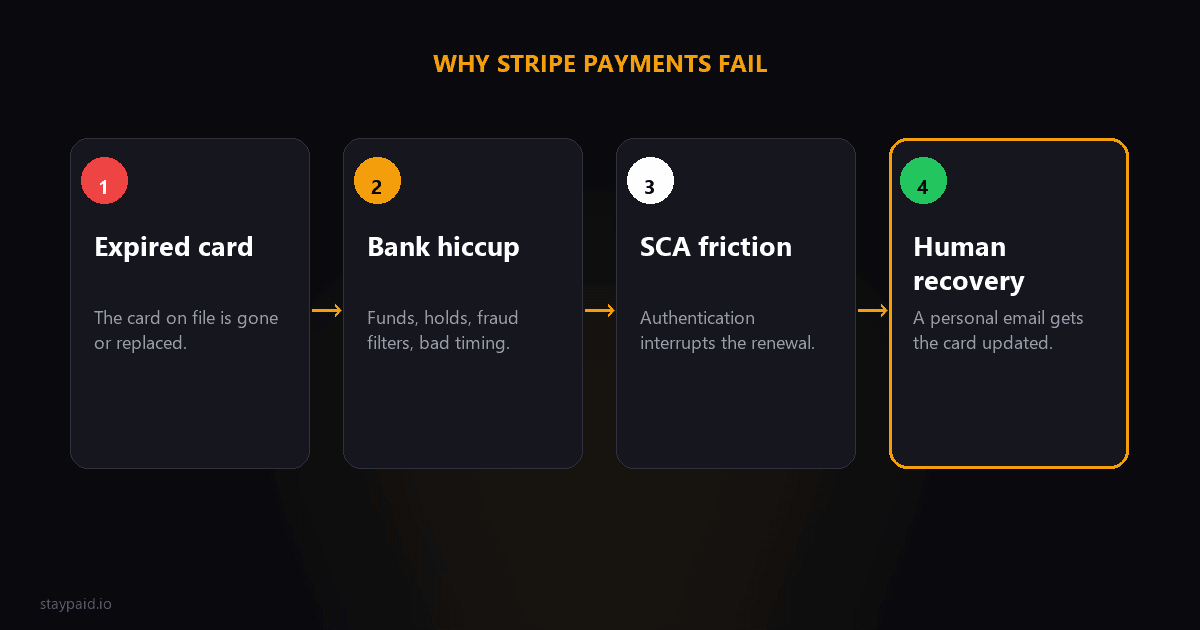
Stripe payments usually fail because the card on file expired, was replaced, hit a temporary bank hold, lacked funds at that exact moment, or got caught by SCA/fraud checks. That's why recovery works: the customer often still wants the product. They just need a fast, human nudge and one working update link.
Stripe is a fantastic payment platform, but the card networks it sits on top of are old, slow, and weirdly fragile. A charge can fail because a bank had a bad morning. It can fail because the customer got a new card and forgot to update it. It can fail because someone traveled, or because the fraud filter was set too tight, or because the moon is in the wrong phase. (Okay, not that last one. But some days it feels like it.)
The biggest failure reasons are boring, not malicious
If you look at the decline codes, the usual suspects show up again and again:
- •Expired or replaced credit cards
- •Insufficient funds at the exact moment of the charge
- •Bank-side fraud blocks or temporary holds
- •Incorrect billing details on file
- •Strong Customer Authentication (SCA) friction in Europe
None of these mean 'I hate your product.' They mean 'something is slightly wrong right now.' That's an important distinction, because it changes how you follow up.
What the customer actually wants
In my experience, subscription customers usually want to keep using the product. Updating a card is a 30-second task, but they forget, or they put it off, or they don't notice the email because it came from a no-reply address with a subject line like 'Action required: billing issue.'
What works better is a short, human email from the founder. Something that sounds like you wrote it, not like a cron job. It makes the update feel like a favor instead of a demand.
The math is worth caring about
If you're running a SaaS at $5K MRR and 15% of your payments fail every month, that's $750 in risk. At $50K MRR, it's $7,500. A small percentage of recoverable revenue turns into real money fast. The good news: a lot of it is recoverable if you reach out like a person instead of a billing system.
"Failed payments are usually a technical problem dressed up as a relationship problem. Treat them like the former, and you win both."
At StayPaid, we built the whole product around this idea. Stripe gives you the raw event. You get to decide how to respond. We keep you in the loop so the email sounds like it came from you—because it did.
FAQ
Why do Stripe payments fail?
Most Stripe payments fail because of expired or replaced cards, insufficient funds at the moment of the charge, bank-side fraud holds, incorrect billing details, or SCA friction. They usually do not mean the customer wants to cancel.
Can failed Stripe payments be recovered?
Yes. Many failed Stripe payments are recoverable when you combine Stripe retries with a fast, personal email that gives the customer one easy card-update link.
Does Stripe automatically retry failed payments?
Stripe can retry failed charges with Smart Retries, but retries cannot fix a dead card by themselves. Recovery works best when the retry is paired with a human-sounding customer email.
Keep reading
Robert
Founder at StayPaid
Want to recover failed payments like a founder?
Start Free — First 3 recoveries