insufficient_funds: The Most Common Stripe Decline, and the Payday Trick That Fixes It
insufficient_funds is the most common Stripe decline and the most recoverable. The payday retry playbook, plus the email that doesn't shame anyone.
The 30-second answer
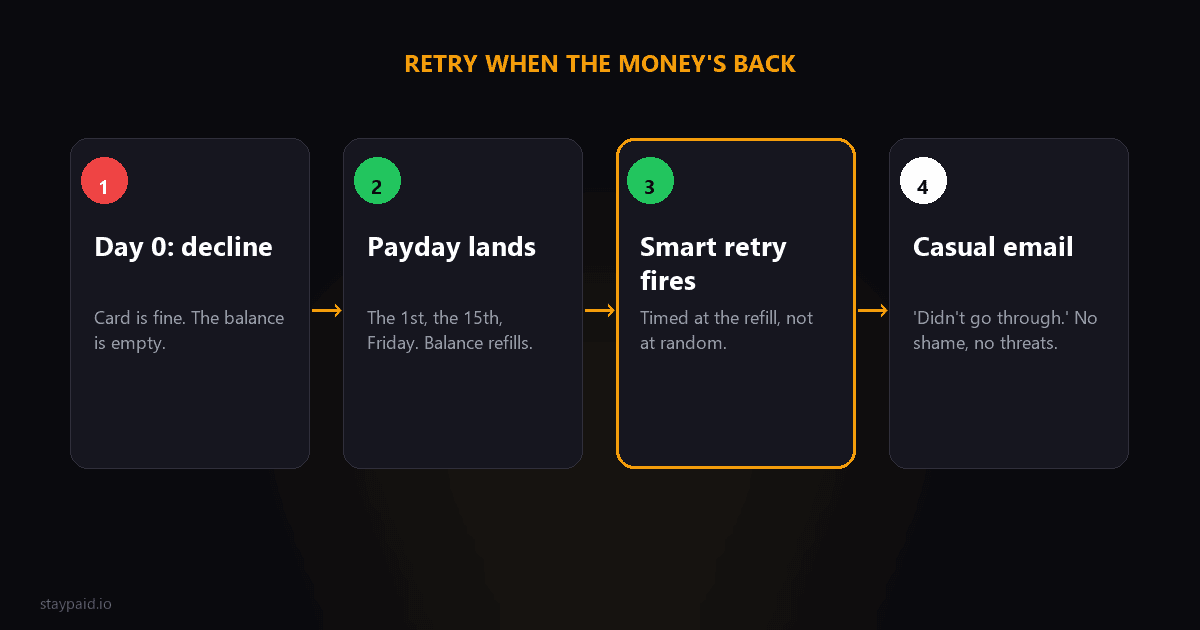
insufficient_funds means the card is fine but the account was empty at the moment Stripe tried to charge it. It's a soft decline — the single most common one — and it's the most recoverable failure you'll ever deal with, because the fix isn't a new card. It's better timing. Retry around payday (the 1st, the 15th, Fridays in the US) and a big share of these just... succeed.
If you only learn one decline code, learn this one. Open your Stripe dashboard, look at your failed payments, and count how many say insufficient_funds. For most subscription businesses, it's the plurality of all declines. And it's the one where your retry strategy actually moves the needle.
Why this decline is different
Most decline codes describe a problem with the card. Wrong number, expired, reported stolen, bank said no. insufficient_funds describes a problem with a moment in time. The card works. The account exists. The customer probably still wants your product. There just wasn't enough money sitting there at 3:07 AM when your subscription renewal fired.
That's important because it flips the strategy. With a dead card, you need the customer to act — new card details, human involvement. With insufficient funds, you mostly need patience. The money is coming. People's balances are cyclical: salary lands, rent leaves, subscriptions fight over what's left in between. Your charge lost the timing lottery. Retrying smart is buying more lottery tickets at better times.
The payday effect
Here's the pattern that matters. In the US, the most common pay cycles land on the 1st and 15th of the month, and on Fridays for weekly and biweekly pay. Account balances are fattest in the 24-72 hours after payday and thinnest right before the next one.
Now think about when subscription renewals fire: whatever day of the month the customer happened to sign up, at whatever hour your billing anchor lands. Random timing against a cyclical balance. A charge that fails on the 28th — three days of rent, groceries, and utilities after the 15th payday, days before the 1st — tells you almost nothing about whether the customer can pay. It tells you when you asked.
- •Worst retry: an hour later, or the next morning. Same empty account, same result, and you're burning retry attempts.
- •Lazy retry: same time next week. Better, but you might land in the same pre-payday trough.
- •Smart retry: 2-4 days out, aimed at the next balance peak — the 1st, the 15th, or a Friday. This is what Stripe's Smart Retries tries to do with machine learning, and it's genuinely one of the better uses of ML in payments.
If you run your own retry logic, you don't need machine learning to capture most of this. A dumb rule — 'retry insufficient_funds declines on the next payday boundary, not tomorrow' — gets you most of the way there.
Debit cards hit this harder
One nuance worth knowing: insufficient_funds shows up far more on debit cards than credit cards. A credit card decline for funds means the customer is at their credit limit — a real solvency signal. A debit decline just means the checking account is temporarily thin. Debit-heavy customer bases (B2C subscriptions, lower-price tiers, international markets where debit dominates) will see this code constantly, and they're also the most recoverable customers you have. Don't write them off.
The email part (handle with care)
If two or three smart retries over a week haven't recovered the payment, it's time to involve the human. And here's where tone matters more than anywhere else in dunning: overdrafts are embarrassing. An email that reads like a collections notice — 'YOUR PAYMENT HAS FAILED. UPDATE IMMEDIATELY' — doesn't just underperform. It actively churns people who were 48 hours away from paying you.
The email that works for insufficient_funds is casual and low-stakes. Something like: 'Hey — your payment didn't go through, happens all the time, usually the bank being weird about timing. Here's a link to retry whenever works: [link]. No rush, your account is fine for now.' You'd be amazed how often people see that, think 'oh right, payday is Thursday,' and just fix it themselves.
"With insufficient_funds, you're not chasing a debtor. You're tapping someone on the shoulder at a better moment. Write the email like you know that."
What NOT to do
- •Don't retry five times in 24 hours. The balance that was empty at 3 AM is still empty at noon. Rapid retries burn attempts and can look like card testing to fraud systems.
- •Don't lead with the deadline in email one. 'Pay now or lose access' on day zero turns a timing hiccup into a breakup. Save the stakes for later in the sequence.
- •Don't cancel after the first failed week. The whole point of the payday cycle is that week two is often when the money arrives. Cutting early converts a recoverable account into a churned one.
- •Don't mention 'insufficient funds' in the email. The customer knows their balance. Naming it feels like an accusation; 'your payment didn't go through' is all they need to hear.
The pattern behind all four: this decline code punishes aggression and rewards patience. Almost every instinct that works for dead cards is counterproductive here.
Worth knowing how this code compares to the rest of your decline mix: insufficient_funds is the one where YOUR behavior has the most influence on the outcome. A stolen card is gone no matter what you do. An empty checking account is a customer who will pay you if you ask at the right moment in the right tone. When I look at a SaaS with a poor recovery rate, this is the first code I check — because improvements here are immediate and entirely within your control. No new tool required, no budget request, just better timing and a better email.
A sane insufficient_funds playbook
- •Retry 1: 2-4 days after the failure, aimed at the nearest payday boundary (1st, 15th, or Friday).
- •Retry 2: 3-4 days after that, next balance peak. Two smart retries beat five random ones.
- •Email 1: after retry 1 fails — light, casual, 'happens all the time' framing, one clear retry link.
- •Email 2: after retry 2 fails — still friendly, but now mention the date access will pause if it doesn't resolve.
- •Grace period: give them a real window (a week or so) before cutting access. Pre-payday customers come back; cut-off customers often don't.
Notice what's not in that playbook: panic. insufficient_funds subscribers are the lowest-intent churners in your entire funnel. They didn't choose to leave. Most of them will pay you the moment money and timing line up — if you haven't alienated them with a robot email from noreply@ in the meantime.
This decline-code-aware approach is exactly how I built StayPaid's recovery flows: insufficient_funds gets patient, payday-aware retries and a friendly nudge from your own email address, while genuinely dead cards get a different, more direct sequence. Same tool, different playbook per code — because a timing problem and a solvency problem are not the same problem. If you're doing this manually for now, start by just separating this one code from everything else. It's the highest-leverage split you'll make.
FAQ
What does insufficient_funds mean on Stripe?
It means the card is valid but the account behind it didn't have enough money at the moment of the charge. It's a soft decline — the card works, the balance didn't. Retrying later often succeeds.
When is the best time to retry an insufficient_funds decline?
Around payday. In the US that's typically the 1st and 15th of the month and Fridays. A retry 2-4 days after the first failure lands in a very different bank balance than a retry an hour later.
Is insufficient_funds a soft or hard decline?
Soft. The card and account are fine — the timing was wrong. Hard declines like stolen_card or lost_card will never succeed on retry; insufficient_funds frequently does.
Should I email the customer about an insufficient_funds decline?
Yes, if retries don't recover it within a few days. Keep the tone light — overdrafts are embarrassing, and a shame-y email loses the customer even when the retry would have worked.
Keep reading
Robert
Founder at StayPaid
Want to recover failed payments like a founder?
Start Free — First 3 recoveries