How to Reduce Chargebacks on Subscriptions: A Founder's Playbook
Most subscription chargebacks are confusion, not crime. The playbook: descriptors, receipts, renewal warnings, easy cancel, and honest dunning.
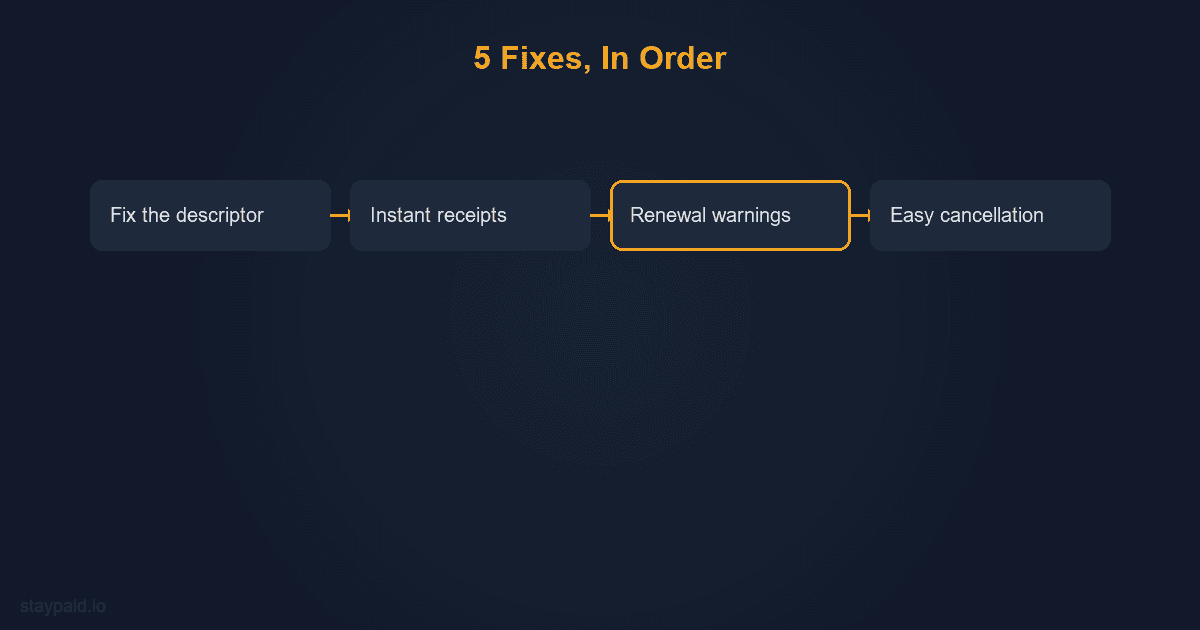
To reduce chargebacks on subscriptions, fix the three things customers dispute about most: they did not recognize the charge, they thought they had canceled, or they could not reach you. In practice that means a clean statement descriptor, instant receipts, renewal warnings, a findable cancel button, and dunning emails that announce charges instead of surprising people with them. Do those five things and most of your dispute problem disappears, because most subscription disputes were never fraud.
The rest of this playbook orders the fixes by the dispute causes they kill, with the monitoring math that tells you how urgent your situation actually is.
Know your number first
Your chargeback ratio is disputes divided by settled transactions for the month. Stripe shows disputes in the dashboard; do the division yourself once a month and write it down. The thresholds that matter: processors get uncomfortable around 0.5% to 0.9%, and Visa's VAMP program sets the merchant Excessive line at 1.5% as of April 1, 2026, down from 2.2% at launch, per Visa program updates reported by the Merchant Risk Council.
If you are under 0.3%, keep doing what you are doing and skim the rest for gaps. Between 0.3% and 0.9%, you have a specific leak to find. Above that, stop everything and treat it as an emergency, because your acquirer soon will.
Fix 1: the descriptor (kills 'unrecognized' disputes)
Pull up your own bank statement and look at your charge the way a customer does. If it shows your legal entity, a payment-processor prefix, or an abbreviation only your accountant recognizes, that is your top dispute source. In Stripe, set the statement descriptor to the product name customers know, and use the shortened descriptor and phone number fields so the bank's truncated version still makes sense.
This is a ten-minute fix that attacks the single biggest category of subscription disputes. A customer who can match the line item to a product they know does not tap 'report a problem'.
Fix 2: receipts and renewal warnings (kills surprise)
- •Send a receipt for every successful charge, instantly. Stripe can do this natively; turn it on and check the emails actually render.
- •Warn 7 days before annual renewals. Annual charges are large, rare, and forgotten, the perfect dispute recipe. One email converts most of them into happy renewals or clean cancellations.
- •Email before the first charge after a trial ends. The trial-to-paid transition is the highest-surprise moment in your entire billing lifecycle.
- •If a failed payment succeeds on retry days later, confirm it immediately. A charge landing on a random Thursday with no warning is how silent retries manufacture disputes.
Fix 3: make leaving easy (kills 'I could not cancel')
Every founder knows a cancel button should exist. Fewer check the full path: can a logged-out customer find it, does it take under two minutes, and does a confirmation email land instantly saying no further charges will occur? That confirmation email is legal-grade evidence, and it also calms the person down. An ex-customer holding written confirmation does not dispute. An ex-customer who submitted a form into the void calls their bank.
The same logic applies to refunds. A refund request answered within a day, granted generously, costs you the revenue. The same request ignored for a week costs you the revenue, a dispute fee, ratio damage, and a support fight. Fast refunds are the cheapest dispute prevention on this list.
Fix 4: honest dunning (kills the failed-payment surprise)
Failed payments are a chargeback factory when handled silently. The sequence looks like this: a card fails, the system retries quietly for two weeks, one retry lands, and the customer sees a charge from a product they had mentally written off. They dispute a charge you fairly earned, because you never told them it was coming.
The fix is a dunning flow that communicates like a person. An email when the payment fails, naming the product and the amount. A clear note about when you will try again. And a confirmation the moment a retry succeeds. Now the charge is expected, documented, and matched to an email the customer received. You recovered the revenue and created evidence at the same time.
"Every dispute reason code is a review of your billing communication, written by your most confused customer."
Fix 5: read your disputes like analytics
Once a month, export your disputes and group them by reason code. 'Fraud' codes on accounts with months of history are usually friendly fraud, which points at descriptor and receipt gaps. 'Canceled' codes point at your cancellation flow and renewal warnings. 'Product not received' on a SaaS almost always means the customer never got their login or invoice emails. Each cluster has one owner and one fix. If you only fight disputes one at a time, you are doing customer support. Grouped, they are a roadmap.
A worked example of the math
Say you process 4,000 successful charges in a month and take 28 disputes. Your ratio is 28 divided by 4,000, which is 0.7%. That feels small, and many founders shrug at it. But 0.7% sits inside the band where processors start watching, and it is nearly half of Visa's 1.5% Excessive line. Now run the trend: if last month was 0.5% and the month before was 0.35%, you do not have a 0.7% problem, you have a doubling problem. The number matters less than its slope.
The same math tells you what a fix is worth. Cutting disputes from 28 to 14 a month is a 0.35-point ratio drop, roughly 14 dispute fees saved, 14 customer relationships not torched, and about 10 hours of evidence-writing handed back to you. Prevention work has a measurable ROI, which is more than most founder tasks can say.
What this looks like in practice
None of this requires enterprise tooling. Descriptor and receipts are Stripe settings. Renewal warnings are one scheduled email. Cancellation is product work you do once. The dunning side is where I am biased: I built StayPaid to send those failed-payment emails from your own address, written like a human, precisely because announced charges do not get disputed the way silent retries do. But even if you use nothing but Stripe's built-in emails, turn them on and make them clear. The cheapest chargeback is the one that was never filed.
A final word on sequencing, because founders always ask where to start. Start with the descriptor, because it takes ten minutes and attacks the biggest category. Then receipts and renewal warnings, because they are configuration, not code. Then the cancel path, because it is the one your future self will thank you for when the 'I could not cancel' disputes stop arriving. The dunning layer you can add last, but do not skip it: silent retries quietly manufacture the disputes that everything else just cleaned up. Work the list in order, check the ratio monthly, and give each fix a full billing cycle to show up in the numbers before judging it. One warning before you start: resist the urge to fight every dispute harder instead of preventing the next one. Fighting feels productive because there is a deadline and a submit button. Prevention is invisible until the monthly number drops. The founders who actually fix their chargeback problem spend 20 percent of their energy on disputes that already happened and 80 percent on the billing experience that creates them.
FAQ
What is a normal chargeback rate for a SaaS?
Card networks start paying attention around 0.5% to 0.9% of transactions, and Visa's VAMP Excessive threshold for merchants is 1.5% as of April 2026. Healthy subscription businesses typically run well under 0.5%. If you are anywhere above that, treat it as a product and communication problem, not bad luck.
Do chargebacks hurt even if I win them?
Yes. A won dispute still counts toward your monitoring ratio at the networks, still costs you the dispute fee in most setups, and still usually costs you the customer. Winning is better than losing, but the only good dispute is the one that never gets filed.
Should I just refund anyone who asks to avoid disputes?
Mostly yes, and it is cheaper than the alternative. A refund costs you the revenue. A dispute costs the revenue, a fee, ratio damage, and your time. A fast, generous refund policy is dispute insurance, not weakness. Reserve the fights for clear friendly fraud where you have strong evidence.
Does a dunning tool affect chargebacks?
Indirectly, yes. Silent retries that succeed days later produce surprise charges, and surprise produces disputes. A dunning flow that emails the customer clearly before and after each retry turns a surprise into a documented, expected charge.
Keep reading
Robert
Founder at StayPaid
Want to recover failed payments like a founder?
Start Free — First 3 recoveries