Free Trial Conversion Rate: Benchmarks, and the Failed Charge Nobody Counts
SaaS trial conversion benchmarks by trial type, and the part every benchmark skips: the first charge after trial is where the revenue actually dies.
Median SaaS free trial conversion sits around 8 to 10 percent for opt-in trials with no card required, and several times higher for opt-out trials that take a card upfront, according to widely cited industry benchmark data from sources like ChartMogul and ProductLed. But the number every founder should obsess over is not the conversion rate. It is how many of those converted trials survive their first real charge.
Let me give you the benchmarks first, then the failure mode nobody puts in the benchmark posts.
The benchmarks, by trial type
Benchmarks only make sense split by trial model, because the two models produce completely different funnels.
- •Opt-in trials (no card required). Signup is frictionless, so trial volume is high and intent is low. Median free-to-paid conversion lands around 8 to 10 percent in commonly cited datasets. Your job in this model is activation: getting the user to the value moment before the trial ends.
- •Opt-out trials (card required upfront). Signup friction filters for intent, so conversion multiplies, often cited in the 25 to 50 percent range depending on market and price point. Your job in this model is trust and billing hygiene, because every one of those conversions starts with an automatic charge.
- •Freemium is a third animal entirely, with free-to-paid rates often in the low single digits, and it belongs in a different post.
If your opt-in trial converts at 6 percent, you are not necessarily broken; you may be near median with an activation problem. If your card-required trial converts at 15 percent, you have a real problem, because that model should be doing far better. Diagnose against the right baseline before fixing anything.
One more caveat on every benchmark you will ever read, including these: the spread inside each category is enormous. Price point, market maturity, and trial length move the numbers as much as the trial model does. A $300-a-month B2B tool and a $9 consumer app both have 'free trial conversion rates', and quoting one number across both is meaningless. Use benchmarks to decide whether you are roughly on track or wildly off, then stop reading them. Your own month-over-month trend is the only benchmark that pays you.
The charge that decides everything
Here is the part the benchmark posts skip. In a card-required trial, the moment of conversion is not a form submission. It is an automatic charge on a card entered two or three weeks ago, for a customer who may have forgotten the trial was ending, issued by a bank that has never seen your recurring charge before.
That charge fails at a higher rate than your steady-state renewals, for structural reasons. Cards expire between signup and first billing. Trial users hit their card's limit or change banks. Issuers treat a brand-new recurring merchant with extra suspicion. And when the charge fails, most founders treat it like any other failed payment, or worse, like a lost cause, because 'the trial did not convert'.
Reframe it: a failed first charge after a card-required trial is not a conversion problem. It is a recovered-customer problem. This person gave you their card, used your product for the full trial, and did not cancel. They are the highest-intent user you will ever have, and they are one declined transaction away from vanishing.
The 3-day warning that changes the math
Stripe fires the customer.subscription.trial_will_end webhook three days before a trial converts. That webhook is your trigger for the single most valuable email in the trial funnel: 'Your trial ends on Thursday, your card ending 4242 will be charged $29, here is what you get, here is how to update the card or cancel.' One email, four facts.
This email does three jobs at once. It converts on-the-fence users by restating value at the decision moment. It catches expiring and replaced cards before the charge fails, because the customer clicks and updates. And it pre-empts the 'I did not know I would be charged' dispute, which is the ugliest way to start a customer relationship. Founders who skip this email are choosing to have harder conversations later, with their bank ratio and their support queue.
Write it like a person, not a billing system. The subject line that works is the honest one: 'Your trial ends Thursday.' Not 'Important account information', not 'Action required', and definitely not a fake-urgent countdown timer. The body names the plan, the price, the card on file, and the two exits: update the card or cancel, each one click. Founders are sometimes tempted to make the cancel path murky in this email to protect conversion. Do the opposite. A customer who cancels cleanly at trial end costs you nothing and might return. A customer who feels trapped becomes your next dispute, and disputes at the trial boundary are the hardest kind to win, because the customer's story, 'I never agreed to be charged', sounds plausible even when your checkout was honest and clearly worded. Prevention beats evidence here, every single time.
When the first charge fails anyway
Some first charges fail no matter what you do. What happens in the next 72 hours decides whether your conversion rate is real. The recovery sequence that works: retry smartly over a few days rather than hammering the card hourly, and send a personal email immediately, from an address a human reads, saying the payment did not go through and here is a one-click way to fix it. Not a threat, not a 'your account is SUSPENDED' robot notice. A note from the founder, because these are your newest customers and the tone of this email is the tone of the relationship.
"A trial conversion is not a conversion until the first charge clears. Everything before that is a promise."
The metric to add to your dashboard
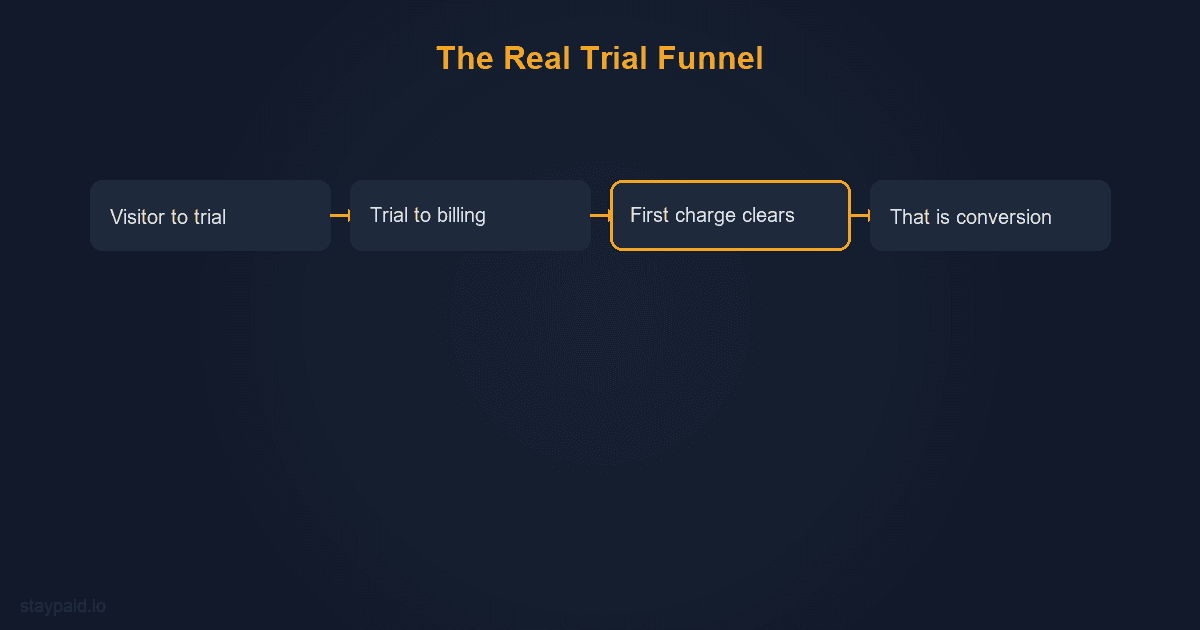
Track first-charge success rate separately from your overall failed-payment rate: of trials that reached billing this month, what share charged successfully on the first attempt, and what share were recovered within a week? Watch what happens to your 'real' trial conversion rate when you multiply signup-to-trial, trial-to-billing, and first-charge success together. Most founders find their leaky funnel is not the trial. It is the charge at the end of it.
That last mile is exactly why I built StayPaid: smart retries and personal recovery emails from your own address, including the trial-conversion moment, for $29 a month flat. You already did the hard part, getting the card and earning the trial. Do not lose the customer to a declined charge and a robot email.
One last piece of measurement advice before you go tweak anything. Run your funnel math monthly with four numbers: visitors to trial, trial to billing attempt, first-charge success, and 90-day retention of new converts. The third number is the one almost no dashboard shows you, and it is where the quiet losses live. I have seen founders celebrate a 40 percent trial conversion rate while their real, money-collected conversion was 31 percent, with the missing 9 points dying in failed first charges nobody followed up on. Fix the charge, and your conversion rate improves without a single change to your landing page, your onboarding, or your pricing. It is the cheapest conversion-rate optimization in SaaS.
FAQ
What is a good free trial conversion rate for SaaS?
It depends heavily on trial type. Widely cited industry data, including ChartMogul and ProductLed benchmark reporting, puts median free-to-paid conversion around 8 to 10 percent for opt-in trials with no card required, while opt-out trials that require a card upfront commonly convert several times higher. Compare yourself to your trial type, not a generic average.
Should I require a credit card for my free trial?
If your product delivers value fast and your traffic is qualified, yes: card-required trials convert far more trials into customers. The trade-off is fewer trial signups and a new risk most founders miss: the first real charge after the trial is a high-failure moment that needs its own recovery plan.
Why do trial-to-paid first charges fail so often?
The card was entered weeks ago and may have expired, hit a limit, or been flagged by an issuer wary of a new recurring merchant. The customer also forgot the trial was converting, so an unexpected-looking charge gets declined or disputed. It is the highest-friction charge in your entire billing lifecycle.
How do I improve trial conversion without more traffic?
Three levers: shorten time-to-value inside the trial, send a reminder 3 days before the trial ends (Stripe fires the trial_will_end webhook for exactly this), and treat the first charge with pre-dunning and instant recovery, because a failed conversion charge that nobody follows up on is a customer you already won and then lost.
Keep reading
Robert
Founder at StayPaid
Want to recover failed payments like a founder?
Start Free — First 3 recoveries