Dunning Management Software: What It Actually Does and When a Small SaaS Needs It
What dunning management software actually does, when a spreadsheet stops working, and how to pick one built for SaaS instead of enterprise AR teams.
What dunning management software actually is
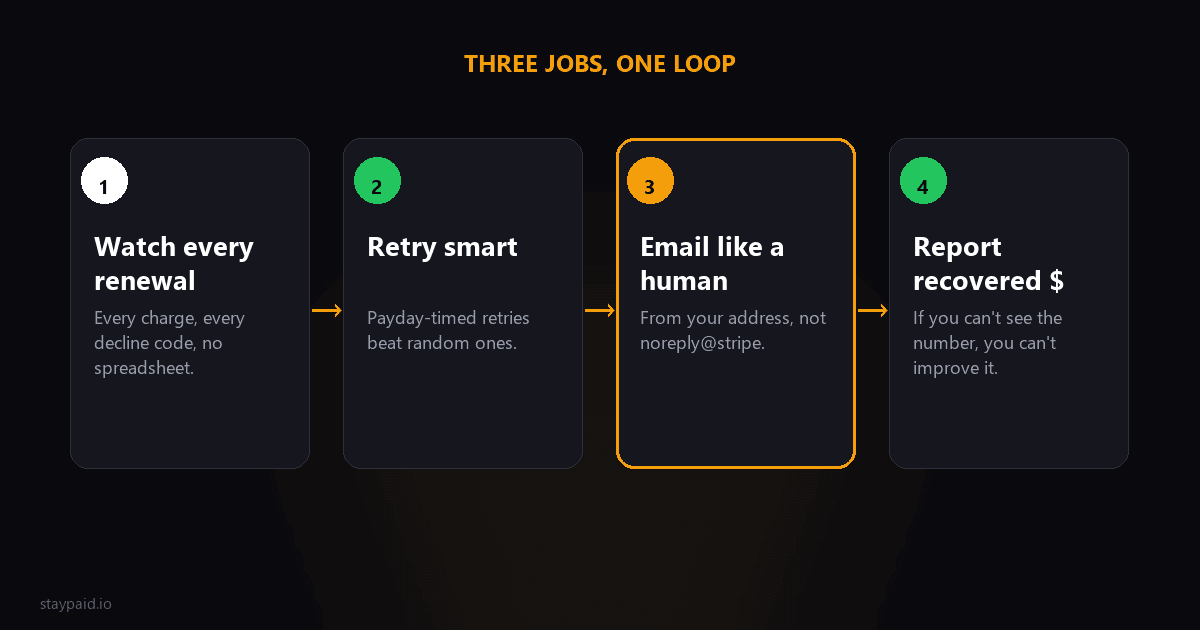
Dunning management software handles failed subscription payments as a system: it retries the charge, emails the customer, and reports what got recovered. You stop digging through Stripe at 11pm and start running a process.
The term sounds enterprisey. It isn't. Dunning is just the old accounting word for asking customers to pay what they owe. Management means you do it on purpose, on a schedule, with numbers attached. If you have subscribers, you already do dunning. The only question is whether a tool runs it or you do.
The reason this category exists at all: payments industry research from companies like Recurly and ProfitWell has consistently put involuntary churn at roughly 20 to 40 percent of total churn for subscription businesses. The customer didn't decide to leave. Their card expired, hit a limit, or got flagged by a bank. That's a plumbing problem, and plumbing problems have tools.
The three jobs every dunning tool does
Strip away the marketing pages and every tool in this category does some mix of three jobs: retries, customer emails, and reporting. Card updater services sit next to these as prevention, quietly refreshing expired card numbers before the charge ever fails.
- •Retries. Charging the card again at smarter times than the defaults, because a decline at 2am on the 1st might succeed on payday.
- •Customer emails. Telling the customer their payment failed and giving them a way to fix it. This is where most recovery actually happens, and where most tools are laziest.
- •Reporting. Telling you how much failed, how much came back, and what's still at risk. Without this you're flying blind on a revenue leak.
Card updater services sit next to these as prevention. They quietly refresh expired card numbers before the charge ever fails. Serious setups use all four pieces together: prevention, retries, emails, reporting.
The money math, with real numbers
Say you have 300 subscribers at $40 average MRR: $12,000 monthly. A typical SaaS sees somewhere between 5 and 10 percent of renewal charges fail in a given month. Call it 7 percent, about $840 at risk every month. Recover half and you get roughly $420 back monthly, about $5,040 a year, against $348 a year for a flat $29 tool. That trade isn't close. But run your own numbers, not mine: our churn calculator takes your customer count, MRR, and failed-payment rate and shows the annual leak in dollars, thirty seconds, no email required.
When a spreadsheet stops working
If you have 20 subscribers, you don't need software. You need a Stripe email filter and the willingness to send a personal note when a charge fails. I did exactly that early on, and honestly, it converts great. A founder emailing 'hey, your card declined, no stress, here's the link' is almost unfair competition for any tool.
The breaking point usually lands somewhere between 50 and 200 paying customers. Failed payments start happening weekly instead of monthly. You forget one. Then you forget three. At 5 percent failures and $50 average MRR, a 200-customer SaaS has about $500 failing every month. Let that sit for a quarter and you've waved goodbye to $1,500 you already earned. The real signal isn't customer count though. It's the day you can't name every customer with a failed payment from memory anymore. That's when you need a system.
The three pricing shapes, and what each one punishes
Dunning tools price themselves three ways, and the shape matters more than the number:
- •Flat monthly. You pay the same whether you recover $100 or $10,000. Predictable, founder-friendly, and it gets relatively cheaper as you grow. This is what we do at StayPaid, so again, bias disclosed.
- •Percentage of recovered revenue. Sounds aligned, and it is, until you're recovering $5,000 a month and handing over a five-figure annual cut for what is fundamentally retry logic and emails.
- •Per-transaction or per-attempt. Punishes volume. Fine at 50 customers, quietly expensive at 500.
Run the pricing model against your 12-month projection, not your current MRR. The tool you pick today should still make sense at three times your size, because switching dunning providers mid-growth is a migration nobody enjoys.
Enterprise AR tools vs SaaS dunning tools
Search this category and half the results are enterprise accounts-receivable platforms: tools built for finance teams chasing B2B invoices on net-30 terms. They do dunning, but for a different sport. Procurement cycles, CSV exports, AR aging reports, six-figure contracts.
SaaS dunning is a different job. Your customers are on cards, on Stripe, renewing monthly. The failure is instant and the fix is a working card, not a purchase order. Tools in this world plug into your billing and work the failed-renewal problem specifically. Quick filter: if a vendor's demo talks about collections workflows and aging reports, close the tab. If it talks about retry timing and update-card pages, keep reading.
What to actually evaluate
- •Who sends the email. From your address with your name, or from a no-reply@ robot address customers have trained themselves to ignore.
- •How much control you keep. Can you read and edit what goes out, or does a black box talk to your customers for you?
- •Retry logic. Fixed schedule, or timed around decline type and payday patterns?
- •Price shape. Flat monthly, percentage of recovered revenue, or per-transaction. Each punishes a different stage of growth.
- •Setup cost. If it needs an SDK integration and a sprint of dev time, that belongs in the price column.
Can you build this yourself? Sure. A webhook listener, a retry schedule, an email template. The question isn't whether you can, it's whether you want to maintain dunning infrastructure instead of your product. Most founders answer that honestly after their first weekend debugging webhook retries.
A realistic rollout for a small SaaS
If you're setting this up for the first time, resist the urge to turn on everything at once. Week one: connect the tool and let it watch, no emails, no retries. You want a baseline of how much actually fails. Week two: enable retries. Week three: turn on customer emails, starting with the gentlest template. By week four you have a full system and you know which piece moved which number.
That staggered approach also protects you from the classic mistake: emailing customers about a 'failed payment' that Stripe was already going to recover on its own retry. Good tools suppress those. Bad tools spam your customers with false alarms, and you only find out from an angry reply.
The question most comparisons skip
Every comparison post asks which tool recovers the most money. Fair. But dunning emails land in your customer's inbox wearing your brand. The better question: which tool recovers money without making your company sound like a collections agency.
That's the bias behind how I built StayPaid, so take it with the appropriate grain of salt. Recovery emails go out from your own address, and you can review them before they send. Automation does the watching and the timing. A human keeps the relationship. Whatever tool you pick, make sure it answers that relationship question on purpose, not by accident.
"Dunning is a revenue problem wearing a customer-service costume. The software you pick decides which of the two your customers experience."
FAQ
What is dunning management software?
Software that automates the recovery of failed subscription payments: retrying the charge, emailing the customer to update their card, and reporting how much revenue came back.
Is dunning management software worth it for a small SaaS?
Usually once you pass roughly 50 to 100 paying customers. Below that, a personal email from the founder works fine. Above it, failed payments pile up faster than you can chase them by hand.
What is the difference between dunning and collections?
Dunning is asking an existing customer to fix a failed payment so their subscription continues. Collections is pursuing debt after the relationship is over. Good SaaS dunning feels like customer service, not collections.
Can Stripe do dunning management by itself?
Stripe includes Smart Retries and basic failed-payment emails. That covers retries and a generic notification, but not custom messaging, emails sent from your own address, or real recovery reporting.
Keep reading
Robert
Founder at StayPaid
Want to recover failed payments like a founder?
Start Free — First 3 recoveries