Churn Buster vs Churnkey vs Butter Payments: An Honest Comparison for Stripe SaaS (2026)
Churn Buster vs Churnkey vs Butter Payments compared: real pricing, who each is built for, and what a Stripe SaaS actually pays in 2026.
The honest answer first
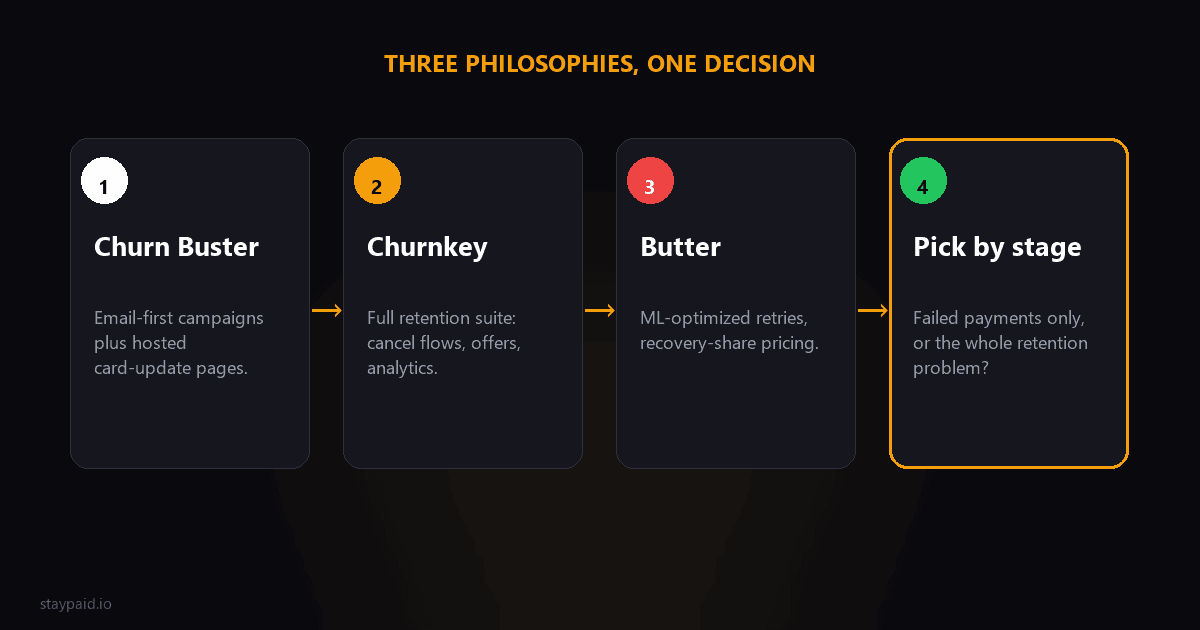
These three tools aren't really competitors — they attack failed payments from different layers. Churn Buster is email-sequence dunning with a decade of recovery data behind it. Churnkey is a broader retention platform where dunning is one feature next to cancel flows. Butter Payments is machine learning applied to the retry itself, at the payment authorization layer. The right pick depends on where your losses actually come from.
Full disclosure up front: I build StayPaid, which competes in this space, so read me with the same skepticism you'd read any vendor. I'll stick to what's publicly verifiable — pricing as published in 2026, positioning as stated on their own sites — and flag where I'm interpreting. And wherever I cite a number, treat it as a snapshot: this space reprices often, and the vendor's own page always wins over any blog post, including mine.
Churn Buster: the email-sequence veteran
Churn Buster has been doing dunning since the early days of SaaS, and it shows in the pitch: adaptive retry logic that responds to decline codes, segmented customer experiences, and recovery campaigns refined over 10+ years of data across eCommerce and B2B SaaS.
What it is in practice: pre-built, well-tested email sequences that go out when payments fail, plus smart retry management, plus newer Cancel Flows for voluntary churn. It's the most 'set it and forget it' option of the three — you install it, and a machine that has recovered payments for thousands of companies starts working yours.
- •Pricing: plans start at $249/month (as published in 2026), scaling with subscription volume. Month-to-month, no contracts.
- •Best fit: established subscription businesses — especially eCommerce (Shopify/Recharge) and B2B SaaS — with enough MRR that a few recovered customers pay for the tool many times over.
- •Trade-off: the emails are automated and template-driven at heart. Good templates, but a customer can still smell automation, and the price is real money for a small SaaS.
Churnkey: the retention platform
Churnkey goes wider than dunning. It wants to own the whole retention surface: payment recovery, cancel flows with save offers, segmented campaigns, dunning offers. If Churn Buster is a dunning specialist, Churnkey is a retention suite where dunning is one tab.
- •Pricing: third-party listings in 2026 put entry pricing in the $199-299/month range depending on plan and company size, scaling with MRR, with custom pricing above that. Their own pricing page is the source of truth — check it before budgeting.
- •Best fit: SaaS companies that want dunning and cancellation-save tooling from one vendor, and have the volume to justify a platform price.
- •Trade-off: you're buying a platform. If all you need is failed-payment recovery, you're paying for surface area you won't use, and the best features sit in higher tiers.
Butter Payments: the ML retry engine
Butter is a different animal. It doesn't start with emails — it starts with the transaction. Their pitch: machine learning that analyzes over a hundred data points per failed payment (their materials cite 128) to decide the optimal retry strategy for each decline category, working at the authorization layer to get the charge itself through.
- •Pricing: no flat published tiers — Butter uses a revenue-share model tied to recovered revenue, which aligns incentives but makes cost comparison hard without a sales conversation. It's generally aimed at companies with serious subscription volume.
- •Best fit: larger subscription businesses where a 1-2% improvement in authorization rates is worth six figures, and where the failures are mostly retryable (insufficient funds, timing issues) rather than dead cards.
- •Trade-off: when the card itself is dead — closed account, expired and never updated, bank switch — no retry strategy fixes it. Someone still has to email the customer. Retry optimization and customer communication are different jobs, and Butter centers on the first one.
The layer cake: what problem each one actually solves
This is the framing that makes the choice obvious:
- •Retryable failures (insufficient funds, bank downtime, timing): Butter's layer. Stripe Smart Retries covers a free, simpler version of this.
- •Recoverable-by-email failures (expired card, closed account, SCA challenges): Churn Buster and Churnkey's layer. This is where a message to a human fixes what no retry can.
- •Voluntary churn (cancellations, save offers): Churnkey's cancel flows, Churn Buster's Cancel Flows. A different problem that happens to share the word 'churn.'
Most small SaaS lose the most money in the middle layer, and that's the layer where tone matters. An automated sequence from a faceless billing system recovers some of it. A personal email from the founder recovers more of it — I've watched the reply rates.
The setup-effort question nobody asks
Pricing pages don't show you the integration cost, and it differs wildly here. Churn Buster and Churnkey are dashboard products: connect Stripe, configure your sequences, and you're live in days. Butter's model sits deeper in the payment flow, which means more engineering involvement, a longer evaluation, and a sales process before you see anything. Neither is automatically better — but if you're a two-person SaaS, a tool that needs an integration project is a tool you'll never finish installing.
Also worth asking each vendor: what happens to my data and my recovery queue if I leave? A dunning tool sees your customers at a sensitive moment. Knowing you can export cleanly matters more than any feature checklist. And ask who owns the email relationship — sequences sent from the vendor's shared domain behave differently in the inbox than mail from your own authenticated domain, especially once you change providers.
A quick way to decide
- •Under roughly $10k MRR: none of the three. The subscription cost eats the recovery gain. Use Stripe's built-in retries plus a simple, human dunning flow.
- •$10k-50k MRR, mostly card problems: Churn Buster's entry tier is the classic choice; Churnkey if you also need cancel flows today.
- •High volume, retryable-decline-heavy (consumers, low ARPU, big card mix): Butter's model is built for you — get a quote and do the revenue-share math.
- •Any size, and your customers know you by name: founder-led recovery outperforms templates on reply rate. Which is exactly the gap StayPaid fills — Stripe's plumbing plus recovery emails from your real address, approved by you before they send.
What to verify before you sign anything
- •Current pricing on each vendor's own site — this space reprices often, and 2026 numbers from a blog post (including this one) go stale.
- •Whether their 'recovery rate' counts retries Stripe would have won anyway. Ask how they attribute.
- •What the emails look like from the customer's inbox: sender name, reply-to, tone. Send yourself through the demo flow.
- •Contract terms. Churn Buster advertises month-to-month; platform and revenue-share deals vary more.
The takeaway
Churn Buster sells proven email sequences, Churnkey sells a retention platform, Butter sells retry optimization at the authorization layer. None of them are wrong — they're answering different questions. Figure out which layer leaks your revenue, then buy the tool that patches that layer and nothing else.
And if your honest answer is 'my customers would reply to me more than they'd reply to a template,' that's the bet StayPaid is built on. No $249 platform fee — just your own voice, sent at the right moment, with you in the loop.
FAQ
Is Churn Buster or Churnkey better for a small Stripe SaaS?
Both are built for companies with meaningful revenue at risk — Churn Buster starts around $249/month and Churnkey around $199-299/month depending on plan and MRR. At a few thousand MRR, the math rarely works; a lighter tool or founder-led recovery usually pays for itself faster.
What is the difference between Churnkey and Butter Payments?
Churnkey is a retention platform: dunning emails, cancel flows, and offers, managed through a dashboard. Butter Payments works at the payment authorization layer, using machine learning to optimize when and how failed transactions get retried, with revenue-share pricing rather than a flat subscription.
Does Butter Payments replace dunning emails?
Not exactly. Butter focuses on retry optimization at the transaction level — getting the card charge itself to succeed. Customer-facing communication (the emails that ask someone to update a dead card) is a separate problem that Butter-style tools don't center on.
How much does Butter Payments cost?
Butter doesn't publish flat pricing — it works on a revenue-share model tied to recovered revenue, and it's generally aimed at companies with substantial subscription volume. You'd need to talk to their sales team for a quote.
Keep reading
Robert
Founder at StayPaid
Want to recover failed payments like a founder?
Start Free — First 3 recoveries