When the Annual Plan Payment Fails: Why a $1,200 Decline Needs a Different Playbook
A failed annual charge is 12x your MRR with a year-stale card. The renewal playbook: pre-emails, longer dunning, and the monthly-plan save.
The 30-second answer
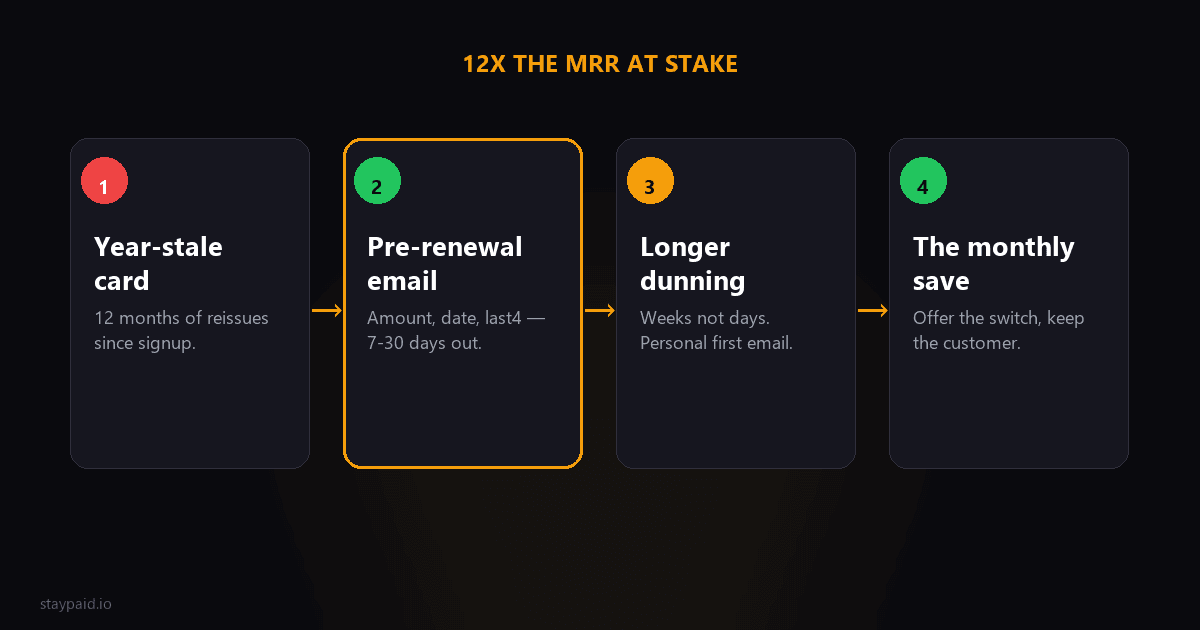
Annual plan failures deserve their own playbook because everything is amplified: the ticket is 12x your MRR, the card on file is up to a year stale, and the customer often forgot they subscribed. The fix: a renewal reminder email before the charge, a longer and more personal dunning sequence after a failure, and the monthly-plan downgrade offer as your best save. Treating annual failures like monthly ones is how you lose a year's revenue over a process designed for a month.
Most dunning advice — including some of mine — implicitly assumes monthly billing. This post is the correction for the plans that pay for your whole quarter.
Why annual failures are a different species
- •The card is a year old. Twelve months of expiry rollovers, fraud replacements, and bank switches sit between signup and renewal. Card updaters catch some of this, but not all — and when they miss, they miss on your biggest charge.
- •Renewal amnesia. Nobody remembers a signup from 11 months ago. The customer sees a four-figure charge from a company they half-recognize — which is why annual renewals are dispute magnets when they're not announced in advance.
- •The amount triggers extra scrutiny. Bigger charges are more likely to hit spending limits, fraud filters, and bank-side declines than your $29 monthly. The same card that sails through monthly can bounce on annual.
- •The stakes change your math. Losing a monthly subscriber to a bad dunning flow costs you a month. Losing an annual one costs you a year — and probably the relationship, since they had a full year of habit built.
Before the charge: the renewal reminder
The single highest-ROI email in annual billing is the pre-renewal reminder, sent 7-30 days out: 'Your annual plan renews on [date] for [amount] on your card ending [last4]. Need to update the card or change plans? Here's the link.' Three sentences. This one email prevents the three worst annual outcomes at once: the dispute from a surprised customer, the failed charge from a stale card (they update it proactively), and the angry 'I forgot I subscribed' refund request. In a growing list of jurisdictions it's also legally required for auto-renewals — but you'd send it even if it weren't, because it prints money.
After the failure: longer runway, human tone
When the annual charge fails anyway, throw out the monthly cadence. A $29 failure gets a friendly automated sequence and a two-week window. A $1,200 failure gets this:
- •Day 0 — personal email, founder address. Not a template blast. 'Your renewal didn't go through — probably a card thing, happens constantly with annual charges. Here's a one-minute fix link. Anything I can help with, just reply.' At this ticket size, the reply rate alone is worth it.
- •Days 3-14 — patient retries plus 1-2 follow-ups. Annual customers are your best customers; give their banks and their paydays time to cooperate. Space retries across at least one or two balance cycles.
- •Grace period measured in weeks, not days. These customers have a year of data and habit in your product. Cutting access on day 10 over a bank hiccup is how you turn a recoverable payment into a churned champion. Three to four weeks is not generous — it's rational.
- •The whole time: a human is watching this one. Not a dashboard. A person, who knows this account is worth twelve normal accounts.
The dispute problem (the real reason pre-emails matter)
The ugliest annual-renewal outcome isn't a failed charge — it's a successful one. Customer forgot they subscribed, sees $1,200 leave their account, doesn't email you, goes straight to their bank and files a dispute. Now you're not doing dunning, you're doing chargeback defense: evidence, fees, and a black mark on your dispute rate that payment processors watch like hawks. Some processors start asking questions when your dispute rate crosses thresholds you don't want to learn about.
Every piece of that is preventable with the renewal reminder. A customer who was told 'your card ending 4242 will be charged $1,200 on March 3rd' cannot plausibly claim they didn't recognize the charge — and the ones who would have disputed just cancel instead, which is a vastly better outcome. You can win back a canceler later; you can't win back a dispute. This is why I get religious about pre-renewal emails: they convert your angriest possible customers into your most informed ones, before the money moves.
Segmenting annual from monthly in your dunning
None of this works if your dunning system can't tell an annual failure from a monthly one. At minimum, tag subscriptions by plan interval and branch the sequence: monthly goes down the standard 10-14 day path, annual gets the longer runway, the personal first email, and the downgrade offer. If your tooling can't branch on plan value or interval, you're forced to pick one cadence — and whichever you pick, it's wrong for half your failures.
The crude version works fine to start: a filter that pings you personally whenever a failed charge crosses some threshold — say $500. That's layer-five escalation with duct tape, and it catches the failures where your personal attention has the highest ROI. I've run exactly this filter from a Stripe email notification and a phone alarm. Ugly, effective. Refine later; segment now.
One more annual-only move: the pause
Some annual customers who balk at renewing don't want out — they want later. Offering a pause (or a delayed renewal date) keeps the relationship alive through a budget freeze or a reorg. It's not always technically trivial in your billing setup, but for a four-figure account, 'I'll push your renewal 60 days' typed by a founder retains customers that every automated sequence would lose. Annual accounts are relationships, and relationships survive on flexibility. Just log what you promised.
The best save nobody uses: offer the monthly switch
Here's the move. A chunk of annual failures aren't card problems at all — they're budget problems. The customer saw $1,200, their balance said no, and quietly they were relieved it failed because they weren't sure about another year. For these customers, 'please fix your card' reads as 'please recommit to $1,200 right now,' and they ghost.
So offer the escape hatch: 'If the annual amount is awkward right now, I can switch you to monthly at [$X]/mo — same product, and you can go back to annual whenever.' You keep the customer, you keep the revenue stream, and a meaningful share of them re-upgrade later when budget season rolls around. Twelve monthly payments beat zero annual payments every single time. The pride move is insisting on the full year. The smart move is taking the money that exists.
"An annual failure isn't a bigger monthly failure. It's a different negotiation — with a better customer, a staler card, and a much more expensive silence if you get it wrong."
This tiered philosophy — monthly failures get efficient automation, annual failures get longer runways and human judgment — is baked into how I think about dunning generally, and it's why StayPaid lets you treat high-value accounts differently: automated sequences for the base, escalation to you personally when the account justifies it. Your annual customers are the ones paying for your roadmap. When their card hiccups once a year, they've earned more than a form letter from noreply@.
FAQ
Why do annual subscription payments fail more often than monthly?
The card on file is up to 12 months old by renewal — expired, replaced, or from a bank the customer has since left. Add renewal amnesia (the customer forgot they subscribed) and surprise at the large amount, and annual charges are the highest-risk charges you run.
Should I email customers before an annual renewal charges?
Yes — a renewal reminder 7-30 days before the charge is one of the highest-ROI emails in SaaS. It prevents disputes from surprised customers, prompts card updates before the failure, and in several jurisdictions is legally required for auto-renewing contracts.
How long should dunning run for a failed annual payment?
Longer than monthly — typically 2-4 weeks with a personal touch. The ticket size justifies founder-level attention, and the customer's alternative (finding a new tool, migrating data) means many will pay if you make it easy.
Should I offer to switch a failed annual payment to monthly?
Yes — it's the single best save for an annual failure caused by sticker shock or budget timing. Recovering 12 monthly payments beats losing the whole year, and you can re-offer annual later.
Keep reading
Robert
Founder at StayPaid
Want to recover failed payments like a founder?
Start Free — First 3 recoveries