When to Write Off a Failed Payment and Move On
Not every failed payment is worth chasing. Here's how to tell dead from alive and write it off gracefully.
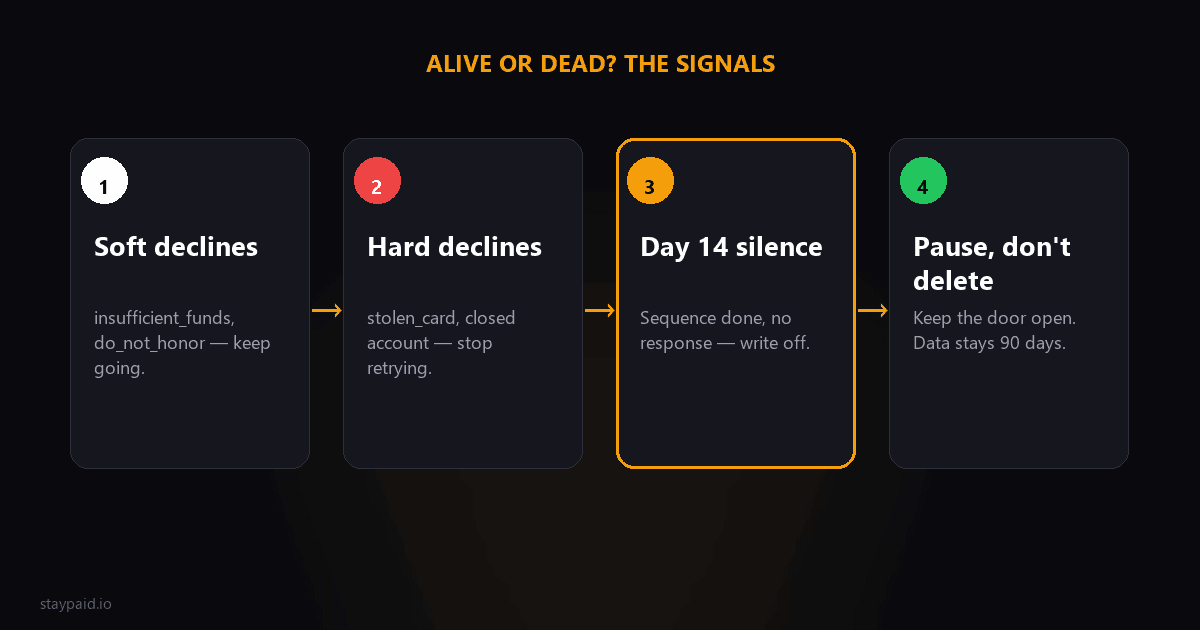
Stop chasing a failed payment when you've hit the end of your sequence, the card is hard-declined, and the customer has gone silent around day 14. Keep going only while there's a live signal — a soft decline, a card update, an open email. Knowing when to write a payment off and move on is how you protect your time, your reputation, and your Stripe risk score.
Everyone markets the recovery game hard. Fix the card, send the emails, win the customer back. And sure — a good dunning setup recovers real revenue. But the uncomfortable truth is that some failed payments are not worth recovering, and the founders who get this right are the ones who know exactly where the line is. I've written off my share, over-chased more than I'd like to admit, and learned the hard way where that line sits.
A decision framework, not a feeling
You don't need a gut instinct. You need a framework you can apply to every failed payment in sixty seconds. Mine comes down to one question: is this customer still there? If the data says yes, keep trying. If it says no, write it off — gracefully. Failed payments cause around 20–40% of subscription churn industry-wide, so this isn't an edge case. It's a routine decision you'll make every single month.
- •Is there a live signal the customer wants to stay — opens, replies, logs in, updates a card?
- •Is the decline soft (insufficient funds, expired card) or hard (the bank rejects it outright)?
- •How far into your recovery sequence are you, and what's the expected value of one more touch?
- •Has the customer done anything that suggests they're already gone?
Answer those four and you've got your answer. Let me unpack each one, because the detail is where most founders get it wrong.
Alive vs. dead: the signals that matter
The single most important skill here is telling the difference between a payment that's momentarily stuck and one that's gone for good. Get this wrong in either direction and you waste money — either too much effort on a corpse, or none at all on a customer you could have kept.
Signals a payment is still alive
- •Soft declines like insufficient_funds or expired_card. The customer exists and the intent is probably there — the money just isn't, right now.
- •Declines that line up with payday cycles. If a card fails on the 1st and the money lands on the 15th, that's a timing problem, not a dead customer.
- •The customer updates their card or opens your recovery emails.
- •Usage is steady or growing right up until the failure.
Signals a payment is dead
- •Hard declines the bank flat-out rejects — sometimes flagged as stolen_card or a closed account.
- •Four or more emails sent over a few weeks with zero replies and zero opens.
- •Silence after your day-14 final email.
- •Usage dropped to zero before the payment ever failed, or they unsubscribed or marked you as spam.
Here's the pattern underneath all of it: dead is when the timeline doesn't matter anymore. No payday is going to fix a stolen card, and no reminder email is going to reach someone who unsubscribed. If you see hard declines or total silence for roughly two weeks, stop.
The day-1/3/7/14 sequence
A sane recovery sequence has an end. For most Stripe SaaS apps, that's a day-1, day-3, day-7, day-14 rhythm — a notice, a reminder, a value-focused nudge, and a graceful goodbye. The whole thing runs about two weeks, and then you stop. Day 14 is the write-off checkpoint.
- •Day 1: the payment failed — here's what happened and here's the link to fix it.
- •Day 3: a short, human follow-up.
- •Day 7: remind them why they signed up in the first place.
- •Day 14: the graceful final email. After this, you're done.
The point of a fixed end isn't just tidiness. It stops you from retrying a dead card four weeks later and looking desperate. It also gives you a clean decision point: if they still haven't responded by day 14, that's your answer.
Watch the math, not the customer
Somewhere after the sequence ends, stop believing that one more email will tip the scales. You can compute the expected value of an extra touch, but most founders never bother. Ask a simpler question: if the recovery rate on your final email is single digits, is the goodwill you burn worth it? Roughly 85% of subscription businesses treat these write-offs as a cost of doing business. That's a sobering number, and it should keep your expectations honest.
None of this means dunning is pointless — far from it. Companies that automate recovery bring back a meaningful slice of that revenue. But the goal is recovery inside your window, not an endless crusade. Write-off is when the window closes.
What to actually do at write-off
Pause, don't delete
When you decide to stop, pause the account instead of nuking it. Keep their data for around 90 days — long enough that a returning customer doesn't have to rebuild from scratch, short enough that you're not hoarding stale records forever.
Send one graceful final email
Don't ghost them and don't guilt them. One warm, short note closes the door on the right terms. It makes clear the account is paused, not deleted, and leaves an easy way back.
""Hey — looks like we couldn't get your payment sorted, so we've paused your account. No surprises. Your data's safe, and if you ever want to come back, just reply to this email. Thanks for being a customer — genuinely.""
That email isn't just politeness. It keeps the win-back door open. A meaningful number of customers come back months later — and they remember the company that handled it with class.
Keep a win-back list
Don't just write the customer off into the void. Log them somewhere as paused or lapsed, and check back in a quarter later with a light-touch note. Sometimes the timing was the problem, not you. A six-word email months from now is cheap, and it occasionally brings back a customer you'd already written off.
The Stripe risk angle (keeping it honest)
Here's the part I want to be straight with you about. Stripe doesn't love endless retries on dead cards. Hammering a card that keeps getting declined can nudge your risk score in the wrong direction, which can affect your processing. I don't want to overstate it — a few aggressive retries won't sink your account — but it's a real reason to stop hammering a dead card.
That's another argument for the day-1/3/7/14 structure. A finite sequence looks like a deliberate, human process. Infinite retries look like a scraper. The moment you have a framework, you're not just being kind to the customer — you're protecting your payments infrastructure too.
Write-off is part of the job
Recovery is a tradeoff, not a religion. The goal was never to recover every dollar; it was to recover the right dollars without burning goodwill, time, or your Stripe risk along the way. Some customers aren't coming back, and that's okay. The ones who are still opening emails and still using the product deserve your energy instead.
That's the part I keep coming back to: knowing when to stop is a skill. It's what separates a founder who chases every dollar from one who recovers the dollars worth recovering. At StayPaid, we give you the data to make the call — tenure, revenue, activity, and email history in one place — so you can see when a payment is still alive and when it's time for that graceful final note. Because knowing when to stop is part of the job.
"The best founders recover revenue with respect. And sometimes, respect means walking away."
FAQ
How long should I keep retrying a failed payment?
Run a day-1/3/7/14 sequence — a notice, a reminder, a value nudge, and a graceful final email — then stop at day 14 if you haven't heard back. Two weeks is enough for any genuinely engaged customer to act, and retrying much longer looks desperate and can hurt your Stripe risk score.
When should I write off a failed payment?
Write it off when the signals say the customer is gone: a hard decline or stolen_card, four-plus emails with zero opens, usage that dropped to zero before the failure, or complete silence after your day-14 final email. Those aren't recoverable events — they're churn signals.
Will retrying failed payments hurt my Stripe account?
It can. Repeatedly retrying a dead card can nudge your Stripe risk score in the wrong direction and affect your processing. A finite, structured sequence looks like a deliberate process; endless retries look like a scraper. Keep it honest and capped.
What do I do when a customer's card keeps failing?
If it's a soft decline tied to payday timing, wait and retry. If their card keeps failing after they've updated it and ignored your emails, pause the account (don't delete it), keep their data for about 90 days, and send one graceful final email that leaves the win-back door open.
Keep reading
Robert
Founder at StayPaid
Want to recover failed payments like a founder?
Start Free — First 3 recoveries