Account Updater Services Compared: What They Fix, What They Miss, and What You Need
Account updaters fix stale cards, not failed payments. Stripe's built-in option vs network updaters vs bundled recovery tools, and what each misses.
An account updater service automatically refreshes your customers' stored card details when their bank issues a replacement card, so renewals keep going through after expirations and reissues. For most Stripe subscription businesses, the right setup is Stripe's built-in automatic card updater as the baseline, plus a recovery tool that handles everything the updater cannot fix. The updater is prevention for one slice of failures, not a complete solution.
Here is how the options actually stack up, and more importantly, what each one leaves on the table.
What an updater actually does
Banks reissue cards constantly: they expire, they get replaced after fraud scares, they get upgraded from one product to another. Each reissue potentially kills every saved card that customer has across every subscription they hold. The card networks built updater services to solve this: the bank reports the new card details to Visa or Mastercard, and merchants connected to the updater receive the fresh number, expiry, or both, before the next charge fails.
When it works, it is invisible and wonderful. A customer's card expires in June, the updater quietly swaps in the new details, and the July renewal succeeds with nobody lifting a finger. No email, no failed payment, no churn risk. This is the single cheapest save in subscription billing.
Option 1: Stripe's automatic card updater
If you bill on Stripe, you already have the baseline. Stripe works with the card networks to update saved cards automatically, and for most accounts this runs without configuration. Confirm it is active in your settings, understand that coverage depends on the issuing bank participating, and you have captured most of the value an updater offers. For the majority of small and mid-sized subscription businesses, this is the only standalone updater decision you need to make.
Its limits are the network's limits, not Stripe's. Some banks do not report replacements. Some customers close accounts entirely instead of replacing cards. And the updater does nothing at all for the failure types that have nothing to do with stale details.
There is also a timing gap worth understanding. Updater responses are not instant; the networks process updates on their own schedule, and a card replaced two days before your renewal may not be refreshed in time. That renewal fails, lands in your dunning flow, and often gets recovered a week later after the update finally propagates. Founders see these as random failed payments. In reality they are updater lag, and the fix is simply having a retry flow patient enough to catch the update when it lands.
Option 2: network updaters via your processor
Visa Account Updater and Mastercard Automatic Billing Updater are the underlying services, and larger merchants or multi-processor setups sometimes access them more directly through their acquirer or gateway. This matters if you process across multiple gateways, vault cards outside Stripe, or run volume big enough that coverage percentages are worth negotiating. For a typical SaaS doing everything through Stripe, this layer is already working for you behind the scenes.
Option 3: updaters bundled into recovery platforms
Dedicated recovery tools, Churnkey, Churn Buster, and similar, fold updater coverage into their platforms alongside retries and dunning emails. This is the honest way to get more updater value: not as a separate service to buy, but as one layer in a stack. The updater prevents the failures it can, the pre-dunning catches expiring cards before they fail, the retries handle temporary money problems, and the emails handle everything that needs a human decision.
Evaluated alone, a paid updater on top of Stripe's free one is hard to justify. Evaluated as part of a recovery platform, it is table stakes you should simply expect to be included.
A word on the enterprise end of the market: vendors selling standalone updater coverage to large merchants will quote you coverage percentages and lift studies. Take both with salt. Coverage depends on your specific mix of issuing banks, which is different from every study's sample, and lift is measured against baselines chosen to flatter the product. If a vendor will not trial against your own decline data, that tells you what their numbers are worth.
One practical tip for measuring any updater's value: tag your recovered payments. When a retry succeeds on a card whose details changed recently, that is updater money. When a retry succeeds on an unchanged card after an insufficient-funds decline, that is retry money. When a customer clicks your email and pays through a fresh checkout link, that is communication money. Split your recovery this way for one quarter and you will never again have to guess which layer of the stack is earning its keep, which makes every future vendor conversation much shorter, much cheaper, and much more honest. Do the tagging once and the whole category demystifies itself for good, permanently.
What no updater will ever fix
- •Insufficient funds. The card is fine; the money is not there today. The fix is smart retry timing, often around payday patterns, plus a clear email.
- •Closed accounts. The customer switched banks. No replacement mapping exists. Only an email asking for new details works.
- •Non-participating banks. Coverage is good but never universal, and it varies by region and issuer.
- •Stolen or fraud-replaced cards without forwarding. Some replacements get reported to the updater, some do not, depending on how the bank handled the reissue.
- •Customer intent. A subscriber who wanted to cancel and let the payment fail on purpose does not need fresh card details. They need a good exit, or they become a dispute.
This is why 'we have an updater, so failed payments are handled' is one of the most expensive assumptions in subscriptions. Pull your own decline reasons from Stripe. You will likely find the stale-card slice is real but minority, and the rest, soft declines, closed accounts, and vague issuer refusals, needs the communication layer.
The stack that actually covers you
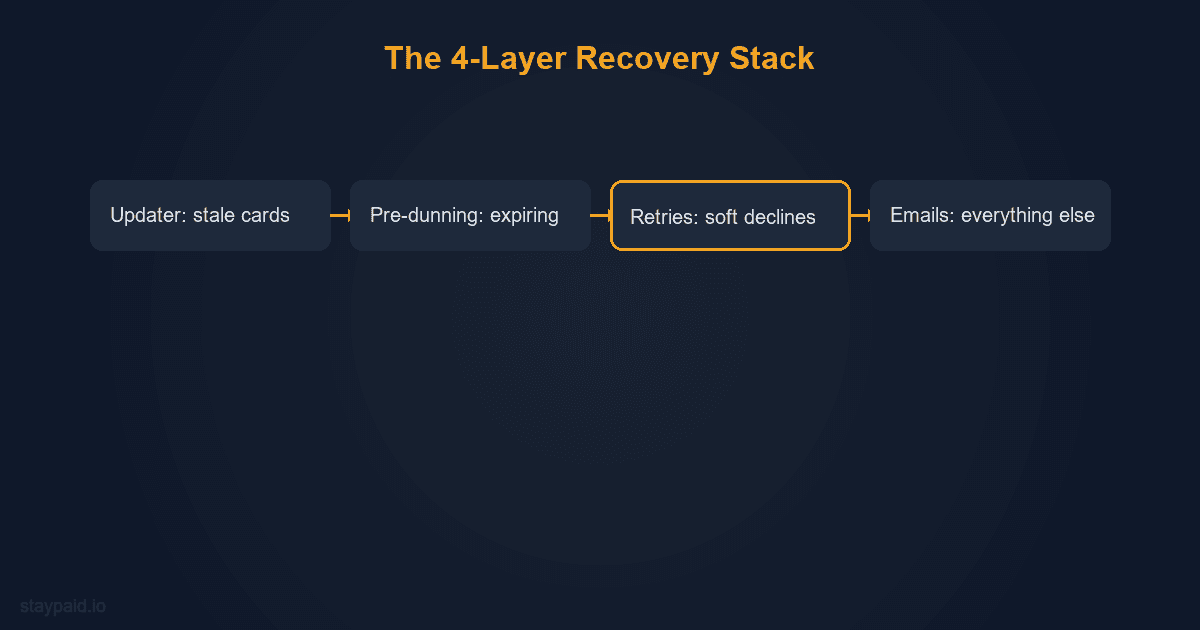
Think of failed-payment prevention and recovery as four layers. The updater silently fixes stale cards. Pre-dunning emails before expiry dates catch what the updater misses. Smart retries handle temporary fund shortages. And personal dunning emails recover everything that requires the customer to act. Each layer catches what the one above it cannot.
The first layer, if you are on Stripe, is already running. The other three are what I built StayPaid for: $29 a month flat, smart retries plus a 4-email sequence sent from your own address, with founder-in-the-loop review if you want eyes on everything before it sends. The updater is the quiet foundation. Make sure it is on, then build the layers above it.
If you do nothing else after reading this, run one audit this week: confirm Stripe's updater is enabled in your account, then pull your last 90 days of declined charges and sort them by decline reason. The expired-card share tells you how much the updater layer is carrying. The insufficient-funds and generic-decline share tells you how much is waiting for retries and emails. Most founders who do this exercise discover they were arguing about the wrong layer entirely, and the fix they actually needed was communication, not coverage. Fifteen minutes in your own Stripe data beats any vendor comparison page, including this one.
FAQ
What is an account updater service?
It is a service that automatically refreshes stored card details when a customer's bank issues a new card. Visa and Mastercard run the underlying networks (Visa Account Updater and Mastercard Automatic Billing Updater), and your processor or billing tool taps into them so saved cards keep working after replacements.
Does Stripe include an account updater?
Yes. Stripe's automatic card updater works with the card networks to refresh expired and replaced cards on file, and for many Stripe businesses it is on by default. It is the baseline every Stripe founder should confirm is enabled before paying for anything else.
What can't an account updater fix?
Insufficient funds, closed accounts with no replacement mapping, cards the bank chose not to forward, customers who switched banks entirely, and any failure where the problem is money or intent rather than stale details. Roughly speaking, updaters fix the 'card changed' slice of failures, not the 'no money' or 'customer gone' slices.
Do I need a paid updater if I already have Stripe's?
Usually not as a standalone purchase. Dedicated dunning and recovery tools bundle additional updater coverage and pre-dunning into their platforms, which is the smarter way to get more: as part of a recovery stack, not as another line item.
Keep reading
Robert
Founder at StayPaid
Want to recover failed payments like a founder?
Start Free — First 3 recoveries