3D Secure Authentication Failed: Why SCA Breaks Subscription Renewals (and How to Fix It)
Renewals fail 3DS because no customer is present to approve the challenge. How MIT exemptions work and the setup that stops the drops.
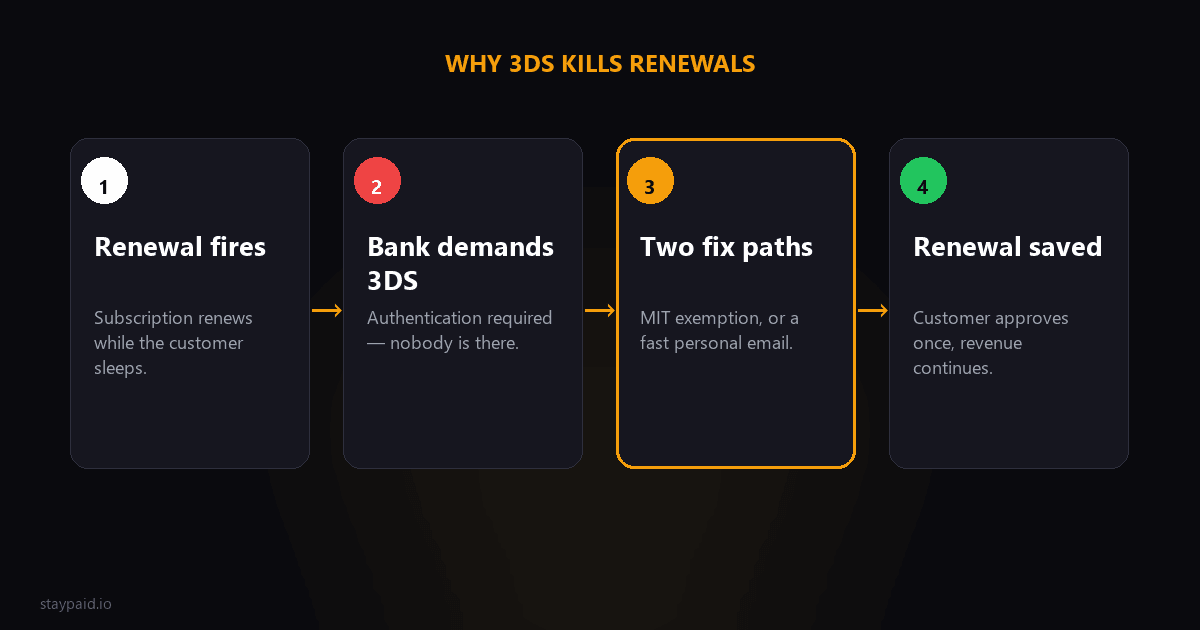
Your renewals are dying at a door nobody is standing in front of
When a renewal comes back with an authentication_required failure, Stripe asked your customer to approve the charge with 3D Secure — and nobody was there to do it. The fix isn't more retries; it's getting the charge classified as exempt, then recovering the rest with a fast personal email.
What 3DS and SCA actually are
3D Secure is that extra step where your bank makes you confirm a payment — the pop-up, the text-message code, the fingerprint on your phone. Strong Customer Authentication, or SCA, is the EU regulation that requires it on most card payments.
Here's the problem nobody tells you: SCA was designed around checkouts, where a customer is physically sitting there with their phone. A subscription renewal happens at 3am with no customer anywhere near the screen. You can't challenge someone who isn't present. So your payment processor does the only thing it can — it fails the charge and hopes the retry schedule figures it out.
And that's the trap. The default retry loop assumes a renewal fails for the same reason a checkout fails: a card that needs another attempt. But an authentication_required failure isn't a card problem and it isn't a money problem. It's an 'a human needs to tap a button' problem. Retrying it without that human is like ringing a doorbell that's not connected.
Why renewals are different from checkouts
- •A checkout has a human ready to approve. The challenge is friction, but it's friction they can clear in ten seconds.
- •A renewal has nobody. An authentication_required there means an instant, silent failure — and often a cancelled subscription.
- •Checkout failures you see live and can react to. Renewal failures happen in bulk, at night, behind your back, until you notice the drop in MRR.
That's the whole reason this is a dunning problem and not just a payments problem. You can't fix a missing human with a better retry schedule.
Merchant-initiated transactions and the exemption logic
Under SCA, recurring charges don't have to trigger a challenge every single time — that's what a merchant-initiated transaction (MIT) is. You're charging a stored card on an agreement the customer already made, so the regulator lets you skip the repeated song-and-dance.
Practically, that means the first payment on a subscription usually runs a real SCA challenge. If the customer approves it and you've captured their agreement to recurring billing, those later renewals can be treated as MITs and pass without a challenge. That's the path you want most subscriptions to travel.
The exceptions are where renewals fall through. Banks don't grant every exemption. A renewal can still get flagged for authentication — maybe it's the first one after a long pause, maybe the issuer wants proof, maybe the customer's bank just doesn't play along. When that happens, you're holding an authentication_required failure and a customer who has no idea.
Worth knowing: your payment flow also matters here. If a customer onboards through Stripe Checkout or Payment Links, Stripe handles a lot of this SCA orchestration for you. Build a custom payment flow and you own more of it — more control, but more ways to get the exemption wiring wrong. Either way, the customer's consent to recurring billing has to exist and be on record, or the MIT path isn't open to you at all.
What actually happens to the subscription
- •Stripe marks the charge as failed and emails the customer a generic failed-payment notice — if it emails them at all.
- •The invoice stays due and Stripe schedules retries according to its smart-retry logic.
- •If nothing clears within the due window, your subscription hits past_due, then unpaid, and the customer's access gets cut off.
- •All of this happened without a single human conversation. That's the leak.
Look at how the customer experiences it. They get a confusing email from no-reply@ asking them to update their card, they don't recognize the charge, they assume it's spam, they ignore it. The subscription dies not because they wanted to leave but because they never knew they had to act.
"A customer who has to figure out that their subscription failed from a no-reply@ email has already half-decided to cancel."
This is a recovery email problem, not just a payments problem
Here's the angle most guides miss. The 3DS failure is the trigger, but the thing that actually saves the customer is a clear, human, personal email the moment it happens. Someone from you — your own name, your own address, a P.S. note — saying 'hey, your card got caught in a security check, tap here and I'll push it through.'
That email works because a person answers it. It's not a robot telling them their payment failed and to go fix it themselves. It's a founder acknowledging the friction and offering a path forward. You can't automate that part into a retry loop.
And speed matters more than you'd think. The longer you wait, the more likely the customer does nothing — either they've moved on, or the failure slips past their attention into the spam-gray zone where failed-payment emails live. A personal reach within hours, while the failure is front-of-mind, converts far better than a cold resend days later asking them to sort it out.
A good recovery note for an SCA drop has four parts: what happened in plain language (their bank asked for a security check), that nothing's wrong with their account, a single clear action (tap to revalidate or update the card), and your actual name and address at the bottom so it reads like a human wrote it. Keep the ask to one click. Every extra step is a customer who wanders off.
What you can do this week
- •Get the exemption plumbing right. Make sure your recurring charges are set up as proper MITs with recorded consent, so most renewals never hit a challenge in the first place.
- •Watch for authentication_required as its own failure class. Don't lump it in with ordinary declines — it needs a different response.
- •Send a personal recovery email within hours of the failure, from your own address, with a clear link and a human P.S. This is the step that actually keeps the customer.
- •Don't burn retries on it. Retrying an authentication_required charge without the customer's action just re-triggers the same wall. The customer is the unlock, not the schedule.
Most of the fixes above are the kind of thing a founder can set up in an afternoon. The principles are simple: exempt what you can, and personally recover what slips through.
The takeaway
SCA didn't break your renewals to punish you. It's a regulation doing what it was built to do, and the casualties are the subscriptions nobody was around to approve. Once you understand why — and that the cure is experience plus a personal email rather than a harder retry loop — the drops stop being a mystery.
That's what I built StayPaid around. When a renewal trips on 3DS or anything else, you get a real notification and a recovery email that goes out from your own address with your name on it — reviewed by a human, not blasted by a robot. It's the difference between a customer who feels ignored and one who feels looked after.
FAQ
Does 3D Secure apply to subscription renewals?
It can. The first payment usually goes through a full SCA challenge. Subsequent renewals can qualify for a merchant-initiated transaction (MIT) exemption if you captured the customer's consent up front — but if Stripe can't apply an exemption, a renewal can still come back with an authentication_required failure.
What is an MIT exemption in plain terms?
A merchant-initiated transaction is a charge you make on a stored card without the customer actively approving it — like a subscription renewal. Under SCA rules, recurring MITs can be exempt from the challenge if the customer agreed to recurring billing when they signed up.
Why did my customer's renewal fail with authentication_required?
It means Stripe is asking the customer to approve the charge with 3D Secure, but nobody is there to approve it. Common triggers: it's the first renewal rather than a proper MIT, the bank didn't grant the exemption, or the payment qualifies for SCA and the issuer wants a challenge.
Can I just turn off 3DS to stop the failures?
No. SCA isn't a Stripe setting you can switch off — it's a regulatory requirement under EU law and the banks enforce it. What you can do is structure your payments to qualify for exemptions and recover the rest with a personal email.
Keep reading
Robert
Founder at StayPaid
Want to recover failed payments like a founder?
Start Free — First 3 recoveries