Friendly Fraud: Why Your Best Customers Dispute Charges They Actually Made
Friendly fraud is when real customers dispute real charges. Why subscriptions get hit hardest, and the paper trail that protects you.
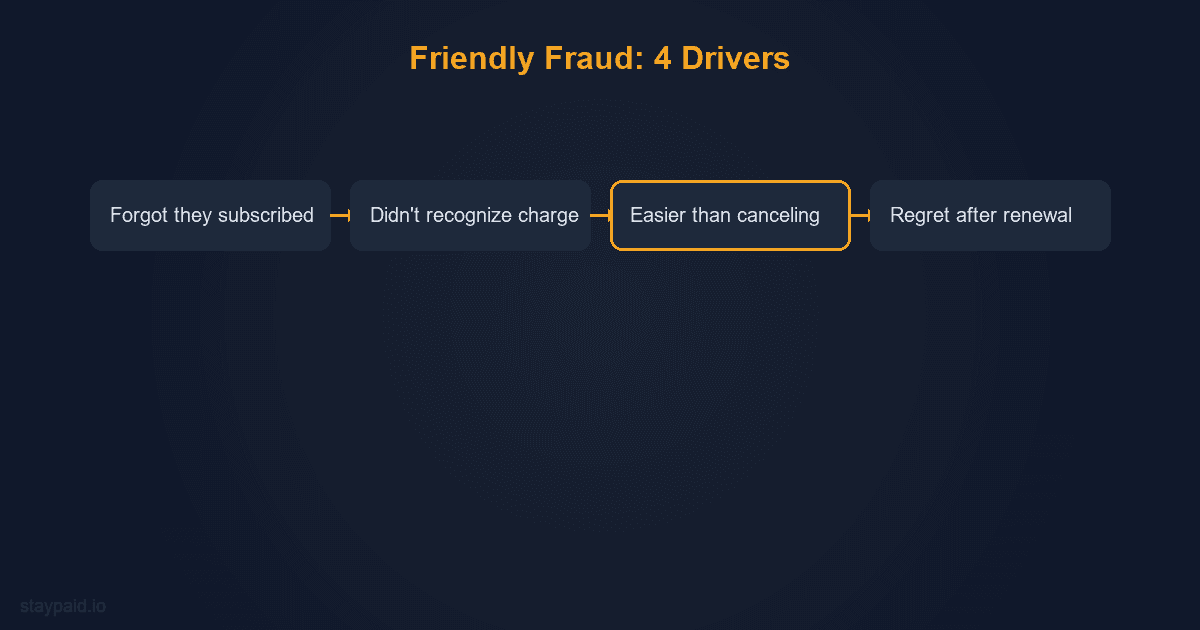
Friendly fraud is when a legitimate customer disputes a legitimate charge with their bank. The card is theirs. The subscription is real. They may even still be using your product. But instead of emailing you for a refund, they clicked the dispute button in their banking app, and now you are fighting a chargeback on revenue you honestly earned.
If you sell subscriptions, this is your dispute problem. Not stolen cards, not criminal rings, but your own customers. Chargeback industry reporting has pointed at first-party misuse overtaking true fraud for years, and recurring billing is the environment where it thrives. Understanding the three scripts behind it is how you cut it down.
Script one: 'I do not recognize this charge'
This is the most common and the most preventable. The customer signed up months ago, forgot, and your statement descriptor says something like 'SP* ACME HOLDINGS' instead of the product name they actually know. They open their banking app, see a mystery charge, and the app helpfully offers a 'report a problem' button one tap away.
Notice what did not happen: they did not search their email for a receipt, because many founders never sent one. They did not visit your site, because the descriptor gave them nothing to search for. The dispute was not a decision, it was the path of least resistance. Every gap in your billing communication pushes customers down that path.
Script two: 'I canceled this months ago'
Sometimes they did cancel, and your system kept billing them, in which case the dispute is deserved and you have a bug to fix. But often they only mentally canceled. They stopped logging in, considered it over, and the next renewal felt like theft.
This script is why cancellation confirmation emails matter so much. An instant 'your subscription is canceled, effective today, no further charges' email ends this dispute before it starts for real cancellations. For the mental cancellers, renewal reminder emails do the same job: a 7-day warning before an annual charge converts a future dispute into either a happy renewal or a clean cancellation. Both outcomes beat a chargeback.
Script three: 'The bank will handle it faster'
This is the deliberate minority, and it is learned behavior. The customer asked for a refund once, got a slow or complicated answer, and discovered that the dispute button skips the queue entirely. Now it is their default. Some cardholders have done this dozens of times across merchants, and banks are often generous to their own customers by default.
You cannot fully stop determined refund abusers, but you can make the honest path easier than the dishonest one: a refund policy people can find, a reply within a day, and a cancellation flow that does not require a phone call. The customers who would have disputed out of frustration mostly do not, when leaving is easy.
What a dispute really costs you
Founders tend to count the refunded amount and stop there. The real bill is longer. You lose the revenue. You pay a dispute fee to your processor on top. You have already spent the money acquiring and serving that customer. The dispute counts toward your Visa monitoring ratio, which tightened to 1.5% for merchants in April 2026 under the VAMP program. And you almost always lose the customer, even when you win the dispute.
Add it up and a dispute on a $29 monthly charge is not a $29 problem. It is comfortably a $60-plus problem once you include fees and sunk costs, and a much bigger one if the customer would have stayed for another year. Prevention is not a nice-to-have at these economics.
The paper trail is your defense
Here is the good news: subscription founders hold better dispute evidence than almost any other kind of merchant. You have the signup timestamp and IP. You have login history showing active use. You have receipts for every charge. You have months of prior undisputed payments from the same card, same device, same customer.
- •Receipts for every charge, sent instantly, including retried charges that succeed late.
- •Renewal reminders before large or annual charges.
- •Cancellation confirmations with an explicit 'no further charges' line.
- •Dunning emails that name the product, the amount, and the retry date, sent from an address a human reads.
- •Login and usage logs you can export when a dispute claims the product was never used.
That last category surprises people. A dunning email is not just a recovery tool. When a failed payment eventually succeeds after a clear, personal email warned the customer of the exact amount and date, that email becomes evidence that the charge was known and expected. Silent retries create surprise charges. Announced retries create documented ones.
Saving the customer after the dispute
Here is a move almost nobody makes: after you win a friendly-fraud dispute, email the customer. Not a victory lap, a genuine note. 'Your bank reversed a charge for your subscription, which usually means the charge looked unfamiliar. Your account is still active, here is your receipt history, and here is how to reach me directly.' A meaningful share of these customers were honestly confused, and they are embarrassed, not hostile. Some of them apologize and stay for years.
The founders who skip this step win the dispute and lose the relationship anyway, because the customer's bank just told them their card might be compromised, and the card on file often gets replaced. That replacement can silently break your next renewal, which is a failed payment problem stacked on top of the dispute problem. One email heads off both.
Fighting back when it happens anyway
When a friendly-fraud dispute lands, respond every single time. Many founders skip disputes under some dollar threshold, which trains nobody but yourself to lose. Stripe's dispute flow lets you submit evidence, and for fraud-coded disputes on accounts with history, Visa's Compelling Evidence 3.0 rules are built exactly for this: show prior undisputed transactions from the same customer credentials and the dispute can be deflected. Keep your evidence templates ready before you need them, because dispute deadlines are short.
And zoom out once a month. If your disputes cluster around 'unrecognized', fix the descriptor and receipts. If they cluster around 'canceled', fix the renewal reminders and cancellation flow. The dispute reason codes are a free audit of your billing communication, from the angriest customers you have.
One more reframe that changed how I think about this: friendly fraud is mostly a memory problem, not a morality problem. People subscribe to a lot of things. Your charge competes with streaming services, app stores, and a dozen other line items for recognition on a statement. Every email, receipt, and clear descriptor you send is a memory aid. The brands with the lowest dispute rates are rarely the ones with the toughest fraud tools. They are the ones nobody could plausibly forget they pay for.
This is also why I built StayPaid the way I did: dunning emails that go out from your own address, written like a person, with the amount and the next step spelled out. They recover more failed payments, and they leave behind exactly the paper trail that wins disputes later. Recovery and dispute prevention turn out to be the same habit.
FAQ
What is friendly fraud in simple terms?
Friendly fraud is when a real customer disputes a legitimate charge with their bank instead of contacting you. The card is theirs, the purchase was real, but the dispute claims otherwise. It is also called first-party misuse, and for subscription businesses it is the most common type of dispute by far.
Is friendly fraud actually fraud?
Sometimes, but usually not in the criminal sense. Most cases are confusion: a forgotten subscription, an unrecognized descriptor, a family member who used the card. A smaller share is deliberate, customers who learned that a dispute is faster than your refund process. Both cost you the same.
Can I win a friendly fraud dispute?
Yes, and subscription businesses are unusually well positioned to win. You have signup records, login history, usage logs, receipts, and months of prior undisputed charges. Under Visa's Compelling Evidence 3.0 rules, that history can deflect certain fraud disputes before they are even decided.
How much does a dispute actually cost?
More than the refunded amount. You lose the revenue, pay a dispute fee (Stripe charges one per dispute), lose the product cost, and the dispute counts toward your monitoring ratio. A $29 dispute can easily cost $60 or more all-in, before you count the churned customer.
Keep reading
Robert
Founder at StayPaid
Want to recover failed payments like a founder?
Start Free — First 3 recoveries