FlyCode Alternatives: Transparent Recovery vs Black-Box Retries
FlyCode bets on ML-timed retries and revenue-share pricing. The alternatives for Stripe founders who want transparent rules and human emails.
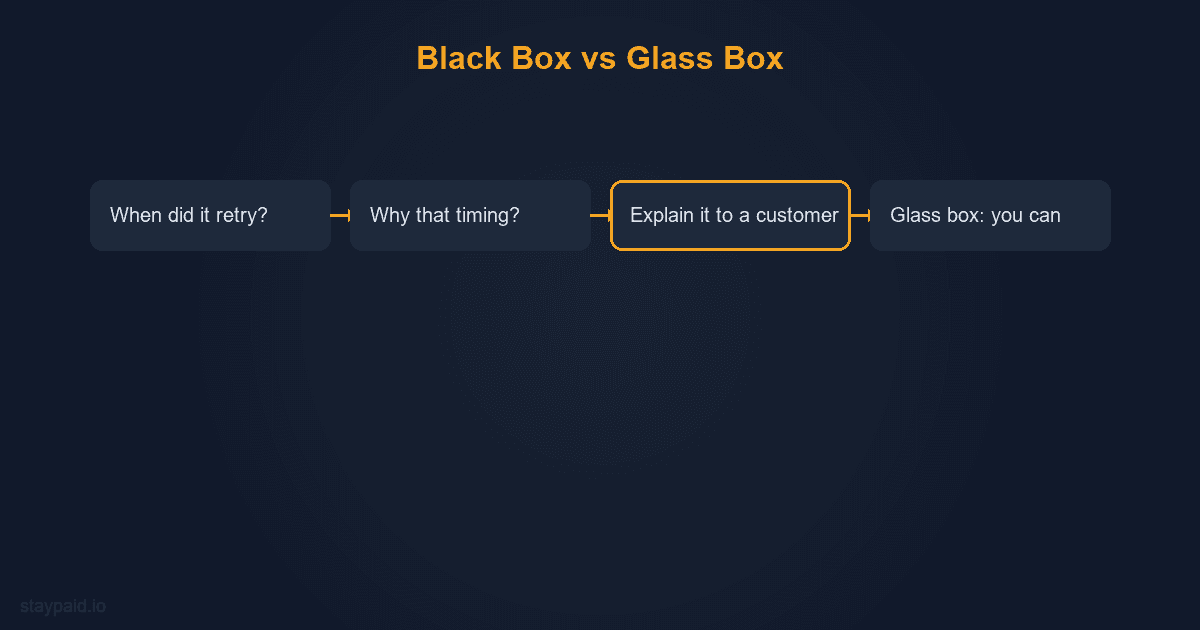
The strongest FlyCode alternatives for Stripe subscription businesses are StayPaid ($29 per month flat with transparent retry rules and personal emails), Churn Buster (the established dedicated dunning tool), and Churnkey (a full retention platform). Which one fits depends on a more fundamental question: do you want a black-box model timing your retries, or a recovery system you can actually explain?
FlyCode has a real pitch. Machine learning on retry timing, plug into Stripe, lift recovery without touching anything. Before choosing, it is worth understanding what that pitch optimizes for, and what it ignores.
What ML retry optimization actually buys you
The idea is sound. Not all failed payments are equal: an insufficient_funds decline on the 28th of the month has different odds than the same decline on the 2nd, right after payday. A model trained on millions of attempts can learn timing patterns a static schedule misses, and tools in this category do report recovery-rate lift from smarter timing.
But keep the size of that lever in perspective. Retry timing matters most for soft declines where the money is temporarily missing. It does nothing for expired cards, dead card numbers, or customers who simply need to be asked, clearly, to update their details. In most subscription businesses, a large share of failed revenue sits in that second bucket, where the fix is communication, not timing. A perfectly timed retry on a dead card is still a decline.
The black-box problem
There is a subtler cost to letting a model schedule charges on your customers. When a retry lands at an odd moment and a confused customer asks why they were charged on a random Tuesday, your honest answer is 'our vendor's algorithm decided to'. For a subscription business, where trust is the entire product, that is a bad answer. Confused customers dispute charges, and at Visa's tightened 2026 monitoring thresholds, disputes are more expensive than ever.
Transparent retry rules flip this. A schedule you chose, like retry in 3, 5, and 7 days, paired with an email before each attempt that names the amount and the date, means no charge ever surprises anyone. Recovery rate matters, but recovery that manufactures disputes and support tickets is revenue with a hidden tax.
The pricing model, same as it ever was
FlyCode prices on performance: a share of recovered revenue. As with every revenue-share dunning tool, this is gentle when you recover little and heavy when you recover a lot. Recover $2,000 a month and a percentage-based fee lands around $160 to $200 depending on the rate. Recover $10,000 and you are paying $800 to $1,000 a month, close to $12,000 a year, for retry scheduling and emails. Flat-fee tools do the same category of work for a fraction of that, and your bill does not grow because the product worked.
The alternatives, honestly
- •StayPaid. $29 per month flat, no cut of recovered revenue, Stripe-only. Transparent retry schedule plus a 4-email sequence sent from your own address, written like a person, with founder-in-the-loop review before anything sends. I built it, so weight this accordingly, but the design is the argument: you should know why every charge happened, and your customers should never be surprised.
- •Churn Buster. The veteran dedicated dunning tool. Rule-based campaigns you can inspect and control, solid reporting, tiered pricing above StayPaid. A reasonable pick if you want maturity over price.
- •Churnkey. The full retention platform: cancel flows, surveys, dunning, analytics. Strong if you want the suite, expensive if you only need failed payments.
- •Stripe Smart Retries, native. Free, built in, and itself machine-learning based. If ML retry timing is what attracts you to FlyCode, know that Stripe already ships a version of it at no cost. What it lacks is the email side: Stripe's default dunning emails are generic and easy to ignore.
What good retry logic actually looks like
Whether or not you ever touch an ML tool, you should know what sound retry strategy looks like, because the model is only as good as the fundamentals underneath it. Soft declines like insufficient funds respond to spacing and timing: several attempts spread across a week or two, ideally landing after common paydays. Hard declines like a closed account or a stolen card never succeed on retry, and every extra attempt wastes issuer goodwill and risks your account looking spammy to the network.
Stripe's Smart Retries already implement a reasonable version of this out of the box, using Stripe's enormous cross-merchant dataset to pick attempt times. That is not a knock on dedicated ML tools; it is context. The marginal lift a third-party model adds on top of Stripe's own model is real but usually modest, and it is worth asking any vendor to show you recovery lift measured against Smart Retries as the baseline, not against no retries at all. Against the wrong baseline, every tool looks like magic.
The other half of sound retry logic is knowing when to stop charging and start emailing. After two or three failed attempts, the probability that another silent retry succeeds drops hard, and the probability that the next attempt annoys the issuer or surprises the customer rises. That crossover point is where human communication takes over: a direct email that says the card keeps declining, here is a one-click link to update it. Tools that keep hammering the card past that point are optimizing for their recovery dashboard at the expense of your customer relationships and your dispute ratio.
This is also where the transparency question becomes practical rather than philosophical. With rule-based retries you can look a customer in the eye: 'we tried on the 3rd, the 6th, and the 9th, and emailed you before each attempt.' With a black box, you are trusting a model's judgment about when to charge someone's card, and you are the one who absorbs the support ticket when it guesses wrong. Choose the system you would be comfortable explaining in a dispute response, because eventually you will have to. And whichever model you pick, measure it against your own baseline for at least two full billing cycles before drawing conclusions. Recovery rates swing month to month with card expiry cycles, and a lucky first month has sold more bad tools than any marketing page ever did.
A decision framework
Ask three questions. First: where do my failed payments actually come from? Pull your Stripe decline breakdown. If it is dominated by soft declines like insufficient funds, retry timing is a real lever and ML tools earn their look. If it is expired cards, closed accounts, and stale details, communication is the lever, and no model fixes that.
Second: can I explain every charge to a customer? If a vendor's system schedules charges you cannot predict or explain, that is a support and dispute liability you are choosing to carry. Third: what does this cost at 5x my current recovery? Revenue-share pricing always looks fine today. Run the number at the scale you are aiming for, because that is the bill you are signing up for.
Most Stripe subscription founders land in the same place: transparent retry rules, emails that sound like they came from a human, flat pricing, and Stripe's free Smart Retries underneath as a baseline. That combination recovers the revenue without the black box, and without a vendor taking a growing cut of money that was always yours.
FAQ
What does FlyCode do?
FlyCode is a failed-payment recovery platform built around machine-learning retry optimization. It plugs into Stripe, models when each failed payment is most likely to succeed on retry, and times attempts accordingly. Its pitch is recovery-rate lift with minimal setup.
Is FlyCode free?
No. FlyCode uses performance-based pricing, meaning you pay a share of the revenue it recovers rather than a small flat fee. That model is friendly at low recovery volumes and gets expensive as recovered revenue grows, the same trade-off as other revenue-share tools.
What is the main downside of ML-optimized retries?
Opacity. A black-box model decides when to charge your customers, and when a customer asks why a charge landed at a strange moment, you have no answer beyond 'the algorithm chose it'. Retry timing also cannot fix the emails: if your dunning messages sound robotic, customers still do not update their cards.
What are the best FlyCode alternatives?
For Stripe subscription businesses: StayPaid ($29 per month flat, transparent retry rules, human-sounding emails), Churn Buster (established dedicated dunning), and Churnkey (full retention suite). Stripe's native Smart Retries are the free baseline everyone should compare against.
Keep reading
Robert
Founder at StayPaid
Want to recover failed payments like a founder?
Start Free — First 3 recoveries